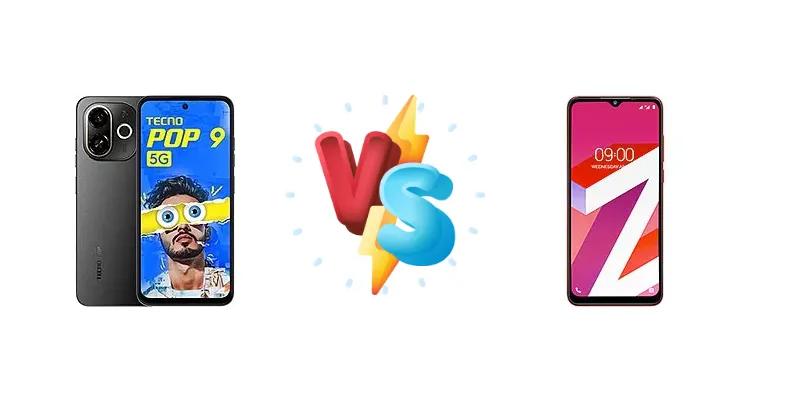
The Tecno Pop 9 and Lava Z4 represent the fiercely competitive entry-level smartphone market. Both aim to deliver essential smartphone functionality at an accessible price point, but they take drastically different approaches to achieving this, primarily through their chipset choices. This comparison will dissect those differences and determine which device offers the best value for your money.
🏆 Quick Verdict
For the average user prioritizing responsiveness and future-proofing, the Tecno Pop 9 is the clear winner. Its Mediatek Dimensity 6300 chipset, built on a 6nm process, provides a significant performance advantage over the Lava Z4’s 12nm Helio G35, translating to smoother multitasking and a better overall user experience.
| Network |
|---|
| 2G bands | GSM 850 / 900 / 1800 / 1900 | GSM 900 / 1800 |
| 3G bands | HSDPA 900 / 2100 | HSDPA 900 / 2100 |
| 4G bands | LTE | 1, 3, 5, 8, 40, 41 |
| 5G bands | SA/NSA | - |
| Speed | HSPA, LTE, 5G | HSPA 42.2/5.76 Mbps, LTE Cat4 150/50 Mbps |
| Technology | GSM / HSPA / LTE / 5G | GSM / HSPA / LTE |
| Launch |
|---|
| Announced | 2024, September 24 | 2021, January 07 |
| Status | Available. Released 2024, October 08 | Available. Released 2021, January 11 |
| Body |
|---|
| Build | Glass front, plastic back, plastic frame | Glass front, plastic back, plastic frame |
| Dimensions | 165 x 77 x 8 mm (6.50 x 3.03 x 0.31 in) | 164.5 x 75.8 x 9 mm (6.48 x 2.98 x 0.35 in) |
| SIM | Nano-SIM + Nano-SIM | Nano-SIM + Nano-SIM |
| Weight | 189 g (6.67 oz) | 190 g (6.70 oz) |
| Display |
|---|
| Protection | - | Corning Gorilla Glass 3 |
| Resolution | 720 x 1612 pixels, 20:9 ratio (~267 ppi density) | 720 x 1600 pixels, 20:9 ratio (~270 ppi density) |
| Size | 6.6 inches, 104.6 cm2 (~82.4% screen-to-body ratio) | 6.51 inches, 102.3 cm2 (~82.1% screen-to-body ratio) |
| Type | IPS LCD, 120Hz | IPS LCD |
| Platform |
|---|
| CPU | Octa-core (2x2.4 GHz Cortex-A76 & 6x2.0 GHz Cortex-A55) | Octa-core (4x2.3 GHz Cortex-A53 & 4x1.8 GHz Cortex-A53) |
| Chipset | Mediatek Dimensity 6300 (6 nm) | Mediatek MT6765G Helio G35 (12 nm) |
| GPU | Mali-G57 MC2 | PowerVR GE8320 |
| OS | Android 14 | Android 10 |
| Memory |
|---|
| Card slot | microSDXC | microSDXC (dedicated slot) |
| Internal | 64GB 4GB RAM, 128GB 4GB RAM | 64GB 4GB RAM |
| | - | eMMC 5.1 |
| Main Camera |
|---|
| Features | Dual-LED flash, HDR | LED flash |
| Single | 48 MP, (wide), 1/2.0", 0.8µm, AF
Auxiliary lens | 13 MP, f/2.0 AF |
| Triple | - | 13 MP, f/1.9, (wide), 1/3.0", 1.12µm, AF
5 MP, (ultrawide)
Auxiliary lens |
| Video | 1080p@30fps | 1080p@30fps |
| Selfie camera |
|---|
| Features | Dual-LED flash | LED flash |
| Single | 8 MP | 16 MP, f/2.0, (wide), 1/3.06" 1.0µm |
| Video | Yes | 1080p@30fps |
| Sound |
|---|
| 3.5mm jack | - | Yes |
| 35mm jack | Yes | Yes |
| Loudspeaker | Yes, with dual speakers | Yes |
| Comms |
|---|
| Bluetooth | Yes | 5.0, A2DP, LE |
| Infrared port | Yes | - |
| NFC | Yes | No |
| Positioning | GPS | GPS |
| Radio | Unspecified | FM radio |
| USB | USB Type-C | USB Type-C |
| WLAN | Yes | Wi-Fi 802.11 b/g/n, Wi-Fi Direct |
| Features |
|---|
| Sensors | Fingerprint (side-mounted); unspecified sensors | Fingerprint (rear-mounted), accelerometer, proximity |
| Battery |
|---|
| Charging | 18W wired | - |
| Stand-by | - | Up to 270 h |
| Talk time | - | Up to 24 h (2G) / Up to 15 h 30 min (3G) |
| Type | 5000 mAh | Li-Po 5000 mAh |
| Misc |
|---|
| Colors | Aurora Cloud, Azure Sky, Midnight Shadow | Blue, Red |
| Models | KL4 | S7 |
| Price | About 100 EUR | About 100 EUR |
| SAR | - | 0.52 W/kg (head) 0.64 W/kg (body) |
Tecno Pop 9
- Significantly more powerful and efficient Mediatek Dimensity 6300 chipset
- Faster 18W wired charging
- Likely better multitasking and app responsiveness
- Display specifications unknown
- Camera specifications unknown
Lava Z4
- Potentially lower price point
- Acceptable for very basic smartphone tasks
- May offer longer standby time due to less powerful processor (though active use will be slower)
- Older and less efficient Mediatek Helio G35 chipset
- Slower performance and responsiveness
- Likely limited gaming capabilities
Display Comparison
Display specifications are not provided for either device. However, given their price points, it's reasonable to expect both utilize LCD panels with 720p+ resolution. The absence of information prevents a detailed comparison of brightness, color accuracy, or refresh rates. Users should expect basic display quality suitable for everyday use, but not ideal for media consumption in bright sunlight.
Camera Comparison
Camera details are absent for both devices. Given the market segment, we can anticipate basic camera setups focused on affordability rather than image quality. The absence of information prevents a meaningful comparison. Users should manage expectations and not anticipate flagship-level photography capabilities.
Performance
The core difference lies in the chipsets. The Tecno Pop 9’s Mediatek Dimensity 6300 (6nm) boasts a modern CPU configuration – 2x2.4 GHz Cortex-A76 and 6x2.0 GHz Cortex-A55 cores – offering significantly higher single-core and multi-core performance than the Lava Z4’s Helio G35 (12nm). The G35’s CPU, comprised of 4x2.3 GHz Cortex-A53 and 4x1.8 GHz Cortex-A53 cores, is an older architecture. The 6nm fabrication process of the Dimensity 6300 also contributes to superior power efficiency, meaning the Pop 9 will likely exhibit less thermal throttling during sustained workloads and offer better battery life. This translates to a noticeably smoother experience when switching between apps, browsing the web, and even light gaming.
Battery Life
Battery capacity is not specified for either device. However, the Dimensity 6300’s superior power efficiency in the Tecno Pop 9 will likely result in longer battery life despite potentially having a similar capacity to the Lava Z4. The Pop 9 also features 18W wired charging, which, while not exceptionally fast, is likely faster than the charging capabilities of the Lava Z4, allowing for quicker top-ups when needed.
Buying Guide
Buy the Tecno Pop 9 if you need a phone capable of handling everyday tasks with ease, appreciate a more efficient processor for longer battery life, and want a device that feels more responsive. Buy the Lava Z4 if your primary needs are extremely basic – calls, texts, and light social media – and you are prioritizing the absolute lowest possible price point, accepting compromises in performance and efficiency.
Frequently Asked Questions
❓ Will the Tecno Pop 9 handle popular games like PUBG Mobile or Call of Duty?
While the Dimensity 6300 is a capable chipset, PUBG Mobile and Call of Duty are demanding games. The Pop 9 will likely be able to run them at lower graphics settings and frame rates. The Lava Z4’s Helio G35 will struggle significantly with these titles, offering a less enjoyable gaming experience.
❓ Is the 18W charging on the Tecno Pop 9 considered fast charging?
18W charging is not considered exceptionally fast in today’s market, but it’s a reasonable charging speed for a budget smartphone. It will likely take around 2-3 hours to fully charge the device from 0%, which is faster than the likely charging speed of the Lava Z4.
❓ How much of a difference will the 6nm vs 12nm process node make in real-world usage?
The 6nm process node used in the Dimensity 6300 is significantly more efficient than the 12nm node in the Helio G35. This translates to less heat generation, reduced power consumption, and ultimately, longer battery life and sustained performance. You'll notice this difference during prolonged use, like video streaming or gaming.