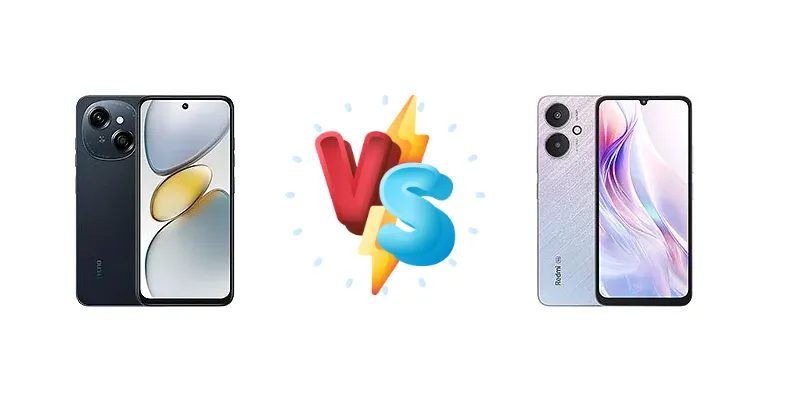
The sub-$150 smartphone market is fiercely competitive. The Tecno Pop 9 4G offers a compelling entry point with its affordability, while the Xiaomi Redmi 13C 5G aims to disrupt with the promise of next-generation connectivity. This comparison dissects their key differences, focusing on performance, battery life, and overall value to help you choose the right device.
🏆 Quick Verdict
For most users, the Xiaomi Redmi 13C 5G is the superior choice. Its more modern Mediatek Dimensity 6100+ chipset, built on a 6nm process, delivers significantly better performance and future-proofs the device with 5G connectivity. While the Tecno Pop 9 4G offers a lower price, the performance gap is substantial.
| Network |
|---|
| 2G bands | GSM 850 / 900 / 1800 / 1900 | GSM 850 / 900 / 1800 / 1900 |
| 3G bands | HSDPA 900 / 2100 | HSDPA 800 / 850 / 900 / 1700(AWS) / 1900 / 2100 - International |
| 4G bands | LTE | 1, 2, 3, 4, 5, 7, 8, 12, 13, 17, 18, 19, 20, 26, 28, 32, 38, 40, 41, 66 - International |
| 5G bands | - | 1, 3, 5, 7, 8, 20, 28, 38, 40, 41, 66, 77, 78 SA/NSA - International |
| Speed | HSPA, LTE | HSPA, LTE, 5G |
| Technology | GSM / HSPA / LTE | GSM / HSPA / LTE / 5G |
| Launch |
|---|
| Announced | 2024, November 22 | 2023, December 06 |
| Status | Available. Released 2024, November 26 | Available. Released 2023, December 16 |
| Body |
|---|
| Build | Glass front, plastic back, plastic frame | Glass front (Gorilla Glass 3), plastic frame, plastic back |
| Dimensions | 166 x 77 x 8 mm (6.54 x 3.03 x 0.31 in) | 168.1 x 77.9 x 8.2 mm (6.62 x 3.07 x 0.32 in) |
| SIM | Nano-SIM + Nano-SIM | Nano-SIM + Nano-SIM |
| Weight | 189 g (6.67 oz) | 192 g or 195 g (6.77 oz) |
| Display |
|---|
| Protection | - | Corning Gorilla Glass 3 |
| Resolution | 720 x 1600 pixels, 20:9 ratio (~263 ppi density) | 720 x 1600 pixels, 20:9 ratio (~260 ppi density) |
| Size | 6.67 inches, 107.4 cm2 (~84.0% screen-to-body ratio) | 6.74 inches, 109.7 cm2 (~83.8% screen-to-body ratio) |
| Type | IPS LCD, 90Hz (India), 120Hz (International) | IPS LCD, 90Hz, 450 nits (typ), 600 nits (HBM) |
| Platform |
|---|
| CPU | Octa-core (2x1.8 GHz Cortex-A75 & 6x1.6 GHz Cortex-A55) - InternationalOcta-core 2.2 GHz Cortex-A53 - India | Octa-core (2x2.2 GHz Cortex-A76 & 6x2.0 GHz Cortex-A55) |
| Chipset | Unisoc T615 (12 nm) - InternationalMediatek Helio G50 - India | Mediatek Dimensity 6100+ (6 nm) |
| GPU | Mali-G57 MP1 - InternationalPowerVR GE8320 - India | Mali-G57 MC2 |
| OS | Android 14 (Go edition) | Android 13, MIUI 14 |
| Memory |
|---|
| Card slot | microSDXC | microSDXC (dedicated slot) |
| Internal | 64GB 3GB RAM, 64GB 4GB RAM, 128GB 3GB RAM, 128GB 4GB RAM | 64GB 4GB RAM, 128GB 4GB RAM, 128GB 6GB RAM, 256GB 8GB RAM |
| Main Camera |
|---|
| Features | Dual-LED flash, HDR | LED flash, HDR |
| Single | 13 MP, f/1.8, 27mm (wide), 1.12µm, PDAF | 50 MP, f/1.8, 28mm (wide), 1/2.76", 1.12µm, PDAF
Auxiliary lens |
| Video | 1080p@30fps | 1080p@30fps |
| Selfie camera |
|---|
| Features | Dual-LED flash | HDR |
| Single | 8 MP | 5 MP, f/2.2, (wide) |
| Video | Yes | 1080p@30fps |
| Sound |
|---|
| 35mm jack | Yes | Yes |
| Loudspeaker | Yes, with stereo speakers | Yes |
| Comms |
|---|
| Bluetooth | Yes | 5.3, A2DP, LE |
| Infrared port | Yes | - |
| NFC | No | Yes (market/region dependent) |
| Positioning | GPS | GPS, GLONASS, GALILEO, BDS |
| Radio | FM radio | FM radio |
| USB | USB Type-C | USB Type-C 2.0, OTG |
| WLAN | Yes | Wi-Fi 802.11 a/b/g/n/ac, dual-band |
| Features |
|---|
| Sensors | Fingerprint (side-mounted); unspecified sensors | Fingerprint (side-mounted), accelerometer, compass |
| Battery |
|---|
| Charging | 15W wired | 18W wired, PD |
| Type | 5000 mAh | 5000 mAh |
| Misc |
|---|
| Colors | Glittery White, Lime Green, Startrail Black | Starry Black, Twilight Blue, Starry Silver, Starlight Black, Startrail Green, Startrail Silver |
| Models | KL4h | 23124RN87G, 23124RN87I, 23124RN87C |
| Price | About 70 EUR | $ 198.99 / £ 119.00 / € 116.99 / ₹ 10,895 |
| SAR | - | 1.09 W/kg (head) 1.09 W/kg (body) |
| SAR EU | - | 0.98 W/kg (head) 0.98 W/kg (body) |
Tecno Pop 9 4G
- Lowest possible price point
- Functional for basic tasks
- Acceptable battery life for light usage
- Significantly slower performance
- Limited future-proofing (4G only)
- Less efficient chipset
Xiaomi Redmi 13C 5G
- Faster and more efficient processor
- 5G connectivity for future networks
- Faster charging with Power Delivery
- Slightly higher price
- Display quality is average
- Camera performance is basic
Display Comparison
Neither device boasts a standout display. Both are likely to feature LCD panels, typical for this price bracket. However, details on resolution and peak brightness are missing for the Tecno Pop 9 4G. The Redmi 13C 5G’s display benefits from the more efficient chipset allowing for potentially better color reproduction and viewing angles. Bezels are expected to be substantial on both, prioritizing cost reduction over premium aesthetics.
Camera Comparison
Camera performance is likely to be similar, with both devices focusing on affordability over image quality. Details on sensor sizes are unavailable, but both will likely feature a primary camera paired with basic auxiliary lenses. The Redmi 13C 5G’s image processing capabilities, powered by the more capable chipset, may offer slightly better dynamic range and noise reduction. The presence of a 2MP macro camera on both is largely a marketing feature with limited practical utility.
Performance
The performance disparity is the most significant difference. The Xiaomi Redmi 13C 5G’s Mediatek Dimensity 6100+ (6nm) is a clear upgrade over the Tecno Pop 9 4G’s Unisoc T615 (12nm) – or Helio G50 in India. The Dimensity 6100+ utilizes more modern Cortex-A76 cores clocked at 2.2 GHz, compared to the Pop 9’s Cortex-A75 cores (1.8 GHz internationally, 2.2 GHz in India). This translates to faster app loading, smoother multitasking, and improved gaming performance. The 6nm process also contributes to better thermal efficiency, reducing throttling under sustained load. The Redmi 13C 5G’s 5G modem is a key advantage for future network compatibility.
Battery Life
The Redmi 13C 5G features 18W charging with Power Delivery (PD), offering faster and more versatile charging compared to the Tecno Pop 9 4G’s 15W charging. While battery capacity isn’t specified for either device, the Dimensity 6100+’s superior power efficiency will likely result in comparable or even better battery life on the Redmi 13C 5G despite potentially having a smaller battery. The PD support on the Redmi 13C 5G allows for compatibility with a wider range of chargers.
Buying Guide
Buy the Tecno Pop 9 4G if you absolutely need the lowest possible price and 5G connectivity isn't a priority. It's a functional device for basic tasks like calls, texts, and light social media. Buy the Xiaomi Redmi 13C 5G if you value performance, future-proofing with 5G, and a more responsive user experience, even if it means spending a bit more.
Frequently Asked Questions
❓ Does the Unisoc T615 in the Tecno Pop 9 4G struggle with modern apps?
Yes, the Unisoc T615 is a budget chipset that will exhibit noticeable lag and slowdowns when running demanding applications or multitasking heavily. It's best suited for basic tasks like calling, texting, and light social media browsing.
❓ Is the 5G connectivity on the Redmi 13C 5G actually useful if 5G coverage is limited in my area?
Even with limited 5G coverage, the Redmi 13C 5G will fall back to 4G LTE. However, having the 5G modem future-proofs the device for when 5G infrastructure expands. It also often provides slightly better 4G performance due to newer modem technology.
❓ How significant is the difference in gaming performance between these two phones?
The difference is substantial. The Redmi 13C 5G’s Dimensity 6100+ will allow for playable frame rates in many popular mobile games at medium settings, while the Tecno Pop 9 4G will struggle even with graphics turned down to the lowest settings.
❓ What type of charging protocol does the Tecno Pop 9 4G use, and is a fast charger recommended?
The Tecno Pop 9 4G uses standard 15W wired charging. While a faster charger *might* work, it won't necessarily charge the phone significantly faster due to the phone's internal charging circuitry limitations. Using the included charger is recommended.