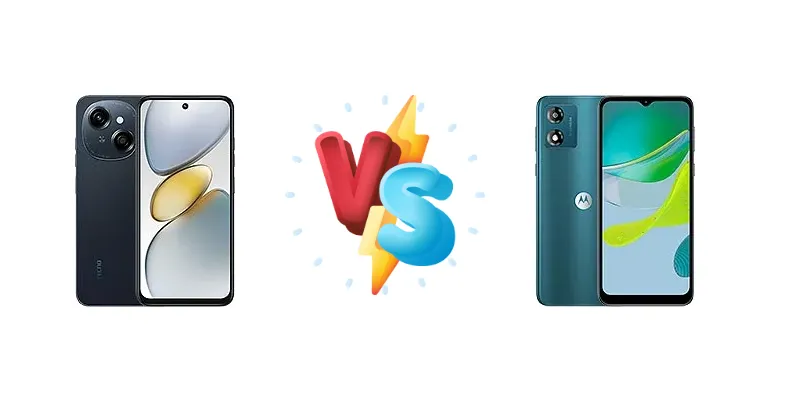
The sub-$150 smartphone market is fiercely competitive, and the Tecno Pop 9 4G and Motorola Moto E13 are two contenders vying for dominance. Both aim to deliver essential smartphone functionality at an incredibly accessible price point, but they achieve this with slightly different approaches to chipset selection and feature prioritization. This comparison will dissect their key specifications to determine which device offers the best value for your money.
🏆 Quick Verdict
For the average user prioritizing slightly better performance and potentially faster app loading times, the Tecno Pop 9 4G (International variant) emerges as the winner. Its Unisoc T615 chipset, with its faster Cortex-A75 cores, provides a noticeable edge over the Moto E13’s T606. However, the Moto E13 remains a viable option for those seeking a reliable, basic smartphone experience.
| Network |
|---|
| 2G bands | GSM 850 / 900 / 1800 / 1900 | GSM 850 / 900 / 1800 / 1900 |
| 3G bands | HSDPA 900 / 2100 | HSDPA 850 / 900 / 2100 |
| 4G bands | LTE | 1, 3, 5, 7, 8, 28, 38, 40, 41 |
| Speed | HSPA, LTE | HSPA, LTE |
| Technology | GSM / HSPA / LTE | GSM / HSPA / LTE |
| | - | 1, 3, 5, 7, 8, 20, 28, 38, 40, 41 |
| Launch |
|---|
| Announced | 2024, November 22 | 2023, January 24 |
| Status | Available. Released 2024, November 26 | Available. Released 2023, February 13 |
| Body |
|---|
| Build | Glass front, plastic back, plastic frame | Glass front, plastic frame, plastic back |
| Dimensions | 166 x 77 x 8 mm (6.54 x 3.03 x 0.31 in) | 164.2 x 75 x 8.5 mm (6.46 x 2.95 x 0.33 in) |
| SIM | Nano-SIM + Nano-SIM | Nano-SIM + Nano-SIM |
| Weight | 189 g (6.67 oz) | 179.5 g (6.35 oz) |
| | - | Water-resistant design |
| Display |
|---|
| Resolution | 720 x 1600 pixels, 20:9 ratio (~263 ppi density) | 720 x 1600 pixels, 20:9 ratio (~270 ppi density) |
| Size | 6.67 inches, 107.4 cm2 (~84.0% screen-to-body ratio) | 6.5 inches, 102.0 cm2 (~82.8% screen-to-body ratio) |
| Type | IPS LCD, 90Hz (India), 120Hz (International) | IPS LCD |
| Platform |
|---|
| CPU | Octa-core (2x1.8 GHz Cortex-A75 & 6x1.6 GHz Cortex-A55) - InternationalOcta-core 2.2 GHz Cortex-A53 - India | Octa-core (2x1.6 GHz Cortex-A75 & 6x1.6 GHz Cortex-A55) |
| Chipset | Unisoc T615 (12 nm) - InternationalMediatek Helio G50 - India | Unisoc T606 (12 nm) |
| GPU | Mali-G57 MP1 - InternationalPowerVR GE8320 - India | Mali-G57 MP1 |
| OS | Android 14 (Go edition) | Android 13 (Go edition) |
| Memory |
|---|
| Card slot | microSDXC | microSDXC (dedicated slot) |
| Internal | 64GB 3GB RAM, 64GB 4GB RAM, 128GB 3GB RAM, 128GB 4GB RAM | 32GB 2GB RAM, 64GB 2GB RAM, 64GB 4GB RAM, 128GB 8GB RAM |
| | - | eMMC 5.1 |
| Main Camera |
|---|
| Features | Dual-LED flash, HDR | LED flash, HDR, panorama |
| Single | 13 MP, f/1.8, 27mm (wide), 1.12µm, PDAF | 13 MP, f/2.2, (wide), 1.12µm, PDAF |
| Video | 1080p@30fps | 1080p@30fps |
| Selfie camera |
|---|
| Features | Dual-LED flash | - |
| Single | 8 MP | 5 MP, f/2.4, (wide), 1/5.0", 1.12µm |
| Video | Yes | 1080p@30fps |
| Sound |
|---|
| 3.5mm jack | - | Yes |
| 35mm jack | Yes | Yes |
| Loudspeaker | Yes, with stereo speakers | Yes |
| Comms |
|---|
| Bluetooth | Yes | 5.0, A2DP, LE |
| Infrared port | Yes | - |
| NFC | No | No |
| Positioning | GPS | GPS, GLONASS, GALILEO |
| Radio | FM radio | FM radio, recording |
| USB | USB Type-C | USB Type-C 2.0, OTG |
| WLAN | Yes | Wi-Fi 802.11 a/b/g/n/ac, dual-band |
| Features |
|---|
| Sensors | Fingerprint (side-mounted); unspecified sensors | Accelerometer, proximity |
| Battery |
|---|
| Charging | 15W wired | 10W wired |
| Type | 5000 mAh | Li-Po 5000 mAh |
| Misc |
|---|
| Colors | Glittery White, Lime Green, Startrail Black | Cosmic Black, Creamy White, Aurora Green |
| Models | KL4h | - |
| Price | About 70 EUR | $ 119.99 / € 104.99 |
Tecno Pop 9 4G
- Potentially faster performance with Unisoc T615 (International variant)
- Faster 15W charging
- May offer more RAM/storage options
- Regional chipset variation (India variant uses slower Helio G50)
- Software experience may be less refined than Motorola
Motorola Moto E13
- Clean and simple Motorola software experience
- Reliable and consistent performance with Unisoc T606
- Generally good build quality for the price
- Slower 10W charging
- Less powerful chipset compared to the Tecno Pop 9 4G (International)
Display Comparison
Neither device boasts a standout display. Both likely utilize LCD panels, typical for this price bracket. Detailed display specs like resolution and brightness are unavailable, but we can infer similar performance. The focus here isn't on visual fidelity, but on basic usability. Bezels are expected to be noticeable on both, and color accuracy will likely be standard for budget phones.
Camera Comparison
Camera performance is likely to be similar on both devices, with both likely featuring a primary sensor and potentially a secondary depth or macro lens. Given the price point, image quality will be adequate for social media sharing in good lighting conditions, but will struggle in low light. The absence of detailed sensor information makes a precise comparison impossible, but the focus should be on the primary sensor's megapixel count and aperture, rather than the often-useless 2MP macro lenses commonly found in this segment.
Performance
The core difference lies in the chipsets. The Tecno Pop 9 4G (International) features the Unisoc T615, utilizing two Cortex-A75 cores clocked at 1.8 GHz alongside six Cortex-A55 cores at 1.6 GHz. This configuration offers a performance advantage over the Moto E13’s Unisoc T606, which has two Cortex-A75 cores clocked slightly lower at 1.6 GHz and the same six Cortex-A55 cores. The India variant of the Pop 9 4G uses the Mediatek Helio G50 with a 2.2 GHz Cortex-A53 CPU, which is a step down in performance compared to the T615. This difference in CPU architecture and clock speeds translates to faster app launch times and smoother multitasking on the Tecno Pop 9 4G (International).
Battery Life
Both phones offer modest battery capacities, and the charging speeds are relatively slow. The Tecno Pop 9 4G supports 15W wired charging, while the Moto E13 is limited to 10W. While the difference in wattage isn't massive, the 15W charging on the Tecno Pop 9 4G will result in slightly faster charging times. Real-world usage will depend heavily on individual usage patterns, but both phones should comfortably last a full day with moderate use.
Buying Guide
Buy the Tecno Pop 9 4G if you need a phone capable of handling slightly more demanding tasks, such as multitasking between several apps or playing less graphically intensive games, and if you are in a region where the International variant with the T615 is available. Buy the Motorola Moto E13 if you prioritize simplicity, a clean software experience, and are content with basic smartphone functionality like calls, messaging, and light social media use. Be aware of the regional chipset differences; the India variant of the Pop 9 4G has a slower processor.
Frequently Asked Questions
❓ Which phone is better for playing games like PUBG Mobile or Call of Duty?
Neither phone is ideally suited for demanding games like PUBG Mobile or Call of Duty. However, the Tecno Pop 9 4G (International) with the Unisoc T615 will offer a slightly smoother experience at lower settings due to its more powerful CPU. Expect significant frame rate drops and graphical compromises on both devices.
❓ Does the Tecno Pop 9 4G's software have a lot of bloatware?
Tecno's HiOS software is known to include pre-installed apps (bloatware). While some can be uninstalled, it's a common complaint. The Motorola Moto E13, on the other hand, offers a near-stock Android experience with minimal bloatware, which many users prefer.
❓ What about software updates? Which phone will receive updates for longer?
Software update support is limited on both devices. Motorola generally provides one major Android update for its budget phones, while Tecno's update policy is less predictable. Don't expect either phone to receive updates for more than a year or two.
❓ Is the difference between the Unisoc T615 and T606 really noticeable in everyday use?
Yes, the difference is noticeable, particularly when multitasking or launching apps. The T615's faster Cortex-A75 cores provide a more responsive experience. While both chips are capable of handling basic tasks, the T615 offers a smoother and more fluid user experience.