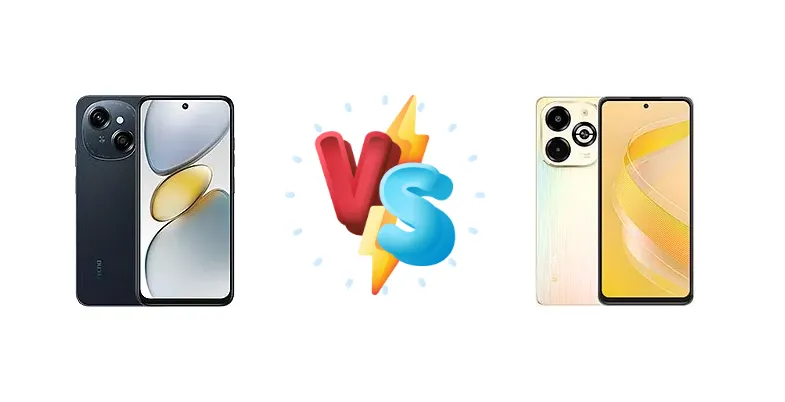
The sub-$150 smartphone market is fiercely competitive, and the Tecno Pop 9 4G and Infinix Smart 8 Plus are two contenders vying for your attention. Both aim to deliver essential smartphone functionality at an incredibly accessible price point, but they take different approaches to achieving this. This comparison dives deep into their specifications to determine which device offers the best overall experience.
🏆 Quick Verdict
For the average user prioritizing consistent performance and a slightly more efficient processor, the Tecno Pop 9 4G (International variant) emerges as the better choice. Its Unisoc T615 chipset, while region-dependent, generally offers a more balanced CPU architecture than the Infinix Smart 8 Plus's Helio G36, translating to smoother multitasking. However, the Infinix Smart 8 Plus's 18W charging is a notable advantage.
| Network |
|---|
| 2G bands | GSM 850 / 900 / 1800 / 1900 | GSM 850 / 900 / 1800 / 1900 |
| 3G bands | HSDPA 900 / 2100 | HSDPA 850 / 900 / 1700(AWS) / 1900 / 2100 |
| 4G bands | LTE | 1, 2, 3, 4, 5, 7, 8, 20, 28, 38, 41, 40 |
| Speed | HSPA, LTE | HSPA, LTE |
| Technology | GSM / HSPA / LTE | GSM / HSPA / LTE |
| Launch |
|---|
| Announced | 2024, November 22 | 2024, January 30 |
| Status | Available. Released 2024, November 26 | Available. Released 2024, February |
| Body |
|---|
| Build | Glass front, plastic back, plastic frame | Glass front, plastic back, plastic frame |
| Dimensions | 166 x 77 x 8 mm (6.54 x 3.03 x 0.31 in) | 163.7 x 75.7 x 9 mm (6.44 x 2.98 x 0.35 in) |
| SIM | Nano-SIM + Nano-SIM | Nano-SIM + Nano-SIM |
| Weight | 189 g (6.67 oz) | 204 g (7.20 oz) |
| Display |
|---|
| Resolution | 720 x 1600 pixels, 20:9 ratio (~263 ppi density) | 720 x 1612 pixels, 20:9 ratio (~267 ppi density) |
| Size | 6.67 inches, 107.4 cm2 (~84.0% screen-to-body ratio) | 6.6 inches, 104.6 cm2 (~84.4% screen-to-body ratio) |
| Type | IPS LCD, 90Hz (India), 120Hz (International) | IPS LCD, 90Hz, 500 nits (peak) |
| Platform |
|---|
| CPU | Octa-core (2x1.8 GHz Cortex-A75 & 6x1.6 GHz Cortex-A55) - InternationalOcta-core 2.2 GHz Cortex-A53 - India | Octa-core (4x2.2 GHz Cortex-A53 & 4x1.6 GHz Cortex-A53) |
| Chipset | Unisoc T615 (12 nm) - InternationalMediatek Helio G50 - India | Mediatek Helio G36 (12 nm) |
| GPU | Mali-G57 MP1 - InternationalPowerVR GE8320 - India | PowerVR GE8320 |
| OS | Android 14 (Go edition) | Android 13 (Go edition), XOS 13 |
| Memory |
|---|
| Card slot | microSDXC | microSDXC (dedicated slot) |
| Internal | 64GB 3GB RAM, 64GB 4GB RAM, 128GB 3GB RAM, 128GB 4GB RAM | 64GB 4GB RAM, 128GB 4GB RAM |
| Main Camera |
|---|
| Features | Dual-LED flash, HDR | Ring-LED flash, HDR, panorama |
| Single | 13 MP, f/1.8, 27mm (wide), 1.12µm, PDAF | 50 MP, f/1.9, (wide), AF
Auxiliary lens |
| Video | 1080p@30fps | 1080p@30fps |
| Selfie camera |
|---|
| Features | Dual-LED flash | - |
| Single | 8 MP | 8 MP, f/2.0, (wide) |
| Video | Yes | Yes |
| Sound |
|---|
| 35mm jack | Yes | Yes |
| Loudspeaker | Yes, with stereo speakers | Yes |
| Comms |
|---|
| Bluetooth | Yes | 5.0, A2DP, LE |
| Infrared port | Yes | - |
| NFC | No | No |
| Positioning | GPS | GPS |
| Radio | FM radio | FM radio |
| USB | USB Type-C | USB Type-C 2.0, OTG |
| WLAN | Yes | Wi-Fi 802.11 a/b/g/n/ac, dual-band |
| Features |
|---|
| Sensors | Fingerprint (side-mounted); unspecified sensors | Fingerprint (side-mounted), accelerometer, proximity, compass |
| Battery |
|---|
| Charging | 15W wired | 18W wired
Reverse wired |
| Type | 5000 mAh | 6000 mAh |
| Misc |
|---|
| Colors | Glittery White, Lime Green, Startrail Black | Galaxy White, Shiny Gold, Timber Black |
| Models | KL4h | X6526 |
| Price | About 70 EUR | About 100 EUR |
Tecno Pop 9 4G
- More efficient CPU architecture (International variant)
- Potentially smoother multitasking
- Competitive price point
- Slower charging speed (15W)
- Region-dependent chipset (India variant uses Helio G50)
Infinix Smart 8 Plus
- Faster 18W charging with reverse wired charging
- Consistent performance (Helio G36)
- Competitive price point
- Less efficient CPU architecture
- Older Cortex-A53 cores
Display Comparison
Neither device boasts a standout display. Both are likely to feature LCD panels, typical for this price bracket. Detailed display specs (resolution, brightness) are missing, but the focus here is on functionality, not fidelity. Bezels are expected to be substantial on both, maximizing screen real estate within a compact form factor. Color accuracy will likely be standard for budget phones, prioritizing power efficiency over color calibration.
Camera Comparison
Camera performance will be limited on both devices. Details on sensor sizes and apertures are unavailable, but it’s safe to assume both will feature a primary camera alongside basic auxiliary lenses (likely a depth or macro sensor). The emphasis here isn’t on image quality, but on basic functionality. Expect adequate performance in well-lit conditions, but struggles in low light. The presence of image processing algorithms will be minimal, resulting in images that are generally soft and lacking in detail. The 2MP macro cameras often found in this segment are largely marketing features and offer limited practical benefit.
Performance
The core difference lies in the chipsets. The Tecno Pop 9 4G (International) utilizes the Unisoc T615, a 12nm chip with an octa-core configuration featuring two Cortex-A75 cores for performance and six Cortex-A55 cores for efficiency. This architecture provides a noticeable boost in single-core performance compared to the Infinix Smart 8 Plus’s MediaTek Helio G36. The Helio G36 employs a homogenous octa-core setup with four Cortex-A53 cores at 2.2 GHz and another four at 1.6 GHz. While the G36’s higher clock speed might seem advantageous, the older Cortex-A53 architecture is less efficient and offers lower IPC (Instructions Per Clock) than the A75 cores in the T615. The India variant of the Pop 9 uses the Helio G50, which is a step down from the T615, making the international version the performance leader. RAM configurations are likely similar, but the T615’s superior CPU architecture will be the deciding factor for multitasking and app responsiveness.
Battery Life
Both phones will likely feature batteries in the 5000mAh range, providing all-day battery life for moderate usage. However, the Infinix Smart 8 Plus has a clear advantage with its 18W wired charging, including reverse wired charging. The Tecno Pop 9 4G is limited to 15W charging. This translates to significantly faster top-up times for the Infinix, a crucial benefit for users who frequently find themselves needing a quick charge. The reverse wired charging feature on the Infinix is a unique addition, allowing it to act as a power bank for other devices.
Buying Guide
Buy the Tecno Pop 9 4G if you need a phone for everyday tasks like calling, messaging, and light social media browsing, and value a processor that handles multiple apps without significant slowdown (International variant). Buy the Infinix Smart 8 Plus if you prioritize faster charging speeds and don't heavily rely on demanding applications, or if you are in India where the Helio G50 variant of the Pop 9 is available.
Frequently Asked Questions
❓ Will the Tecno Pop 9 4G handle popular games like PUBG Mobile?
While the Unisoc T615 can run PUBG Mobile, expect to play at low to medium settings with reduced frame rates. The Helio G36 in the Infinix Smart 8 Plus will offer a similar gaming experience. These phones are not designed for intensive gaming.
❓ Does the Infinix Smart 8 Plus's reverse wired charging work with any device?
Yes, the Infinix Smart 8 Plus's reverse wired charging is compatible with most devices that charge via USB-C. However, the charging speed will be limited, and it's best suited for topping up smaller devices like earbuds or smartwatches.
❓ Which phone is better for streaming videos on YouTube?
Both phones will be adequate for YouTube streaming, but the experience won't be exceptional due to the likely LCD panels and limited processing power. The Tecno Pop 9 4G (International) might offer slightly smoother playback due to its more efficient processor.
❓ Is the difference between the Unisoc T615 and Helio G36 noticeable in everyday use?
Yes, the difference is noticeable, particularly when multitasking. The Unisoc T615's Cortex-A75 cores provide a more responsive experience when switching between apps and handling demanding tasks. The Helio G36 may exhibit slight lag in similar scenarios.