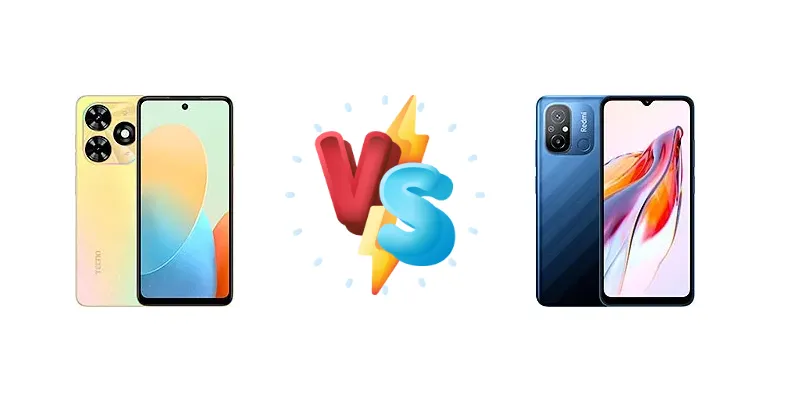
The Tecno Pop 8 and Xiaomi Redmi 12C represent the fiercely competitive sub-$150 smartphone market. Both aim to deliver essential smartphone functionality at an incredibly accessible price point. However, differing chipset choices and subtle design variations mean one will likely be a better fit for your needs. This comparison dives deep into the specifics to help you decide.
🏆 Quick Verdict
For most users, the Xiaomi Redmi 12C emerges as the slightly better choice. Its Helio G85 chipset, with higher clocked Cortex-A75 cores, provides a noticeable performance edge in everyday tasks and light gaming, offsetting the identical 10W charging and similar feature sets.
| Network |
|---|
| 2G bands | GSM 850 / 900 / 1800 / 1900 | GSM 850 / 900 / 1800 / 1900 |
| 3G bands | HSDPA 900 / 2100 | HSDPA 850 / 900 / 2100 |
| 4G bands | LTE | 1, 3, 5, 7, 8, 20, 28, 38, 40, 41 - International |
| Speed | HSPA, LTE | HSPA, LTE |
| Technology | GSM / HSPA / LTE | GSM / CDMA / HSPA / EVDO / LTE |
| | - | CDMA2000 1xEV-DO |
| Launch |
|---|
| Announced | 2023, October 30 | 2022, December 31 |
| Status | Available. Released 2023, November | Available. Released 2023, January 01 |
| Body |
|---|
| Build | Glass front, plastic back, plastic frame | - |
| Dimensions | 163.7 x 75.6 x 8.6 mm (6.44 x 2.98 x 0.34 in) | 168.8 x 76.4 x 8.8 mm (6.65 x 3.01 x 0.35 in) |
| SIM | Nano-SIM + Nano-SIM | Nano-SIM + Nano-SIM |
| Weight | - | 192 g (6.77 oz) |
| Display |
|---|
| Resolution | 720 x 1612 pixels, 20:9 ratio (~267 ppi density) | 720 x 1650 pixels (~268 ppi density) |
| Size | 6.6 inches, 104.6 cm2 (~84.6% screen-to-body ratio) | 6.71 inches, 106.5 cm2 (~82.6% screen-to-body ratio) |
| Type | IPS LCD, 90Hz | IPS LCD, 500 nits (typ) |
| Platform |
|---|
| CPU | Octa-core (2x1.6 GHz Cortex-A75 & 6x1.6 GHz Cortex-A55) | Octa-core (2x2.0 GHz Cortex-A75 & 6x1.8 GHz Cortex-A55) |
| Chipset | Unisoc T606 (12 nm) | Mediatek MT6769Z Helio G85 (12 nm) |
| GPU | Mali-G57 MP1 | Mali-G52 MC2 |
| OS | Android 13 (Go edition) | Android 12, MIUI 13 |
| Memory |
|---|
| Card slot | microSDXC | microSDXC (dedicated slot) |
| Internal | 64GB 2GB RAM, 64GB 3GB RAM, 64GB 4GB RAM, 128GB 4GB RAM | 32GB 2GB RAM, 32GB 3GB RAM, 32GB 4GB RAM, 64GB 3GB RAM, 64GB 4GB RAM, 128GB 3GB RAM, 128GB 4GB RAM, 128GB 6GB RAM |
| | - | eMMC 5.1 |
| Main Camera |
|---|
| Dual | - | 50 MP, (wide), PDAF
0.08 MP (depth) |
| Features | Dual-LED flash, HDR | LED flash, HDR |
| Single | 13 MP, f/1.8, (wide), 1.12µm, AF
Auxiliary lens | 50 MP, f/1.8, (wide), 1/2.76", PDAF
Auxiliary lens |
| Video | 1080p@30fps | 1080p@30fps |
| Selfie camera |
|---|
| Features | Dual-LED flash | - |
| Single | 8 MP | 5 MP, f/2.2, (wide) |
| Video | Yes | 1080p@30fps |
| Sound |
|---|
| 3.5mm jack | - | Yes |
| 35mm jack | Yes | Yes |
| Loudspeaker | Yes, with dual speakers | Yes |
| Comms |
|---|
| Bluetooth | Yes | 5.1, A2DP, LE |
| NFC | No | Yes (market/region dependent) |
| Positioning | GPS | GPS, GLONASS, BDS, GALILEO |
| Radio | FM radio | FM radio |
| USB | USB Type-C, OTG | microUSB 2.0 |
| WLAN | Yes | Wi-Fi 802.11 a/b/g/n/ac, dual-band, Wi-Fi Direct |
| Features |
|---|
| Sensors | Fingerprint (side-mounted), accelerometer | Fingerprint (rear-mounted), accelerometer |
| | - | Virtual proximity sensing |
| Battery |
|---|
| Charging | 10W wired | 10W wired |
| Type | 5000 mAh | Li-Po 5000 mAh |
| Misc |
|---|
| Colors | Mystery White, Alpenglow Gold, Magic Skin, Gravity Black | Graphite Gray, Ocean Blue, Mint Green, Lavender Purple |
| Models | BG6h, BG6i | 22120RN86G, 22120RN86I, 22126RN91Y, 2212ARNC4L |
| Price | - | £ 132.99 / € 107.41 |
| SAR | - | 1.08 W/kg (head) 0.64 W/kg (body) |
| SAR EU | - | 0.98 W/kg (head) 0.99 W/kg (body) |
Tecno Pop 8
- Potentially cleaner software experience (depending on Tecno’s UI)
- Competitive price point
- Likely good battery life due to efficient chipset
- Slower processor compared to Redmi 12C
- Less responsive user experience
- Limited gaming capabilities
Xiaomi Redmi 12C
- More powerful Helio G85 chipset
- Slightly better multitasking performance
- Potentially more refined camera software
- Xiaomi’s MIUI can be resource-intensive
- 10W charging is slow
- Build quality may feel less premium
Display Comparison
Neither device boasts a standout display. Both likely utilize LCD panels, typical for this price bracket. The focus here isn't on visual fidelity, but practicality. While specific display specs (resolution, brightness) are unavailable, the Redmi 12C’s slightly larger screen size (6.71” vs. Pop 8’s 6.56”) may offer a more immersive viewing experience. Bezels are expected to be substantial on both, prioritizing cost reduction over premium aesthetics.
Camera Comparison
Camera performance will be similar, leaning towards basic functionality. Both phones likely feature a primary camera and a depth sensor, with the Redmi 12C potentially having a slightly higher resolution main sensor (though specifics are unavailable). The 2MP auxiliary cameras found on many phones in this segment are unlikely to deliver significant image quality improvements on either device. Image processing will be the key differentiator, and Xiaomi’s software generally offers more features and refinement, even at the budget level.
Performance
The core difference lies in the chipsets. The Xiaomi Redmi 12C’s MediaTek Helio G85 (12nm) features two Cortex-A75 cores clocked at 2.0 GHz, compared to the Tecno Pop 8’s Unisoc T606 (12nm) with 1.6 GHz Cortex-A75 cores. This 0.4 GHz clock speed difference, coupled with slightly faster Cortex-A55 cores (1.8 GHz vs 1.6 GHz), translates to a tangible performance advantage for the Redmi 12C in CPU-bound tasks. While both are octa-core designs, the G85’s architecture provides a more responsive user experience, particularly when launching apps or multitasking. The GPU in the Helio G85 also offers a modest improvement for gaming, though neither phone is designed for graphically intensive titles.
Battery Life
Both the Tecno Pop 8 and Xiaomi Redmi 12C are equipped with 10W wired charging, indicating similar charging speeds – expect around 3-4 hours for a full charge. Battery capacity is not specified, but both will likely fall in the 5000mAh range, common for this price point. Real-world battery life will depend heavily on usage patterns, but both should comfortably last a full day with moderate use, prioritizing efficiency over power-hungry features.
Buying Guide
Buy the Tecno Pop 8 if you prioritize a potentially cleaner software experience and are primarily focused on basic communication – calls, texts, and light social media. It’s a solid option for first-time smartphone users or those needing a very simple device. Buy the Xiaomi Redmi 12C if you want a phone that feels a bit more responsive for multitasking, handles app switching more smoothly, and offers a slightly better experience with more demanding applications, even if only marginally.
Frequently Asked Questions
❓ Will the Redmi 12C’s Helio G85 handle popular games like PUBG Mobile?
The Helio G85 can run PUBG Mobile, but you’ll need to lower the graphics settings to medium or low and the frame rate to achieve a playable experience. Don’t expect high frame rates or ultra-smooth gameplay; it’s suitable for casual gaming sessions.
❓ Is the software on the Tecno Pop 8 heavily customized, and does it include a lot of bloatware?
Tecno’s HiOS is a customized version of Android, and it typically includes pre-installed apps (bloatware). The extent of customization and bloatware can vary by region, but it’s generally less aggressive than Xiaomi’s MIUI. However, updates may be less frequent on the Pop 8.
❓ How does the 10W charging affect the daily usability of both phones?
10W charging is slow by modern standards. You’ll need to charge these phones overnight or during extended periods of inactivity. It’s not ideal for quick top-ups, but the large battery capacities (likely around 5000mAh) mitigate the issue somewhat, providing all-day battery life with moderate use.
❓ Which phone is better for someone who primarily uses WhatsApp and makes phone calls?
Both phones are perfectly adequate for WhatsApp and phone calls. The Tecno Pop 8 might be slightly preferable if simplicity and a potentially cleaner software experience are priorities, as the less powerful processor won't be stressed by these basic tasks.