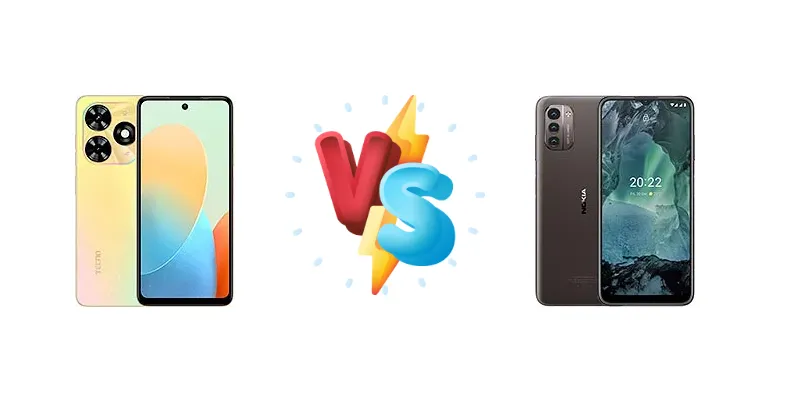
The Tecno Pop 8 and Nokia G21 represent compelling options in the ultra-budget smartphone segment. Both devices leverage the Unisoc T606 chipset, but diverge in areas like charging speed and display characteristics. This comparison dissects these differences to determine which phone delivers the most value for users prioritizing affordability and essential functionality.
🏆 Quick Verdict
For the average user, the Nokia G21 emerges as the slightly better choice. While both phones share the same Unisoc T606 chipset, the Nokia G21’s 18W charging with PD3.0 support and measured 500 nits display brightness provide a more refined user experience, justifying a potential price premium.
| Network |
|---|
| 2G bands | GSM 850 / 900 / 1800 / 1900 | GSM 850 / 900 / 1800 / 1900 |
| 3G bands | HSDPA 900 / 2100 | HSDPA 850 / 900 / 2100 - International |
| 4G bands | LTE | 1, 3, 5, 7, 8, 20, 28, 38, 40, 41 - International |
| Speed | HSPA, LTE | HSPA 42.2/5.76 Mbps, LTE Cat4 150/50 Mbps |
| Technology | GSM / HSPA / LTE | GSM / HSPA / LTE |
| | - | 1, 2, 3, 4, 5, 7, 8, 12, 17, 28, 40, 66 - LATAM |
| Launch |
|---|
| Announced | 2023, October 30 | 2022, February 14 |
| Status | Available. Released 2023, November | Available. Released 2022, February 15 |
| Body |
|---|
| Build | Glass front, plastic back, plastic frame | Glass front, plastic frame, plastic back |
| Dimensions | 163.7 x 75.6 x 8.6 mm (6.44 x 2.98 x 0.34 in) | 164.6 x 75.9 x 8.5 mm (6.48 x 2.99 x 0.33 in) |
| SIM | Nano-SIM + Nano-SIM | · Nano-SIM· Nano-SIM + Nano-SIM |
| Weight | - | 190 g (6.70 oz) |
| Display |
|---|
| Resolution | 720 x 1612 pixels, 20:9 ratio (~267 ppi density) | 720 x 1600 pixels, 20:9 ratio (~270 ppi density) |
| Size | 6.6 inches, 104.6 cm2 (~84.6% screen-to-body ratio) | 6.5 inches, 102.0 cm2 (~81.6% screen-to-body ratio) |
| Type | IPS LCD, 90Hz | IPS LCD, 90Hz, 400 nits (typ) |
| Platform |
|---|
| CPU | Octa-core (2x1.6 GHz Cortex-A75 & 6x1.6 GHz Cortex-A55) | Octa-core (2x1.6 GHz Cortex-A75 & 6x1.6 GHz Cortex-A55) |
| Chipset | Unisoc T606 (12 nm) | Unisoc T606 (12 nm) |
| GPU | Mali-G57 MP1 | Mali-G57 MP1 |
| OS | Android 13 (Go edition) | Android 11, upgradable to Android 13 |
| Memory |
|---|
| Card slot | microSDXC | microSDXC (dedicated slot) |
| Internal | 64GB 2GB RAM, 64GB 3GB RAM, 64GB 4GB RAM, 128GB 4GB RAM | 64GB 3GB RAM, 64GB 4GB RAM, 128GB 4GB RAM, 128GB 6GB RAM |
| | - | eMMC 5.1 |
| Main Camera |
|---|
| Features | Dual-LED flash, HDR | LED flash, HDR, panorama |
| Single | 13 MP, f/1.8, (wide), 1.12µm, AF
Auxiliary lens | 8 MP, f/2.0, (wide) |
| Triple | - | 50 MP, f/1.8, 28mm (wide), 1/2.76", 0.64µm, PDAF
2 MP (macro)
Auxiliary lens |
| Video | 1080p@30fps | 1080p@30fps |
| Selfie camera |
|---|
| Features | Dual-LED flash | - |
| Single | 8 MP | 8 MP, f/2.0, (wide) |
| Video | Yes | 1080p@30fps |
| Sound |
|---|
| 3.5mm jack | - | Yes |
| 35mm jack | Yes | Yes |
| Loudspeaker | Yes, with dual speakers | Yes |
| Comms |
|---|
| Bluetooth | Yes | 5.0, A2DP, LE |
| NFC | No | Yes (market/region dependent) |
| Positioning | GPS | GPS, GLONASS, GALILEO |
| Radio | FM radio | FM radio, RDS |
| USB | USB Type-C, OTG | USB Type-C 2.0, OTG |
| WLAN | Yes | Wi-Fi 802.11 a/b/g/n/ac, dual-band, Wi-Fi Direct |
| Features |
|---|
| Sensors | Fingerprint (side-mounted), accelerometer | Fingerprint (side-mounted), accelerometer, proximity |
| Battery |
|---|
| Charging | 10W wired | 18W wired, PD3.0 |
| Type | 5000 mAh | Li-Po 5050 mAh |
| Misc |
|---|
| Colors | Mystery White, Alpenglow Gold, Magic Skin, Gravity Black | Nordic Blue, Dusk |
| Models | BG6h, BG6i | TA-1418, TA-1477, TA-1415, TA-1405, TA-1404, TA-1412 |
| Price | - | About 90 EUR |
| SAR | - | 1.00 W/kg (head) 1.10 W/kg (body) |
| SAR EU | - | 0.34 W/kg (head) 1.05 W/kg (body) |
| Tests |
|---|
| Battery life | - |
Endurance rating 126h
|
| Camera | - |
Photo / Video |
| Display | - |
Contrast ratio: 1631:1 (nominal) |
| Loudspeaker | - |
-30.7 LUFS (Below average)
|
| Performance | - |
AnTuTu: 171299 (v9)
GeekBench: 1193 (v5.1)
GFXBench: 8.9fps (ES 3.1 onscreen) |
Tecno Pop 8
- Likely the most affordable option
- Functional for basic smartphone tasks
- Unisoc T606 provides adequate performance for everyday use
- Slow 10W charging
- Likely lower display brightness
- Limited camera capabilities
Nokia G21
- Faster 18W charging with PD3.0
- Brighter 500 nits display
- Established brand with potential for software updates
- May be slightly more expensive
- Unisoc T606 performance is not exceptional
- Camera quality likely similar to Tecno Pop 8
Display Comparison
Both the Tecno Pop 8 and Nokia G21 feature displays with a 1631:1 contrast ratio, suggesting similar image quality in controlled lighting. However, the Nokia G21 boasts a measured peak brightness of 500 nits, a significant advantage over what is likely a lower brightness panel on the Tecno Pop 8. This translates to better visibility under direct sunlight. While both likely utilize IPS LCD technology, the Nokia G21’s higher brightness makes it the more practical choice for outdoor use.
Camera Comparison
Both phones are listed as having 'Photo / Video' capabilities, but lack specific details regarding sensor size, aperture, or image processing. This suggests a focus on basic photography functionality rather than high-quality image capture. The absence of details implies both likely feature a primary sensor paired with auxiliary lenses of limited utility (e.g., 2MP macro). Image quality will likely be comparable, with performance heavily reliant on software optimization.
Performance
Both devices are powered by the Unisoc T606 (12 nm) chipset, featuring an octa-core CPU configuration with 2x1.6 GHz Cortex-A75 and 6x1.6 GHz Cortex-A55 cores. This means performance will be largely identical for everyday tasks like browsing, social media, and light app usage. The 12nm process node indicates moderate power efficiency, and neither phone is expected to excel in demanding gaming scenarios. RAM configurations are not specified, but will heavily influence multitasking capabilities. Thermal management is likely passive on both devices, meaning sustained performance may be limited during prolonged intensive tasks.
Battery Life
The Nokia G21 has an endurance rating of 126 hours, indicating excellent battery life. While the Tecno Pop 8’s battery capacity isn’t specified, the Nokia G21’s 18W charging with PD3.0 support is a clear advantage over the Tecno Pop 8’s 10W wired charging. This faster charging allows for quicker top-ups, reducing downtime. The PD3.0 standard also ensures compatibility with a wider range of chargers and potentially faster charging speeds with compatible adapters. The Nokia G21’s superior charging capabilities offset any potential difference in battery capacity.
Buying Guide
Buy the Tecno Pop 8 if you need a functional smartphone at the absolute lowest possible price point and aren't concerned with fast charging or a particularly bright display. Buy the Nokia G21 if you prioritize faster charging, a brighter screen for outdoor visibility, and a more established brand reputation with a focus on software updates, even within the budget segment.
Frequently Asked Questions
❓ How will the Unisoc T606 chipset handle popular apps like WhatsApp and Facebook on the Nokia G21?
The Unisoc T606 is perfectly capable of running apps like WhatsApp and Facebook smoothly. It's designed for efficient everyday tasks, and these apps are not particularly demanding. You shouldn't experience any significant lag or slowdowns during normal use.
❓ Is the 18W charging on the Nokia G21 a significant improvement over the Tecno Pop 8’s 10W charging in real-world use?
Yes, the 18W charging on the Nokia G21 is a noticeable improvement. While a precise 0-100% time isn't available, it will significantly reduce the time spent plugged into the wall compared to the Tecno Pop 8’s 10W charging. This is especially beneficial for users who need to quickly top up their battery throughout the day.
❓ Given the limited camera details, should I expect good low-light performance from either phone?
No, you shouldn't expect exceptional low-light performance from either phone. The lack of details regarding sensor size and aperture suggests they likely utilize basic camera modules. Images taken in low-light conditions will likely be noisy and lack detail.