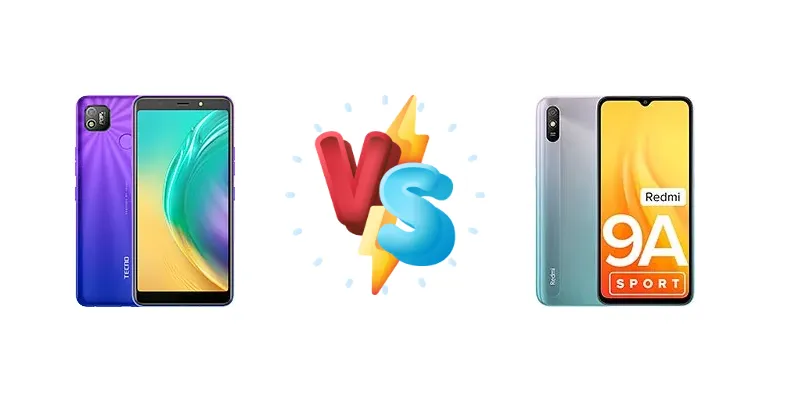
The sub-$100 smartphone market is fiercely competitive. Both the Tecno Pop 4 and the Xiaomi Redmi 9A Sport aim to deliver essential smartphone functionality at an incredibly low price point. However, they take different approaches to achieving this, with the Redmi 9A Sport leveraging a more modern chipset while the Pop 4 focuses on extreme affordability. This comparison will break down the key differences to help you choose the right device.
🏆 Quick Verdict
For most users, the Xiaomi Redmi 9A Sport is the better choice. Its Mediatek Helio G25 chipset, with its octa-core configuration, provides a significantly smoother and more responsive experience than the Tecno Pop 4’s quad-core processor. While both phones are limited, the Redmi 9A Sport offers a tangible performance advantage for everyday tasks.
| Network |
|---|
| 2G bands | GSM 900 / 1800 | GSM 850 / 900 / 1800 / 1900 |
| 3G bands | HSDPA 900 / 2100 | HSDPA 850 / 900 / 2100 |
| 4G bands | - | 1, 3, 5, 8, 40, 41 |
| Speed | HSPA 21.1/5.76 Mbps | HSPA, LTE |
| Technology | GSM / HSPA | GSM / HSPA / LTE |
| Launch |
|---|
| Announced | 2020, July 24. Released 2020, July 24 | 2021, September 28 |
| Status | Discontinued | Available. Released 2021, September 28 |
| Body |
|---|
| Build | Plastic frame, plastic back | - |
| Dimensions | 160 x 77.3 x 9.5 mm (6.30 x 3.04 x 0.37 in) | 164.9 x 77.1 x 9 mm (6.49 x 3.04 x 0.35 in) |
| SIM | Nano-SIM + Nano-SIM | Nano-SIM + Nano-SIM |
| Weight | - | 194 g (6.84 oz) |
| | - | Water-repellent coating |
| Display |
|---|
| Resolution | 480 x 960 pixels, 18:9 ratio (~179 ppi density) | 720 x 1600 pixels, 20:9 ratio (~269 ppi density) |
| Size | 6.0 inches, 92.9 cm2 (~75.1% screen-to-body ratio) | 6.53 inches, 102.9 cm2 (~81.0% screen-to-body ratio) |
| Type | IPS LCD | IPS LCD, 400 nits (typ) |
| Platform |
|---|
| CPU | Quad-core 1.3 GHz | Octa-core (4x2.0 GHz Cortex-A53 & 4x1.5 GHz Cortex-A53) |
| Chipset | - | Mediatek MT6762G Helio G25 (12 nm) |
| GPU | - | PowerVR GE8320 |
| OS | Android 10 (Go edition), HIOS | Android 10, MIUI 12 |
| Memory |
|---|
| Card slot | microSDXC | microSDXC (dedicated slot) |
| Internal | 32GB 2GB RAM | 32GB 2GB RAM, 32GB 3GB RAM |
| | eMMC 5.1 | eMMC 5.1 |
| Main Camera |
|---|
| Features | Dual-LED flash | LED flash, HDR |
| Single | 5 MP | 13 MP, f/2.2, 28mm (wide), 1.0µm, PDAF |
| Video | 1080p@30fps | 1080p@30/60fps |
| Selfie camera |
|---|
| Features | LED flash | HDR |
| Single | 8 MP | 5 MP, f/2.2, (wide), 1.12µm |
| Video | - | 1080p@30fps |
| Sound |
|---|
| 3.5mm jack | Yes | Yes |
| 35mm jack | Yes | Yes |
| Loudspeaker | Yes | Yes |
| Comms |
|---|
| Bluetooth | 4.2, A2DP, LE | 5.0, A2DP, LE |
| NFC | No | No |
| Positioning | GPS | GPS, GLONASS, BDS |
| Radio | FM radio | FM radio |
| USB | microUSB 2.0 | microUSB 2.0, OTG |
| WLAN | Wi-Fi 802.11 b/g/n | Wi-Fi 802.11 a/b/g/n, Wi-Fi Direct |
| Features |
|---|
| Sensors | Fingerprint (rear-mounted), accelerometer, proximity | Accelerometer, proximity |
| Battery |
|---|
| Charging | - | 10W wired |
| Type | 5000 mAh | Li-Po 5000 mAh |
| Misc |
|---|
| Colors | Ice Lake Green, Dawn Blue | Carbon Black, Coral Green, Metallic Blue |
| Models | BC2c, BC1s | - |
| Price | About 80 EUR | About 100 EUR |
Tecno Pop 4
- Potentially the lowest price point available.
- Simple and easy-to-use interface.
- May offer longer standby time due to less powerful processor.
- Extremely limited performance.
- Likely poor camera quality.
- Display quality is likely to be basic.
Xiaomi Redmi 9A Sport
- Significantly better performance thanks to the Helio G25.
- More responsive user experience.
- Potentially better camera image processing.
- 10W charging is relatively slow.
- Still limited in terms of overall performance.
- Display quality is still basic.
Display Comparison
Neither device boasts a standout display. The Tecno Pop 4’s display specifications are not provided, but given its price point, it likely features a basic LCD panel with a resolution around 720p. The Redmi 9A Sport also utilizes an LCD, but its focus is on efficiency rather than quality. Both will likely suffer from narrow viewing angles and limited color accuracy. The lack of detailed display specs on the Pop 4 makes a direct comparison difficult, but we can assume the Redmi 9A Sport offers a slightly more refined visual experience due to its more modern manufacturing process.
Camera Comparison
Both phones are likely to offer underwhelming camera performance. Details on the Tecno Pop 4’s camera are unavailable, but budget phones in this segment typically feature low-resolution sensors and limited image processing capabilities. The Redmi 9A Sport’s camera specifications are also not detailed, but it’s reasonable to expect a basic main sensor paired with a depth sensor. Image quality will be acceptable in good lighting conditions, but expect significant noise and a lack of detail in low light. The presence of a dedicated chipset for image processing in the Redmi 9A Sport may offer a slight edge in image quality.
Performance
This is where the Redmi 9A Sport pulls ahead significantly. The Tecno Pop 4’s quad-core 1.3 GHz processor is a basic configuration, suitable only for the most rudimentary tasks. In contrast, the Redmi 9A Sport’s Mediatek Helio G25 (12nm) is an octa-core processor featuring Cortex-A53 cores clocked at 2.0 GHz and 1.5 GHz. The 12nm process node also contributes to better power efficiency. This translates to faster app loading times, smoother multitasking, and a more responsive user interface on the Redmi 9A Sport. While not a gaming powerhouse, the Helio G25 can handle less demanding mobile games with acceptable frame rates, something the Pop 4 would struggle with.
Battery Life
Battery life will be a key consideration for users in this segment. The Tecno Pop 4’s battery capacity is unknown, but it’s likely to be in the 3000-4000 mAh range. The Redmi 9A Sport’s battery capacity is also not specified, but its more efficient chipset and 10W wired charging suggest it will offer comparable or slightly better battery life. The 10W charging on the Redmi 9A Sport is slow by modern standards, but adequate for overnight charging. Without knowing the Pop 4’s battery capacity, it’s difficult to definitively declare a winner, but the Redmi 9A Sport’s chipset efficiency gives it a potential advantage.
Buying Guide
Buy the Tecno Pop 4 if your absolute priority is the lowest possible price and you only need a phone for basic communication – calls, texts, and very light app usage. Buy the Xiaomi Redmi 9A Sport if you want a more usable experience, even for light multitasking, social media browsing, and occasional gaming. The Redmi 9A Sport’s chipset provides a noticeable improvement in responsiveness and overall performance, justifying a potentially slightly higher cost.
Frequently Asked Questions
❓ Will the Redmi 9A Sport be able to run popular social media apps like Facebook and Instagram smoothly?
Yes, the Redmi 9A Sport’s Mediatek Helio G25 chipset is capable of running social media apps like Facebook and Instagram without significant lag. While it won’t offer a blazing-fast experience, it will provide a usable and responsive experience for everyday social media browsing.
❓ Is the Redmi 9A Sport suitable for playing mobile games like PUBG Mobile or Call of Duty Mobile?
The Redmi 9A Sport can run PUBG Mobile and Call of Duty Mobile, but you’ll need to lower the graphics settings to the lowest possible levels and accept lower frame rates. It’s not ideal for serious gaming, but it can provide a playable experience for casual gamers.
❓ How long will the battery last on the Tecno Pop 4 with typical usage (calls, texts, and occasional browsing)?
Without knowing the exact battery capacity of the Tecno Pop 4, it’s difficult to provide a precise estimate. However, given its less powerful processor, it should be able to last a full day with typical usage. Expect to charge it overnight to ensure it’s ready for the next day.
❓ Does the Redmi 9A Sport support dual SIM functionality?
Yes, the Redmi 9A Sport supports dual SIM functionality, allowing you to use two SIM cards simultaneously. This is a useful feature for users who want to separate their personal and work contacts or take advantage of different carrier plans.