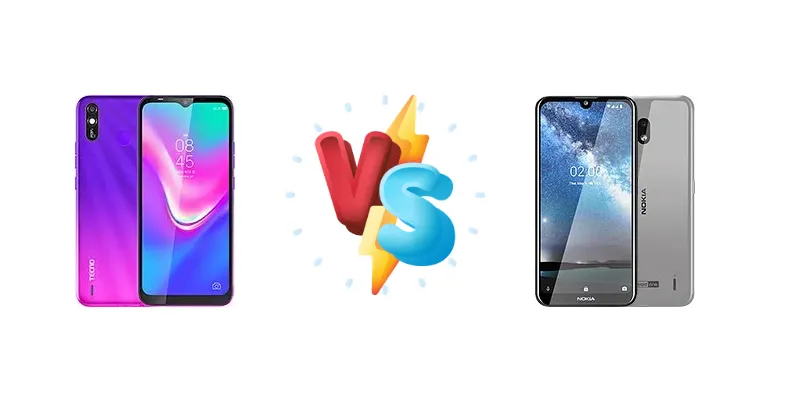
The Tecno Pop 3 Plus and Nokia 2.2 represent the extreme end of the smartphone price spectrum, targeting first-time buyers or those needing a reliable secondary device. Both rely on the Mediatek Helio A22 chipset, but subtle differences in CPU clock speed and charging capabilities could sway your decision. This comparison dissects these nuances to determine which phone delivers the most bang for your buck.
🏆 Quick Verdict
For the average user prioritizing responsiveness, the Nokia 2.2 emerges as the slightly better choice. Its 2.0 GHz CPU, while using the same architecture as the Tecno Pop 3 Plus’s 1.8 GHz CPU, provides a noticeable performance edge in everyday tasks. However, the Tecno Pop 3 Plus remains a viable option for those on the tightest of budgets.
| Network |
|---|
| 2G bands | GSM 900 / 1800 | GSM 850 / 900 / 1800 / 1900 |
| 3G bands | HSDPA 900 / 2100 | HSDPA 850 / 900 / 2100 - APAC, EMEA, India |
| 4G bands | 3, 7, 20 | 1, 3, 5, 7, 8, 20, 38, 40 - APAC, EMEA |
| Speed | HSPA 42.2/5.76 Mbps, LTE Cat4 150/50 Mbps | HSPA 42.2/5.76 Mbps, LTE Cat4 150/50 Mbps |
| Technology | GSM / HSPA / LTE | GSM / HSPA / LTE |
| | - | 1, 3, 5, 40, 41 - India |
| Launch |
|---|
| Announced | 2019, December. Released 2019, December | 2019, June 06. Released 2019, June 11 |
| Status | Discontinued | Discontinued |
| Body |
|---|
| Build | - | Glass front, plastic back, plastic frame |
| Dimensions | 166.7 x 75.8 x 8.4 mm (6.56 x 2.98 x 0.33 in) | 146 x 70.6 x 9.3 mm (5.75 x 2.78 x 0.37 in) |
| SIM | Nano-SIM + Nano-SIM | · Nano-SIM· Nano-SIM + Nano-SIM |
| Weight | 180.5 g (6.38 oz) | 153 g (5.40 oz) |
| Display |
|---|
| Resolution | 720 x 1600 pixels, 20:9 ratio (~269 ppi density) | 720 x 1520 pixels, 19:9 ratio (~295 ppi density) |
| Size | 6.52 inches, 102.6 cm2 (~81.2% screen-to-body ratio) | 5.71 inches, 81.4 cm2 (~79.0% screen-to-body ratio) |
| Type | IPS LCD | IPS LCD |
| | - | Always-on display |
| Platform |
|---|
| CPU | Quad-core 1.8 GHz Cortex-A53 | Quad-core 2.0 GHz Cortex-A53 |
| Chipset | Mediatek MT6761 Helio A22 (12 nm) | Mediatek MT6761 Helio A22 (12 nm) |
| GPU | PowerVR GE8320 | PowerVR GE8320 |
| OS | Android 9.0 (Pie), HIOS 5.5 | Android 9.0 (Pie), upgradable to Android 11, Android One |
| Memory |
|---|
| Card slot | microSDXC (dedicated slot) | microSDXC (uses shared SIM slot) |
| Internal | 16GB 1GB RAM | 16GB 2GB RAM, 32GB 3GB RAM |
| | eMMC 5.1 | eMMC 5.1 |
| Main Camera |
|---|
| Features | LED flash, HDR, panorama | LED flash, HDR, panorama |
| Single | 8 MP, AF | 13 MP, f/2.2, 1/3.1", 1.12µm, AF |
| Video | 1080p@30fps | 1080p@30fps |
| Selfie camera |
|---|
| Features | LED flash, HDR | - |
| Single | 8 MP, f/2.0 | 5 MP |
| Video | 1080p@30fps | 1080p@30fps |
| Sound |
|---|
| 3.5mm jack | Yes | Yes |
| 35mm jack | Yes | Yes |
| Loudspeaker | Yes | Yes |
| Comms |
|---|
| Bluetooth | 4.2, A2DP, LE | 4.2, A2DP, LE |
| NFC | No | No |
| Positioning | GPS | GPS, GLONASS, BDS |
| Radio | FM radio | FM radio |
| USB | microUSB 2.0 | microUSB 2.0, OTG |
| WLAN | Wi-Fi 802.11 b/g/n | Wi-Fi 802.11 b/g/n |
| Features |
|---|
| Sensors | Fingerprint (rear-mounted), accelerometer, proximity | Accelerometer, proximity |
| Battery |
|---|
| Charging | - | 10W wired |
| Type | 4000 mAh | Li-Ion 3000 mAh, removable |
| Misc |
|---|
| Colors | Midnight Black, Vacation Blue, Hillier Purple | Steel, Tungsten Black |
| Models | - | TA-1183, TA-1179, TA-1191, TA-1188 |
| Price | - | About 100 EUR |
| SAR | - | 0.43 W/kg (head) 1.37 W/kg (body) |
| SAR EU | - | 0.45 W/kg (head) 1.61 W/kg (body) |
Tecno Pop 3 Plus
- Potentially lower price point
- Mediatek Helio A22 chipset provides basic functionality
- Likely lightweight and portable
- Slower 1.8 GHz CPU
- Likely slower charging speeds
- Limited multitasking capabilities
Nokia 2.2
- Faster 2.0 GHz CPU for improved responsiveness
- 10W wired charging for quicker top-ups
- Nokia’s reputation for software updates (though limited)
- May be slightly more expensive
- Still limited by the Helio A22 chipset
- Likely similar RAM capacity to the Tecno Pop 3 Plus
Display Comparison
Neither Tecno nor Nokia provide display specifications beyond the basic panel type. Given the price point, both likely utilize LCD panels with modest resolutions (likely 720p+). Without data on brightness (nits), color gamut coverage, or viewing angles, it’s impossible to declare a clear winner. Expect both displays to be adequate for indoor use but struggle in direct sunlight. The absence of features like higher PWM dimming rates means both phones may cause eye strain for sensitive users.
Camera Comparison
Camera details are sparse for both devices. It’s safe to assume both feature basic camera setups, likely with a single main sensor and potentially a secondary depth sensor. Without knowing sensor size, aperture, or image processing algorithms, a direct comparison is difficult. The market segment suggests image quality will be adequate for casual snapshots in good lighting conditions, but expect significant noise and limited detail in low-light scenarios. The presence of a 2MP macro camera on either device is largely marketing fluff and unlikely to deliver meaningful improvements in image quality.
Performance
Both the Tecno Pop 3 Plus and Nokia 2.2 are powered by the Mediatek MT6761 Helio A22 (12 nm). However, the Nokia 2.2 boasts a CPU clocked at 2.0 GHz, a 10% increase over the Tecno Pop 3 Plus’s 1.8 GHz. While both utilize a quad-core Cortex-A53 configuration, the higher clock speed translates to faster processing of instructions, resulting in snappier app launches and smoother multitasking. The 12nm process node ensures reasonable power efficiency, but neither phone is designed for demanding gaming or resource-intensive applications. RAM capacity, not provided, will be a significant bottleneck; expect both to ship with 1-2GB, limiting multitasking.
Battery Life
Battery capacity is not specified for either device, but given their target market, both likely house batteries in the 3000-4000 mAh range. The Nokia 2.2 has a clear advantage with its 10W wired charging support. While not fast by modern standards, it’s significantly faster than the likely 5W or slower charging on the Tecno Pop 3 Plus. This translates to a considerably shorter time to reach a full charge, a crucial benefit for users who rely on their phone throughout the day. Without knowing the exact battery capacity, it’s difficult to predict real-world battery life, but the Nokia 2.2’s faster charging offers a practical advantage.
Buying Guide
Buy the Tecno Pop 3 Plus if you absolutely need the lowest possible price and are willing to accept slightly slower performance. It’s ideal for basic communication and light app usage. Buy the Nokia 2.2 if you value a more responsive user experience, even for simple tasks, and appreciate the convenience of 10W wired charging, making it a better choice for users who don't want to wait hours for a full charge.
Frequently Asked Questions
❓ Will the Nokia 2.2’s faster CPU noticeably improve app loading times compared to the Tecno Pop 3 Plus?
Yes, the 2.0 GHz CPU in the Nokia 2.2 will provide a measurable improvement in app loading times and overall system responsiveness. While both phones use the same chipset architecture, the higher clock speed allows the CPU to process instructions more quickly, resulting in a smoother user experience, especially when launching apps or switching between tasks.
❓ Is the 10W charging on the Nokia 2.2 a significant advantage over the Tecno Pop 3 Plus?
Absolutely. While 10W isn't fast charging in the modern sense, it's a substantial improvement over the likely 5W or slower charging on the Tecno Pop 3 Plus. This means you'll spend considerably less time tethered to a power outlet, which is particularly important for users who rely on their phone throughout the day.
❓ Can either of these phones handle popular mobile games like PUBG Mobile or Call of Duty Mobile?
Neither the Tecno Pop 3 Plus nor the Nokia 2.2 are well-suited for demanding games like PUBG Mobile or Call of Duty Mobile. The Mediatek Helio A22 chipset lacks the processing power and graphics capabilities to deliver a smooth gaming experience, even at the lowest settings. Expect significant lag and frame rate drops.