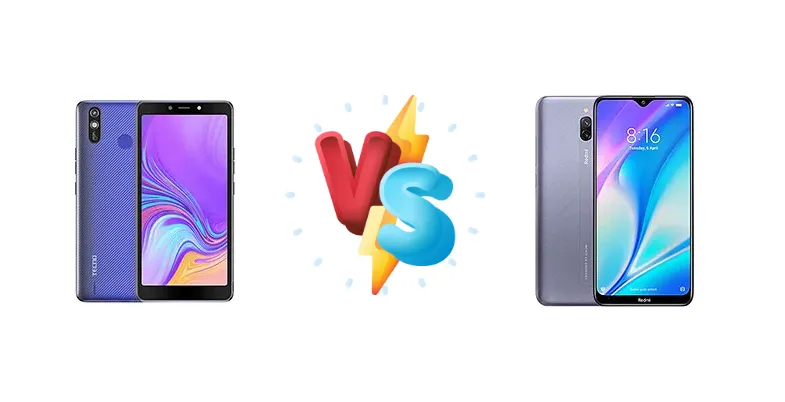
The Tecno Pop 2 Plus and Xiaomi Redmi 8A Pro represent the extreme end of the smartphone price spectrum. Both aim to deliver essential functionality at a minimal cost, but they achieve this through vastly different approaches to hardware. This comparison dissects their key specifications to determine which device offers the best value for users prioritizing affordability.
🏆 Quick Verdict
For the average user, the Xiaomi Redmi 8A Pro emerges as the superior choice. Its Snapdragon 439 chipset, built on a 12nm process, provides a significantly more responsive experience than the Tecno Pop 2 Plus’s Mediatek MT6580P. The inclusion of 18W fast charging further solidifies its advantage, making it a more practical daily driver.
| Network |
|---|
| 2G bands | GSM 900 / 1800 | GSM 850 / 900 / 1800 / 1900 |
| 3G bands | HSDPA 2100 | HSDPA 850 / 900 / 1900 / 2100 |
| 4G bands | - | 1, 3, 5, 8, 40, 41 |
| Speed | HSPA | HSPA, LTE |
| Technology | GSM / HSPA | GSM / HSPA / LTE |
| Launch |
|---|
| Announced | 2019, May. Released 2019, May | 2020, April 02. Released 2020, April 02 |
| Status | Discontinued | Discontinued |
| Body |
|---|
| Build | Glass front, plastic back, plastic frame | Glass front (Gorilla Glass 5), plastic back, plastic frame |
| Dimensions | 161.7 x 78.9 x 9.6 mm (6.37 x 3.11 x 0.38 in) | 156.5 x 75.4 x 9.4 mm (6.16 x 2.97 x 0.37 in) |
| SIM | Dual SIM (Micro-SIM, dual stand-by) | Nano-SIM + Nano-SIM |
| Weight | 205 g (7.23 oz) | 188 g (6.63 oz) |
| | - | Water-repellent coating |
| Display |
|---|
| Protection | - | Corning Gorilla Glass 5 |
| Resolution | 480 x 960 pixels, 18:9 ratio (~179 ppi density) | 720 x 1520 pixels, 19:9 ratio (~270 ppi density) |
| Size | 6.0 inches, 92.9 cm2 (~72.8% screen-to-body ratio) | 6.22 inches, 96.6 cm2 (~81.8% screen-to-body ratio) |
| Type | IPS LCD | IPS LCD, 400 nits (typ) |
| Platform |
|---|
| CPU | Quad-core 1.3 GHz Cortex-A7 | Octa-core (4x1.95 GHz Cortex-A53 & 4x1.45 GHz Cortex A53) |
| Chipset | Mediatek MT6580P | Qualcomm SDM439 Snapdragon 439 (12 nm) |
| GPU | Mali-400MP2 | Adreno 505 |
| OS | Android 8.1 Oreo (Go edition) | Android 9.0 (Pie), planned upgrade to Android 10, MIUI 12 |
| Memory |
|---|
| Card slot | microSD | microSDXC (dedicated slot) |
| Internal | 16GB 1GB RAM | 32GB 2GB RAM, 32GB 3GB RAM |
| | - | eMMC 5.1 |
| Main Camera |
|---|
| Dual | - | 13 MP, f/2.2, (wide), 1/3.1", 1.12µm, PDAF
Auxiliary lens |
| Features | Dual-LED flash, HDR | LED flash, HDR, panorama |
| Single | 5 MP | - |
| Video | 1080p@30fps | 1080p@30fps |
| Selfie camera |
|---|
| Features | LED flash | HDR |
| Single | 8 MP, f/2.0 | 8 MP, f/2.0, 1/4.0", 1.12µm |
| Video | 1080p@30fps | 1080p@30fps |
| Sound |
|---|
| 3.5mm jack | Yes | Yes |
| 35mm jack | Yes | Yes |
| Loudspeaker | Yes | Yes |
| Comms |
|---|
| Bluetooth | 4.2, A2DP, LE | 4.2, A2DP, LE |
| NFC | No | No |
| Positioning | GPS | GPS, GLONASS, BDS |
| Radio | FM radio | FM Radio, built-in antenna |
| USB | microUSB 2.0 | USB Type-C 2.0, OTG |
| WLAN | Wi-Fi 802.11 b/g/n | Wi-Fi 802.11 b/g/n, Wi-Fi Direct |
| Features |
|---|
| Sensors | Fingerprint (rear-mounted), accelerometer, proximity, compass | Accelerometer, proximity, compass |
| Battery |
|---|
| Charging | - | 18W wired
2.5W reverse wired |
| Type | 5000 mAh, non-removable | Li-Po 5000 mAh |
| Misc |
|---|
| Colors | Midnight Black, Champagne Gold, Nebula Black | Sky White, Sea Blue, Midnight Grey |
| Models | BA2, RB8S | - |
| Price | - | About 90 EUR |
Tecno Pop 2 Plus
- Lowest possible price point
- Functional for basic tasks
- Simple and easy to use
- Significantly slower performance
- Likely slow charging speeds
- Limited multitasking capabilities
Xiaomi Redmi 8A Pro
- Faster and more responsive processor
- 18W fast charging support
- Reverse wired charging capability
- Slightly higher price
- Still limited camera performance
- May not be ideal for demanding games
Display Comparison
Neither device boasts a standout display. Both likely feature LCD panels, typical for this price point. However, the Redmi 8A Pro’s larger screen size (though unspecified in the data) is a likely advantage. The absence of detailed display specs for both phones suggests a focus on cost reduction over visual fidelity. Expect basic color reproduction and limited viewing angles on both.
Camera Comparison
Camera performance is likely to be similar – basic. Without sensor size or aperture information, it’s safe to assume both phones rely on low-resolution sensors and limited image processing capabilities. The Redmi 8A Pro may benefit from Qualcomm’s image signal processor (ISP), potentially offering slightly better dynamic range and noise reduction. However, users shouldn’t expect flagship-level image quality from either device. Any secondary cameras on either phone are likely to be of minimal utility.
Performance
The performance gap is the most significant differentiator. The Xiaomi Redmi 8A Pro’s Qualcomm Snapdragon 439, an octa-core processor fabricated on a 12nm process, offers a substantial advantage over the Tecno Pop 2 Plus’s Mediatek MT6580P quad-core processor. The 12nm process node of the Snapdragon 439 translates to improved power efficiency and reduced thermal throttling compared to the older architecture of the MT6580P. This means the Redmi 8A Pro will handle multitasking and app loading times more effectively. The Cortex-A53 cores in the Snapdragon 439, while not high-end, are demonstrably more capable than the Cortex-A7 cores found in the Tecno.
Battery Life
While the battery capacity of both devices is unknown, the Redmi 8A Pro’s 18W wired charging is a major advantage. This allows for significantly faster charging times compared to the likely 5W or 10W charging of the Tecno Pop 2 Plus. The Redmi 8A Pro also features 2.5W reverse wired charging, a niche feature allowing it to charge other devices, albeit slowly. This capability is absent on the Tecno Pop 2 Plus. Even with a similar battery capacity, the faster charging of the Redmi 8A Pro translates to less downtime.
Buying Guide
Buy the Tecno Pop 2 Plus if you absolutely need the lowest possible price and your smartphone usage is limited to basic tasks like calls, texts, and light web browsing. It’s a functional device for first-time smartphone owners or as a temporary backup. Buy the Xiaomi Redmi 8A Pro if you prioritize a smoother user experience, faster charging, and a more capable processor for handling social media, streaming, and occasional gaming. The extra investment delivers a noticeable improvement in usability.
Frequently Asked Questions
❓ Will the Redmi 8A Pro handle popular apps like WhatsApp and Facebook smoothly?
Yes, the Snapdragon 439 in the Redmi 8A Pro is sufficiently capable of running apps like WhatsApp and Facebook without significant lag. The Mediatek MT6580P in the Tecno Pop 2 Plus may struggle with these apps, especially with multiple apps open simultaneously.
❓ Is the 18W charging on the Redmi 8A Pro a significant improvement over standard charging?
Absolutely. 18W charging will dramatically reduce the time it takes to charge the Redmi 8A Pro compared to the likely 5W or 10W charging on the Tecno Pop 2 Plus. Expect to go from 0% to 50% in around 30-45 minutes with the Redmi 8A Pro, versus potentially over 2 hours with the Tecno.
❓ Can I play games on the Redmi 8A Pro?
The Redmi 8A Pro can handle casual games, but it's not designed for demanding titles. Expect lower graphics settings and potential frame rate drops in more intensive games. The Tecno Pop 2 Plus will struggle even with basic games.
❓ How much storage do these phones typically offer?
While not specified, both phones likely come in 16GB or 32GB storage configurations. The Redmi 8A Pro typically offers a microSD card slot for expandable storage, which is a significant advantage over the Tecno Pop 2 Plus if expandable storage is not available.