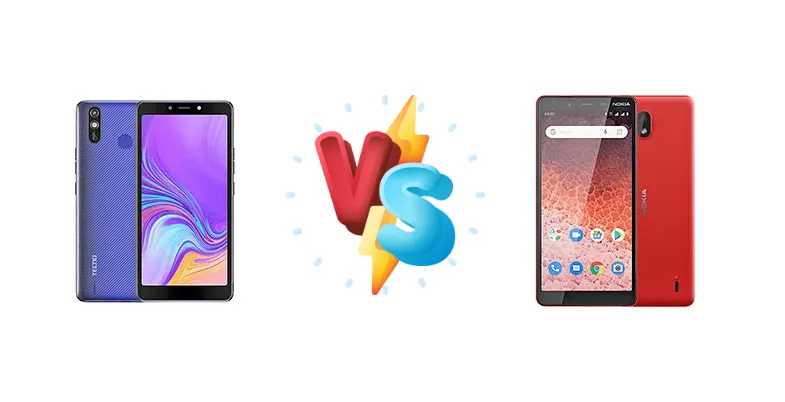
The Tecno Pop 2 Plus and Nokia 1 Plus represent the absolute bottom end of the smartphone market, targeting first-time smartphone buyers or those needing a very basic secondary device. Both run Android Go, optimized for low RAM, but their underlying hardware differs significantly. This comparison dissects those differences to determine which offers the best experience for the price.
🏆 Quick Verdict
For most users, the Nokia 1 Plus emerges as the slightly better choice. While both phones are extremely limited, the Nokia 1 Plus’s Mediatek MT6739WW chipset, built on a 28nm process, offers a noticeable performance advantage over the Tecno Pop 2 Plus’s MT6580P, translating to smoother multitasking and app loading, even within the constraints of Android Go.
| Network |
|---|
| 2G bands | GSM 900 / 1800 | GSM 850 / 900 / 1800 / 1900 |
| 3G bands | HSDPA 2100 | HSDPA 850 / 900 / 2100 - Global |
| 4G bands | - | 1, 3, 5, 7, 8, 20, 38, 40 - Global |
| Speed | HSPA | HSPA 42.2/5.76 Mbps, LTE Cat4 150/50 Mbps |
| Technology | GSM / HSPA | GSM / HSPA / LTE |
| | - | 1, 2, 3, 4, 5, 7, 8, 12, 17, 28 - LATAM |
| Launch |
|---|
| Announced | 2019, May. Released 2019, May | 2019, February 24. Released 2019, February 24 |
| Status | Discontinued | Discontinued |
| Body |
|---|
| Build | Glass front, plastic back, plastic frame | Glass front, plastic back, plastic frame |
| Dimensions | 161.7 x 78.9 x 9.6 mm (6.37 x 3.11 x 0.38 in) | 145 x 70.4 x 8.6 mm (5.71 x 2.77 x 0.34 in) |
| SIM | Dual SIM (Micro-SIM, dual stand-by) | Nano-SIM + Nano-SIM |
| Weight | 205 g (7.23 oz) | 138.4 g (4.87 oz) |
| Display |
|---|
| Resolution | 480 x 960 pixels, 18:9 ratio (~179 ppi density) | 480 x 960 pixels, 18:9 ratio (~197 ppi density) |
| Size | 6.0 inches, 92.9 cm2 (~72.8% screen-to-body ratio) | 5.45 inches, 76.7 cm2 (~75.1% screen-to-body ratio) |
| Type | IPS LCD | IPS LCD |
| Platform |
|---|
| CPU | Quad-core 1.3 GHz Cortex-A7 | Quad-core 1.5 GHz Cortex-A53 |
| Chipset | Mediatek MT6580P | Mediatek MT6739WW (28 nm) |
| GPU | Mali-400MP2 | PowerVR GE8100 |
| OS | Android 8.1 Oreo (Go edition) | Android 9.0 Pie (Go edition), upgradable to Android 10 (Go edition) |
| Memory |
|---|
| Card slot | microSD | microSDXC (dedicated slot) |
| Internal | 16GB 1GB RAM | 8GB 1GB RAM, 16GB 1GB RAM, 16GB 3GB RAM |
| | - | eMMC 5.1 |
| Main Camera |
|---|
| Features | Dual-LED flash, HDR | LED flash |
| Single | 5 MP | 8 MP, AF |
| Video | 1080p@30fps | 720p@30fps |
| Selfie camera |
|---|
| Features | LED flash | - |
| Single | 8 MP, f/2.0 | 5 MP |
| Video | 1080p@30fps | 720p |
| Sound |
|---|
| 3.5mm jack | Yes | Yes |
| 35mm jack | Yes | Yes |
| Loudspeaker | Yes | Yes |
| Comms |
|---|
| Bluetooth | 4.2, A2DP, LE | 4.2, A2DP |
| NFC | No | No |
| Positioning | GPS | GPS, GLONASS |
| Radio | FM radio | FM radio |
| USB | microUSB 2.0 | microUSB 2.0 |
| WLAN | Wi-Fi 802.11 b/g/n | Wi-Fi 802.11 a/b/g/n |
| Features |
|---|
| Sensors | Fingerprint (rear-mounted), accelerometer, proximity, compass | Accelerometer, proximity |
| Battery |
|---|
| Type | 5000 mAh, non-removable | Li-Ion 2500 mAh, removable |
| Misc |
|---|
| Colors | Midnight Black, Champagne Gold, Nebula Black | Black, Red, Blue |
| Models | BA2, RB8S | TA-1130, TA-1111, TA-1123, TA-1127, TA-1131 |
| Price | - | About 80 EUR |
| SAR | - | 0.96 W/kg (head) 0.72 W/kg (body) |
| SAR EU | - | 0.59 W/kg (head) 1.79 W/kg (body) |
Tecno Pop 2 Plus
- Potentially lower price point
- Android Go optimized for minimal resources
- Basic functionality for essential tasks
- Significantly weaker processor (MT6580P)
- Likely poorer performance and responsiveness
- Limited camera capabilities
Nokia 1 Plus
- More powerful processor (MT6739WW)
- Improved performance and multitasking
- Slightly better camera ISP
- May be slightly more expensive
- Still limited by Android Go and low-end hardware
- Small battery capacity (2500mAh)
Display Comparison
Neither device boasts a standout display. Specifications are largely unavailable for the Tecno Pop 2 Plus’s panel, suggesting a basic LCD. The Nokia 1 Plus also utilizes a standard LCD. The key difference lies in the processing power driving them; the Nokia’s chipset is better equipped to handle basic display tasks without significant lag. Both will likely suffer from narrow viewing angles and limited brightness, making outdoor visibility a challenge. Expect similar resolutions, likely around 480x854, given the target price point.
Camera Comparison
Camera performance on both devices will be extremely limited. Details are scarce, but both likely feature a basic 5MP or 8MP rear camera and a 2MP front camera. Image quality will be acceptable only in ideal lighting conditions. The Nokia 1 Plus may benefit slightly from the more capable ISP (Image Signal Processor) within the MT6739WW, potentially resulting in marginally better dynamic range and noise reduction. However, don't expect flagship-level results; these cameras are primarily for basic snapshots.
Performance
The core difference between these phones is the chipset. The Nokia 1 Plus’s Mediatek MT6739WW, fabricated on a 28nm process, features a quad-core Cortex-A53 CPU clocked at 1.5 GHz. This architecture is significantly more efficient and capable than the Tecno Pop 2 Plus’s Mediatek MT6580P, with its quad-core 1.3 GHz Cortex-A7 CPUs. The Cortex-A53 offers improved instruction set performance, leading to faster app launches and smoother scrolling. While neither chipset is a powerhouse, the Nokia 1 Plus will demonstrably outperform the Tecno in almost all tasks. The 28nm process node also contributes to better thermal management, reducing the likelihood of throttling under sustained load.
Battery Life
Battery capacity is a critical factor in this segment. While specific numbers are unavailable for the Tecno Pop 2 Plus, the Nokia 1 Plus packs a 2500mAh battery. Given the low-power chipsets and basic displays, both phones should achieve all-day battery life with moderate usage (primarily calls and texts). However, the Nokia 1 Plus’s more efficient chipset will likely translate to slightly longer standby times. Charging speeds are likely to be slow on both devices, utilizing Micro-USB, and lacking any form of fast charging technology.
Buying Guide
Buy the Tecno Pop 2 Plus if your absolute priority is minimizing cost and you only need a phone for basic calling and texting. Its lower price point makes it suitable for those on the tightest of budgets. Buy the Nokia 1 Plus if you value a slightly more responsive user experience and anticipate using a few more apps, even if they are lightweight. The MT6739WW provides a small but meaningful performance boost for everyday tasks.
Frequently Asked Questions
❓ Will the Nokia 1 Plus struggle with WhatsApp and Facebook?
While not ideal, the Nokia 1 Plus’s MT6739WW chipset is better equipped to handle the lightweight versions of WhatsApp and Facebook available through Android Go than the Tecno Pop 2 Plus. Expect some lag, especially with multiple chats open, but it should be usable for basic communication.
❓ Is the 2MP front camera on either phone suitable for video calls?
No. The 2MP front cameras on both the Tecno Pop 2 Plus and Nokia 1 Plus are extremely low resolution. While functional for basic video calls in good lighting, image quality will be poor, and the experience will be far from ideal. Expect grainy and blurry video.
❓ Can either phone play PUBG Mobile?
No. Neither the MT6580P nor the MT6739WW are powerful enough to run PUBG Mobile, even at the lowest settings. The game will likely be unplayable due to severe lag and frame rate drops.
❓ What version of Android do these phones run?
Both the Tecno Pop 2 Plus and Nokia 1 Plus run Android Go Edition, a stripped-down version of Android designed for devices with limited RAM. This ensures a smoother experience on low-end hardware by using less storage space and data.