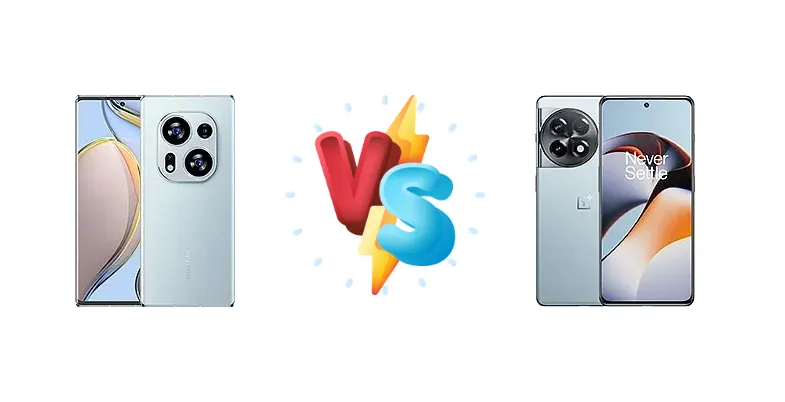
The Tecno Phantom X2 and OnePlus 11R represent compelling options in the increasingly competitive mid-range to upper-mid-range smartphone market. The Phantom X2, powered by the MediaTek Dimensity 9000, aims to deliver flagship-level performance at a more accessible price. Meanwhile, the OnePlus 11R leverages the Qualcomm Snapdragon 8+ Gen 1, prioritizing fast charging and a refined user experience. This comparison dissects their key differences to help you choose the right device.
🏆 Quick Verdict
For the average user prioritizing all-around performance and battery endurance, the Tecno Phantom X2 emerges as the stronger contender. Its Dimensity 9000 chipset, coupled with a respectable 110-hour endurance rating, offers a compelling package. However, the OnePlus 11R’s 100W charging is a significant advantage for those who value speed above all else.
| Network |
|---|
| 2G bands | GSM 850 / 900 / 1800 / 1900 | GSM 850 / 900 / 1800 / 1900 |
| 3G bands | HSDPA 850 / 900 / 1700(AWS) / 1900 / 2100 | HSDPA 850 / 900 / 1700(AWS) / 2100 |
| 4G bands | 1, 2, 3, 4, 5, 7, 8, 20, 28, 38, 40, 41, 66 | 1, 3, 4, 5, 8, 28, 34, 38, 39, 40, 41 |
| 5G bands | 1, 3, 8, 28, 38, 40, 41, 71, 77, 78, 79 SA/NSA/Sub6 | 1, 3, 5, 8, 28, 40, 41, 77, 78 SA/NSA |
| Speed | HSPA, LTE, 5G | HSPA, LTE (3CA), 5G |
| Technology | GSM / HSPA / LTE / 5G | GSM / CDMA / HSPA / LTE / 5G |
| | - | CDMA 800 |
| Launch |
|---|
| Announced | 2022, December 07 | 2023, February 07 |
| Status | Available. Released 2023, January 09 | Available. Released 2023, February 21 |
| Body |
|---|
| Build | Glass front (Gorilla Glass Victus), aluminum frame, plastic back | Glass front, glass back (Gorilla Glass 5), plastic frame |
| Dimensions | 164.6 x 72.7 x 8.9 mm (6.48 x 2.86 x 0.35 in) | 163.4 x 74.3 x 8.7 mm (6.43 x 2.93 x 0.34 in) |
| SIM | Nano-SIM + Nano-SIM | Nano-SIM + Nano-SIM |
| Weight | 203 g (7.16 oz) | 204 g (7.20 oz) |
| Display |
|---|
| Protection | Corning Gorilla Glass Victus | - |
| Resolution | 1080 x 2400 pixels, 20:9 ratio (~387 ppi density) | 1240 x 2772 pixels, 20:9 ratio (~451 ppi density) |
| Size | 6.8 inches, 111.6 cm2 (~93.3% screen-to-body ratio) | 6.74 inches, 109.2 cm2 (~90.0% screen-to-body ratio) |
| Type | AMOLED, 120Hz | Fluid AMOLED, 1B colors, 120Hz, HDR10+, 1450 nits (peak) |
| Platform |
|---|
| CPU | Octa-core (1x3.05 GHz Cortex-X2 & 3x2.85 GHz Cortex-A710 & 4x1.80 GHz Cortex-A510) | Octa-core (1x3.0 GHz Cortex-X2 & 3x2.5 GHz Cortex-A710 & 4x1.80 GHz Cortex-A510) |
| Chipset | Mediatek Dimensity 9000 (4 nm) | Qualcomm SM8475 Snapdragon 8+ Gen 1 (4 nm) |
| GPU | Mali-G710 MC10 | Adreno 730 |
| OS | Android 12, HIOS 12 | Android 13, upgradable to Android 15, OxygenOS 15 |
| Memory |
|---|
| Card slot | No | No |
| Internal | 256GB 8GB RAM | 128GB 8GB RAM, 256GB 16GB RAM, 512GB 18GB RAM |
| | - | UFS 3.1 |
| Main Camera |
|---|
| Features | LED flash, panorama, HDR | Color spectrum sensor, LED flash, HDR, panorama |
| Single | 32 MP, f/2.5, (wide) | 16 MP, f/2.4, 24mm (wide), 1/3.09", 1.0µm |
| Triple | 64 MP, f/1.7, (wide), PDAF, OIS
13 MP, f/2.2, (ultrawide), 1/1.3", 1.12µm, AF
2 MP | 50 MP, f/1.8, 24mm (wide), 1/1.56", 1.0µm, multi-directional PDAF, OIS
8 MP, f/2.2, 120˚ (ultrawide), 1/4.0", 1.12µm
2 MP (macro) |
| Video | 4K@30/60fps, 1080p@30fps | 4K@30/60fps, 1080p@30/60/240fps, gyro-EIS |
| Selfie camera |
|---|
| Features | LED flash | HDR |
| Single | 32 MP, f/2.5, (wide) | 16 MP, f/2.4, 24mm (wide), 1/3.09", 1.0µm |
| Video | 1080p@30fps | 1080p@30fps |
| Sound |
|---|
| 3.5mm jack | No | No |
| 35mm jack | No | No |
| Loudspeaker | Yes | Yes, with stereo speakers |
| | - | 24-bit/192kHz audio |
| Comms |
|---|
| Bluetooth | 5.3, A2DP, LE | 5.3, A2DP, LE, aptX HD |
| Infrared port | - | Yes |
| NFC | Yes | Yes |
| Positioning | GPS | GPS (L1+L5), GLONASS (G1), BDS (B1I+B1c+B2a), GALILEO (E1+E5a), QZSS (L1+L5) |
| Radio | FM radio, recording | No |
| USB | USB Type-C 2.0, OTG | USB Type-C 2.0 |
| WLAN | Wi-Fi 802.11 a/b/g/n/ac, dual-band | Wi-Fi 802.11 a/b/g/n/ac/6, dual-band |
| Features |
|---|
| Sensors | Fingerprint (under display, optical), accelerometer, gyro, proximity, compass | Fingerprint (under display, optical), accelerometer, gyro, proximity, compass |
| Battery |
|---|
| Charging | 45W wired, 54% in 20 min, 100% in 60 min | 100W wired |
| Type | 5160 mAh | Li-Po 5000 mAh |
| Misc |
|---|
| Colors | Stardust Gray, Moonlight Silver | Galactic Silver, Sonic Black, Solar Red |
| Models | AD8 | CPH2487 |
| Price | About 460 EUR | About 600 EUR |
| SAR | - | 1.16 W/kg (head) 0.61 W/kg (body) |
| Tests |
|---|
| Battery life |
Endurance rating 110h
| - |
| Camera |
Photo / Video | - |
| Display |
Contrast ratio: Infinite (nominal) | - |
| Loudspeaker |
-26.8 LUFS (Good)
| - |
| Performance |
AnTuTu: 973623 (v9)
GeekBench: 4027 (v5.1)
GFXBench: 71fps (ES 3.1 onscreen) | - |
Tecno Phantom X2
- Strong CPU performance with Dimensity 9000
- Excellent battery endurance (110h rating)
- Competitive price point
- Charging speed is slower than OnePlus 11R
- Camera specifications are unknown
OnePlus 11R
- Blazing-fast 100W charging
- Snapdragon 8+ Gen 1 offers good thermal management
- Likely refined software experience (OnePlus OxygenOS)
- Battery life may be shorter than Tecno Phantom X2
- CPU clock speeds are slightly lower than Dimensity 9000
Display Comparison
The Tecno Phantom X2 boasts a display capable of reaching 710 nits of peak brightness, which is adequate for outdoor visibility but doesn’t challenge the brightest displays on the market. While contrast is listed as 'Infinite (nominal)', this is standard marketing terminology. The OnePlus 11R’s display specifications are not provided, but OnePlus typically prioritizes color accuracy and refresh rate in this segment. Without direct comparison data, it’s difficult to definitively declare a winner, but the Phantom X2’s measured brightness provides a concrete data point.
Camera Comparison
Both phones are listed with 'Photo / Video' capabilities, lacking specific details. This suggests neither prioritizes a groundbreaking camera system. Without sensor size, aperture, or OIS information, a meaningful comparison is impossible. It’s reasonable to assume both will offer competent image capture in good lighting conditions, but low-light performance will likely be a differentiating factor dependent on sensor size and image processing algorithms. The absence of detail suggests neither phone is a primary contender for mobile photography enthusiasts.
Performance
Both devices utilize 4nm process technology, but the chipsets differ significantly. The Tecno Phantom X2’s MediaTek Dimensity 9000 features a Cortex-X2 prime core clocked at 3.05 GHz, alongside three Cortex-A710 performance cores at 2.85 GHz and four Cortex-A510 efficiency cores. The OnePlus 11R employs the Qualcomm Snapdragon 8+ Gen 1, with a slightly lower clocked Cortex-X2 at 3.0 GHz, three Cortex-A710 cores at 2.5 GHz, and four Cortex-A510 cores. While the Snapdragon 8+ Gen 1 is known for its excellent thermal management, the Dimensity 9000’s architecture offers competitive performance, potentially trading blows in CPU-intensive tasks. The difference in A710 clock speeds suggests the Dimensity 9000 may have a slight edge in multi-core performance.
Battery Life
The Tecno Phantom X2’s endurance rating of 110 hours indicates strong battery life, likely due to a combination of efficient chipset and battery capacity (not specified). This contrasts with the OnePlus 11R’s focus on charging speed. The 11R’s 100W wired charging is a significant advantage, achieving a full charge in just 60 minutes, while the Phantom X2 takes 60 minutes to reach 100% with its 45W charging. The trade-off is clear: the Phantom X2 prioritizes longevity, while the 11R prioritizes convenience.
Buying Guide
Buy the Tecno Phantom X2 if you need extended battery life and sustained performance for demanding tasks like video editing or prolonged gaming sessions. Its Dimensity 9000 offers a strong CPU and GPU combination. Buy the OnePlus 11R if you prioritize incredibly fast charging – getting back to 100% in just an hour is a game-changer – and a streamlined software experience, even if it means slightly less battery longevity.
Frequently Asked Questions
❓ Does the Dimensity 9000 in the Tecno Phantom X2 suffer from significant thermal throttling during extended gaming sessions?
While the Snapdragon 8+ Gen 1 is known for its thermal efficiency, the Dimensity 9000’s 4nm process and MediaTek’s thermal management technologies are designed to mitigate throttling. Real-world testing would be needed to confirm, but the Dimensity 9000 is generally capable of sustaining high performance for extended periods.
❓ How does the 100W charging on the OnePlus 11R impact battery health over the long term?
While 100W charging is incredibly fast, it can potentially contribute to faster battery degradation over time. However, OnePlus employs charging algorithms designed to minimize this effect, such as trickle charging when the battery is near full capacity. The impact is likely to be minimal for most users.
❓ Is the lack of detailed camera specifications on both phones a cause for concern?
Yes, it suggests that neither phone is positioned as a camera-centric device. Users prioritizing mobile photography should consider alternatives with larger sensors, optical image stabilization, and more advanced image processing capabilities.