
Tecno Phantom X2 vs Honor Magic Vs3: Which Foldable Delivers the Best Performance and Value?
| Phones Images | |||||
|---|---|---|---|---|---|
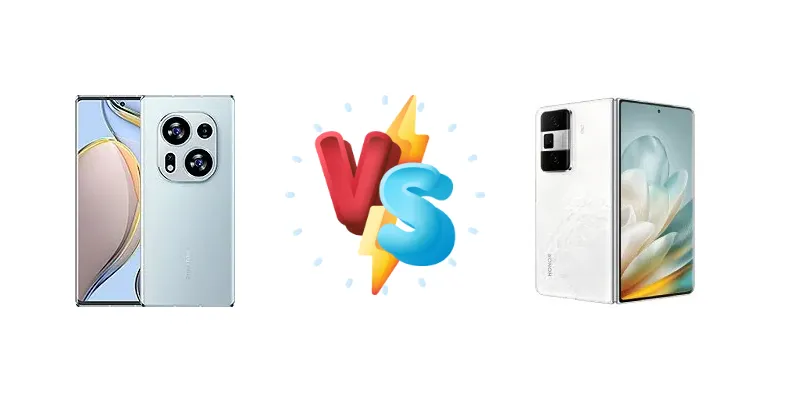
|
🏆 Quick Verdict
For the average user prioritizing raw performance and future-proofing, the Honor Magic Vs3 is the clear winner. Its Snapdragon 8 Gen 2 chipset offers a significant performance advantage and superior thermal efficiency. However, the Tecno Phantom X2 remains a strong contender for budget-conscious buyers who value a respectable experience.
| PHONES | ||
|---|---|---|
| Phone Names | Tecno Phantom X2 | Honor Magic Vs3 |
| Network | ||
|---|---|---|
| 2G bands | GSM 850 / 900 / 1800 / 1900 | GSM 850 / 900 / 1800 / 1900 |
| 3G bands | HSDPA 850 / 900 / 1700(AWS) / 1900 / 2100 | HSDPA 800 / 850 / 900 / 1700(AWS) / 1900 / 2100 |
| 4G bands | 1, 2, 3, 4, 5, 7, 8, 20, 28, 38, 40, 41, 66 | 1, 2, 3, 4, 5, 7, 8, 12, 17, 18, 19, 20, 26, 28, 34, 38, 39, 40, 41, 66 |
| 5G bands | 1, 3, 8, 28, 38, 40, 41, 71, 77, 78, 79 SA/NSA/Sub6 | 1, 3, 5, 8, 28, 38, 41, 77, 78 SA/NSA |
| Speed | HSPA, LTE, 5G | HSPA, LTE, 5G |
| Technology | GSM / HSPA / LTE / 5G | GSM / CDMA / HSPA / CDMA2000 / LTE / 5G |
| Launch | ||
|---|---|---|
| Announced | 2022, December 07 | 2024, July 12 |
| Status | Available. Released 2023, January 09 | Available. Released 2024, July 19 |
| Body | ||
|---|---|---|
| Build | Glass front (Gorilla Glass Victus), aluminum frame, plastic back | - |
| Dimensions | 164.6 x 72.7 x 8.9 mm (6.48 x 2.86 x 0.35 in) | Unfolded: 156.8 x 145.2 x 4.65 mm or 4.8 mmFolded: 156.8 x 74.0 x 9.8 mm or 10.1 mm |
| SIM | Nano-SIM + Nano-SIM | · Nano-SIM + eSIM· Nano-SIM + Nano-SIM |
| Weight | 203 g (7.16 oz) | 229 g or 231 g (8.08 oz) |
| Display | ||
|---|---|---|
| Protection | Corning Gorilla Glass Victus | King Kong Rhinoceros |
| Resolution | 1080 x 2400 pixels, 20:9 ratio (~387 ppi density) | 2156 x 2344 pixels (~402 ppi density) |
| Size | 6.8 inches, 111.6 cm2 (~93.3% screen-to-body ratio) | 7.92 inches, 201.6 cm2 (~88.6% screen-to-body ratio) |
| Type | AMOLED, 120Hz | Foldable LTPO AMOLED, 1B colors, Dolby Vision, 120Hz |
| Platform | ||
|---|---|---|
| CPU | Octa-core (1x3.05 GHz Cortex-X2 & 3x2.85 GHz Cortex-A710 & 4x1.80 GHz Cortex-A510) | Octa-core (1x3.2 GHz Cortex-X3 & 2x2.8 GHz Cortex-A715 & 2x2.8 GHz Cortex-A710 & 3x2.0 GHz Cortex-A510) |
| Chipset | Mediatek Dimensity 9000 (4 nm) | Qualcomm SM8550-AB Snapdragon 8 Gen 2 (4 nm) |
| GPU | Mali-G710 MC10 | Adreno 740 |
| OS | Android 12, HIOS 12 | Android 14, MagicOS 8.0.1 |
| Memory | ||
|---|---|---|
| Card slot | No | No |
| Internal | 256GB 8GB RAM | 256GB 12GB RAM, 512GB 12GB RAM, 1TB 16GB RAM |
| Main Camera | ||
|---|---|---|
| Features | LED flash, panorama, HDR | Laser AF, LED flash, HDR, panorama |
| Single | 32 MP, f/2.5, (wide) | - |
| Triple | 64 MP, f/1.7, (wide), PDAF, OIS 13 MP, f/2.2, (ultrawide), 1/1.3", 1.12µm, AF 2 MP | 50 MP, f/1.9, (wide), 1/1.56", PDAF, OIS 8 MP, f/3.4, (periscope telephoto), PDAF, OIS, 5x optical zoom 40 MP, f/2.2, 112˚, (ultrawide), AF |
| Video | 4K@30/60fps, 1080p@30fps | 4K@30/60fps (10-bit), 1080p@30/60fps, gyro-EIS, OIS |
| Selfie camera | ||
|---|---|---|
| Features | LED flash | HDR |
| Single | 32 MP, f/2.5, (wide) | 16 MP, f/2.2, 90˚, (wide) Cover camera: 16 MP, f/2.2, 90˚, (wide) |
| Video | 1080p@30fps | 4K@30fps, 1080p@30fps, gyro-EIS |
| Sound | ||
|---|---|---|
| 3.5mm jack | No | - |
| 35mm jack | No | No |
| Loudspeaker | Yes | Yes, with stereo speakers |
| Comms | ||
|---|---|---|
| Bluetooth | 5.3, A2DP, LE | 5.3, A2DP, LE, aptX HD, LDAC |
| Infrared port | - | Yes |
| NFC | Yes | Yes |
| Positioning | GPS | GPS (L1+L5), GLONASS (L1), BDS (B1I+B1c+B2a), GALILEO (E1+E5a) |
| Radio | FM radio, recording | No |
| USB | USB Type-C 2.0, OTG | USB Type-C 3.1, OTG, Display Port 1.2 |
| WLAN | Wi-Fi 802.11 a/b/g/n/ac, dual-band | Wi-Fi 802.11 a/b/g/n/ac/6e/7, dual-band, Wi-Fi Direct |
| Features | ||
|---|---|---|
| Sensors | Fingerprint (under display, optical), accelerometer, gyro, proximity, compass | Fingerprint (side-mounted), accelerometer, gyro, proximity, compass, barometer |
| Battery | ||
|---|---|---|
| Charging | 45W wired, 54% in 20 min, 100% in 60 min | 66W wired 50W wireless 5W reverse wired |
| Type | 5160 mAh | Li-Po 5000 mAh |
| Misc | ||
|---|---|---|
| Colors | Stardust Gray, Moonlight Silver | Velvet Black, Snow, Tundra Green |
| Models | AD8 | FLC-AN00 |
| Price | About 460 EUR | About 980 EUR |
| Tests | ||
|---|---|---|
| Battery life | Endurance rating 110h | - |
| Camera | Photo / Video | - |
| Display | Contrast ratio: Infinite (nominal) | - |
| Loudspeaker | -26.8 LUFS (Good) | - |
| Performance | AnTuTu: 973623 (v9) GeekBench: 4027 (v5.1) GFXBench: 71fps (ES 3.1 onscreen) | - |
Tecno Phantom X2
- Competitive price point
- Respectable battery endurance (110h)
- Capable Dimensity 9000 chipset
- Less powerful chipset compared to Snapdragon 8 Gen 2
- Limited camera information
- Slower charging speeds
Honor Magic Vs3
- Flagship Snapdragon 8 Gen 2 performance
- Faster 66W wired and 50W wireless charging
- Potentially superior camera system
- Likely higher price tag
- Battery endurance rating unavailable
- Potential for software bloat (Honor's history)
Display Comparison
The Tecno Phantom X2 boasts a 710 nits max brightness, a respectable figure for outdoor visibility, but the Honor Magic Vs3’s display specifications are currently unavailable. Given Honor’s history with high-quality panels, we anticipate a comparable or superior brightness level. Both devices feature an 'Infinite' (nominal) contrast ratio, typical of OLED displays. Without knowing the Magic Vs3’s panel technology (LTPO or not), it’s difficult to assess power efficiency differences, but the Snapdragon’s superior ISP could contribute to more accurate color calibration on the Honor device.
Camera Comparison
Both devices are listed as having Photo/Video capabilities, but detailed camera specifications are absent. Given the market positioning, we can infer that the Honor Magic Vs3 will likely feature a more sophisticated camera system with larger sensors and advanced image processing algorithms. The Snapdragon 8 Gen 2’s ISP (Image Signal Processor) is renowned for its superior noise reduction and dynamic range capabilities, potentially resulting in better low-light performance and more vibrant photos on the Magic Vs3. The lack of detail on the Phantom X2’s camera makes a direct comparison impossible, but it’s unlikely to match the flagship-level imaging expected from the Honor device.
Performance
The Honor Magic Vs3’s Snapdragon 8 Gen 2 (4nm) represents a significant leap over the Tecno Phantom X2’s Dimensity 9000 (4nm). The Snapdragon 8 Gen 2’s Cortex-X3 prime core, clocked at 3.2 GHz, outperforms the Dimensity 9000’s Cortex-X2 at 3.05 GHz. Furthermore, the Snapdragon 8 Gen 2’s architecture, with its enhanced Cortex-A715 and A710 cores, provides a more efficient and powerful processing experience. The 4nm process node on both chips is similar, but Qualcomm’s optimizations generally result in better thermal management, reducing the likelihood of performance throttling during sustained workloads. This translates to smoother gaming and faster rendering times for the Magic Vs3.
Battery Life
The Tecno Phantom X2 offers an endurance rating of 110 hours, a solid figure indicating good battery life. It supports 45W wired charging, achieving 54% charge in 20 minutes and 100% in 60 minutes. The Honor Magic Vs3, however, boasts a more versatile charging solution with 66W wired, 50W wireless, and 5W reverse wired charging. While the Phantom X2’s endurance rating is respectable, the Magic Vs3’s faster wired charging and the convenience of wireless charging provide a more user-friendly experience. The absence of battery capacity information for both devices makes a direct comparison challenging, but the Magic Vs3’s charging speed advantage is undeniable.
Buying Guide
Buy the Tecno Phantom X2 if you need a capable foldable experience without breaking the bank, and are willing to accept slightly less processing power and potentially more thermal throttling during extended gaming. Buy the Honor Magic Vs3 if you prioritize top-tier performance for demanding tasks like video editing, high-end gaming, and multitasking, and appreciate the benefits of faster charging and potentially better long-term software support.