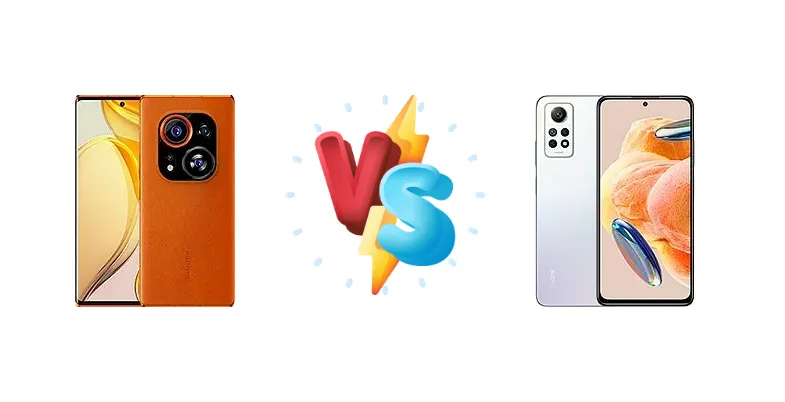
The mid-range smartphone market is fiercely competitive, offering incredible value for your money. Today, we're pitting two strong contenders against each other: the Tecno Phantom X2 Pro and the Xiaomi Redmi Note 12 Pro 4G. Let's dive into a comprehensive comparison to see which phone reigns supreme.
🏆 Quick Verdict
The Tecno Phantom X2 Pro boasts a significantly more powerful chipset and impressive battery life, alongside faster charging. However, the Redmi Note 12 Pro 4G offers a potentially more refined software experience and a slightly more competitive price point. Ultimately, the X2 Pro wins for performance, but the Note 12 Pro is a strong contender for budget-conscious buyers.
| Network |
|---|
| 2G bands | GSM 850 / 900 / 1800 / 1900 | GSM 850 / 900 / 1800 / 1900 |
| 3G bands | HSDPA 850 / 900 / 1700(AWS) / 1900 / 2100 | HSDPA 850 / 900 / 1700(AWS) / 1900 / 2100 |
| 4G bands | 1, 2, 3, 4, 5, 7, 8, 20, 28, 38, 40, 41, 66 | 1, 2, 3, 4, 5, 7, 8, 20, 28, 38, 40, 41, 66 |
| 5G bands | 1, 3, 8, 28, 38, 40, 41, 71, 77, 78, 79 SA/NSA/Sub6 | - |
| Speed | HSPA, LTE, 5G | HSPA, LTE |
| Technology | GSM / HSPA / LTE / 5G | GSM / HSPA / LTE |
| Launch |
|---|
| Announced | 2022, December 07 | 2023, March 03 |
| Status | Available. Released 2023, January 17 | Available. Released 2023, April 11 |
| Body |
|---|
| Build | Glass front (Gorilla Glass Victus), aluminum frame, plastic back | - |
| Dimensions | 164.6 x 72.7 x 9 mm (6.48 x 2.86 x 0.35 in) | 164.2 x 76.1 x 8.1 mm (6.46 x 3.00 x 0.32 in) |
| SIM | Nano-SIM + Nano-SIM | Nano-SIM + Nano-SIM |
| Weight | 201 g (7.09 oz) | 201.8 g (7.13 oz) |
| Display |
|---|
| Protection | Corning Gorilla Glass Victus | - |
| Resolution | 1080 x 2400 pixels, 20:9 ratio (~387 ppi density) | 1080 x 2400 pixels, 20:9 ratio (~395 ppi density) |
| Size | 6.8 inches, 111.6 cm2 (~93.3% screen-to-body ratio) | 6.67 inches, 107.4 cm2 (~86.0% screen-to-body ratio) |
| Type | AMOLED, 120Hz, 500 nits | AMOLED, 120Hz, Dolby Vision, 700 nits (HBM), 1100 nits (peak) |
| Platform |
|---|
| CPU | Octa-core (1x3.05 GHz Cortex-X2 & 3x2.85 GHz Cortex-A710 & 4x1.80 GHz Cortex-A510) | Octa-core (2x2.2 GHz Kryo 470 Gold & 6x1.8 GHz Kryo 470 Silver) |
| Chipset | Mediatek Dimensity 9000 (4 nm) | Qualcomm SM7150 Snapdragon 732G (8 nm) |
| GPU | Mali-G710 MC10 | Adreno 618 |
| OS | Android 12, HIOS 12 | Android 11, MIUI 13 |
| Memory |
|---|
| Card slot | No | microSDXC (uses shared SIM slot) |
| Internal | 256GB 12GB RAM | 128GB 6GB RAM, 128GB 8GB RAM, 256GB 8GB RAM |
| | UFS 3.1 | UFS 2.2 |
| Main Camera |
|---|
| Features | LED flash, panorama, HDR | LED flash, HDR, panorama |
| Quad | - | 108 MP, f/1.9, (wide), 1/1.52", 0.7µm, PDAF
8 MP, 120˚, (ultrawide)
2 MP (macro)
Auxiliary lens |
| Single | 32 MP, f/2.5, (wide), 1/2.8", 0.8µm | - |
| Triple | 50 MP, f/1.9, (wide), 1/1.3", 1.2µm, PDAF
50 MP, f/1.5, 65mm (telephoto), 1/2.7", 0.64µm, PDAF, 2.5x optical zoom, retractable lens
13 MP, f/2.2, (ultrawide), 1/1.3", 1.12µm, AF | - |
| Video | 4K@30/60fps, 1080p@30fps | 4K@30fps, 1080p@30/60fps |
| Selfie camera |
|---|
| Features | LED flash | - |
| Single | 32 MP, f/2.5, (wide), 1/2.8", 0.8µm | 16 MP, f/2.4, (wide) |
| Video | 1080p@30fps | 1080p@30fps |
| Sound |
|---|
| 3.5mm jack | No | Yes |
| 35mm jack | No | Yes |
| Loudspeaker | Yes | Yes, with stereo speakers |
| Comms |
|---|
| Bluetooth | 5.3, A2DP, LE | 5.0, A2DP, LE |
| Infrared port | - | Yes |
| NFC | Yes | Yes (market/region dependent) |
| Positioning | GPS | GPS, GLONASS, GALILEO, BDS |
| Radio | FM radio, recording | Unspecified |
| USB | USB Type-C 2.0, OTG | USB Type-C 2.0, OTG |
| WLAN | Wi-Fi 802.11 a/b/g/n/ac, dual-band | Wi-Fi 802.11 a/b/g/n/ac, dual-band |
| Features |
|---|
| Sensors | Fingerprint (under display, optical), accelerometer, gyro, proximity, compass | Fingerprint (side-mounted), accelerometer, gyro, compass |
| Battery |
|---|
| Charging | 45W wired, 54% in 20 min, 100% in 60 min | 67W wired |
| Type | 5160 mAh | Li-Po 5000 mAh |
| Misc |
|---|
| Colors | Stardust Gray, Mars Orange | Star Blue, Graphite Gray, Polar White, Ice blue |
| Models | AD9 | 2209116AG, 2209116AG |
| Price | ₹ 49,999 | About 150 EUR |
| Tests |
|---|
| Battery life |
Endurance rating 109h
| - |
| Camera |
Photo / Video | - |
| Display |
Contrast ratio: Infinite (nominal) | - |
| Loudspeaker |
-29.3 LUFS (Average)
| - |
| Performance |
AnTuTu: 961576 (v9)
GeekBench: 3984 (v5.1)
GFXBench: 71fps (ES 3.1 onscreen) | - |
Tecno Phantom X2 Pro
- Superior Performance (Dimensity 9000)
- Exceptional Battery Life (109h Endurance)
- Faster Charging (45W)
- Potentially Better Camera
- Software experience may not be as refined as Xiaomi
- Price may be higher
Xiaomi Redmi Note 12 Pro 4G
- Faster Charging (67W)
- Potentially More Refined Software (MIUI)
- Competitive Price
- Good Display (likely AMOLED)
- Weaker Performance (Snapdragon 732G)
- Shorter Battery Life
- Camera may not be as capable
Display Comparison
Both phones feature vibrant displays, but the Redmi Note 12 Pro 4G likely has better color accuracy and calibration. The Phantom X2 Pro's 505 nits brightness is respectable, but the Note 12 Pro's AMOLED panel (assumed) will offer deeper blacks and better contrast. The Phantom X2 Pro's 'Infinite' contrast ratio is a marketing term and not a measurable value.
Camera Comparison
While both phones offer capable cameras, the Phantom X2 Pro likely has an edge due to its higher-end chipset and potentially better image processing. Expect better low-light performance and more detail in photos from the X2 Pro. Specific camera specs (megapixels, sensor size) would be needed for a more precise comparison.
Performance
The Tecno Phantom X2 Pro's Mediatek Dimensity 9000 is a clear winner here. It's a flagship-level chipset that significantly outperforms the Snapdragon 732G in the Redmi Note 12 Pro 4G. Expect smoother multitasking, faster app loading times, and better gaming performance on the Phantom X2 Pro.
Battery Life
The Phantom X2 Pro's endurance rating of 109 hours is astonishing and a major selling point. The Redmi Note 12 Pro 4G's 67W charging is faster, but the X2 Pro's battery capacity (assumed to be larger) and efficiency give it a significant advantage in overall battery life.
Buying Guide
The Tecno Phantom X2 Pro is ideal for users prioritizing performance, camera capabilities, and long battery life. It's a great choice for gamers and those who frequently multitask. The Xiaomi Redmi Note 12 Pro 4G is best suited for users seeking a reliable, well-rounded smartphone with a good display and fast charging, at a more accessible price.
Frequently Asked Questions
❓ Which phone is better for gaming?
The Tecno Phantom X2 Pro is significantly better for gaming due to its much more powerful Dimensity 9000 chipset.
❓ Does the Redmi Note 12 Pro have a good camera?
The Redmi Note 12 Pro has a decent camera, but the Phantom X2 Pro is likely to produce higher-quality images, especially in low light.