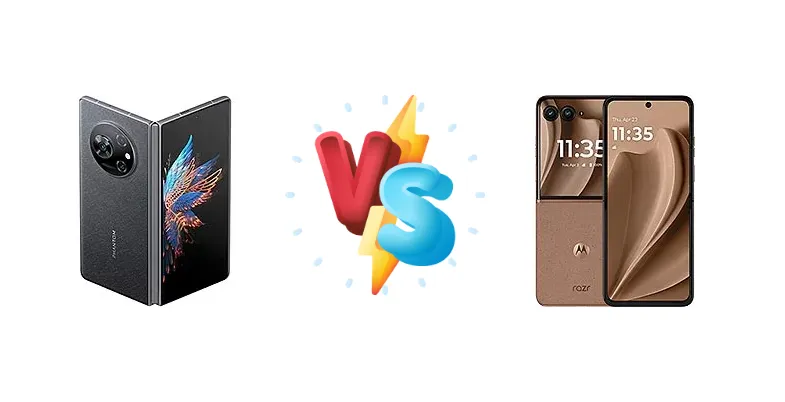
The foldable market is rapidly evolving, with two distinct approaches emerging: the book-style fold of the Tecno Phantom V Fold, aiming for expansive screen real estate at a competitive price, and the clamshell flip of the Motorola Razr+ 2025, prioritizing pocketability and style. This comparison dissects these philosophies, examining performance, battery life, and camera capabilities to determine which foldable best suits your needs.
🏆 Quick Verdict
For the average user prioritizing all-day battery life and a more traditional smartphone experience with a larger screen, the Tecno Phantom V Fold emerges as the winner. Its 92-hour endurance rating significantly surpasses the Motorola Razr+ 2025’s 10:12 active use score, making it the more practical choice for power users.
| Network |
|---|
| 2G bands | GSM 850 / 900 / 1800 / 1900 | GSM 900 / 1800 / 1900 |
| 3G bands | HSDPA 850 / 900 / 1700(AWS) / 1900 / 2100 | HSDPA 850 / 900 / 1700(AWS) / 1900 / 2100 |
| 4G bands | LTE | 1, 2, 3, 4, 5, 7, 8, 12, 13, 14, 17, 18, 19, 20, 25, 26, 28, 29, 30, 38, 39, 40, 41, 46, 48, 66, 71 |
| 5G bands | SA/NSA | 1, 2, 3, 5, 7, 12, 14, 20, 25, 26, 28, 29, 30, 38, 40, 41, 48, 66, 70, 71, 77, 78 SA/NSA/Sub6 |
| Speed | HSPA, LTE, 5G | HSPA, LTE, 5G |
| Technology | GSM / HSPA / LTE / 5G | GSM / HSPA / LTE / 5G |
| Launch |
|---|
| Announced | 2023, February 28 | 2025, April 24 |
| Status | Available. Released 2023, April 12 | Available. Released 2025, June 03 |
| Body |
|---|
| Build | Glass front folded (Gorilla Glass Victus), plastic back, aluminum frame | Plastic front (unfolded), glass front (folded, Gorilla Glass Victus), silicone polymer back (eco leather), aluminum frame (6000 series), hinge (titanium) |
| Dimensions | Unfolded: 159.4 x 140.4 x 6.9 mmFolded: 159.4 x 72 x 14.2-14.5 mm | Unfolded: 171.4 x 74 x 7.1 mmFolded: 88.1 x 74 x 15.3 mm |
| SIM | Nano-SIM + Nano-SIM | Nano-SIM + eSIM |
| Weight | 299 g (10.55 oz) | 189 g (6.67 oz) |
| Display |
|---|
| Resolution | 2000 x 2296 pixels (~388 ppi density) | 1080 x 2640 pixels (~413 ppi density) |
| Size | 7.85 inches, 196.9 cm2 (~88.0% screen-to-body ratio) | 6.9 inches, 107.6 cm2 (~84.9% screen-to-body ratio) |
| Type | Foldable LTPO AMOLED, 1B colors, 120Hz, 1100 nits (peak) | Foldable LTPO AMOLED, 1B colors, Dolby Vision, 165Hz, HDR10+, 3000 nits (peak) |
| | Cover display:
LTPO AMOLED, 1B colors, 120Hz, 1100 nits (peak), Corning Gorilla Glass Victus
6.42 inches, 1080 x 2550 pixels, 431 PPI | - |
| Platform |
|---|
| CPU | Octa-core (1x3.20 GHz Cortex-X2 & 3x2.85 GHz Cortex-A710 & 4x1.80 GHz Cortex-A510) | Octa-core (1x3.0 GHz Cortex-X4 & 4x2.8 GHz Cortex-A720 & 3x2.0 GHz Cortex-A520) |
| Chipset | Mediatek Dimensity 9000+ (4 nm) | Qualcomm SM8635 Snapdragon 8s Gen 3 (4 nm) |
| GPU | Mali-G710 MC10 | Adreno 735 |
| OS | Android 13, HiOS 13 Fold | Android 15 |
| Memory |
|---|
| Card slot | No | No |
| Internal | 256GB 12GB RAM, 512GB 12GB RAM | 256GB 12GB RAM |
| | UFS 3.1 | - |
| Main Camera |
|---|
| Dual | - | 50 MP, f/1.7, 24mm (wide), 1/1.95", 0.8µm, dual pixel PDAF, OIS
50 MP, f/2.0, 47mm (telephoto), 1/2.76", 0.64µm, PDAF, 2x optical zoom |
| Features | Dual-LED flash, HDR, panorama | LED flash, panorama, HDR |
| Single | 16 MP, f/2.5, (wide), 1/2.8", 1.12µm
Cover camera:
32 MP, f/2.5, (wide), 1/2.8", 0.8µm | - |
| Triple | 50 MP, f/1.9, (wide), 1/1.3", 1.2µm, PDAF
50 MP, f/2.0, (telephoto), 1/2.8", 0.64µm, PDAF, 2x optical zoom
13 MP, f/2.2, 120˚ (ultrawide), 1/3.0", 1.12µm, PDAF | - |
| Video | 4K@30fps, 1080p@30/60fps | 4K@30/60fps, 1080p@30/60/120/240/960fps, HDR10+, gyro-EIS |
| Selfie camera |
|---|
| Features | - | HDR |
| Single | 16 MP, f/2.5, (wide), 1/2.8", 1.12µm
Cover camera:
32 MP, f/2.5, (wide), 1/2.8", 0.8µm | 32 MP, f/2.4, 25mm (wide), 1/3.14", 0.7µm |
| Video | 1080p@60fps | 4K@30/60fps, 1080p@30/60fps |
| Sound |
|---|
| 3.5mm jack | No | - |
| 35mm jack | No | No |
| Loudspeaker | Yes, with stereo speakers | Yes, with stereo speakers (with Dolby Atmos) |
| Comms |
|---|
| Bluetooth | 5.2, A2DP, LE | 5.4, A2DP, LE, aptX HD, aptX Adaptive, aptX Lossless |
| NFC | Yes | Yes |
| Positioning | GPS, GLONASS, GALILEO, BDS | GPS (L1+L5), GLONASS (L1), BDS (B1I+B1c+B2a), GALILEO (E1+E5a), QZSS (L1+L5) |
| Radio | FM radio, recording | No |
| USB | USB Type-C, OTG | USB Type-C 2.0, OTG |
| WLAN | Wi-Fi 802.11 a/b/g/n/ac, dual-band | Wi-Fi 802.11 a/b/g/n/ac/6e/7, tri-band |
| Features |
|---|
| Sensors | Fingerprint (side-mounted), accelerometer, gyro, proximity, compass | Fingerprint (side-mounted), accelerometer, gyro, proximity, compass, barometer |
| Battery |
|---|
| Charging | 45W wired, 40% in 15 min, 100% in 55 min | 45W wired
15W wireless
5W reverse wired |
| Type | 5000 mAh | 4000 mAh |
| Misc |
|---|
| Colors | Black, White | Pantone: Mocha Mousse, Midnight Blue, Hot Pink |
| Models | AD10 | XT2451-1 |
| Price | About 1030 EUR | $ 500.00 |
| Tests |
|---|
| Battery life |
Endurance rating 92h
| - |
| Camera |
Photo / Video | - |
| Display |
Contrast ratio: Infinite (nominal) | - |
| Loudspeaker |
-24.3 LUFS (Very good)
| - |
| Performance |
AnTuTu: 999348 (v9)
GeekBench: 3963 (v5.1), 3748 (v6)
GFXBench: 45fps (ES 3.1 onscreen) | - |
Tecno Phantom V Fold
- Exceptional battery life (92h endurance)
- Larger, more immersive foldable display
- Competitive 45W fast charging
- Moderate peak display brightness (492 nits)
- Older chipset (Dimensity 9000+) compared to the competition
Motorola Razr+ 2025
- Powerful Snapdragon 8s Gen 3 chipset
- Compact and stylish clamshell design
- Wireless and reverse wireless charging
- Significantly shorter battery life (10:12h active use)
- Smaller internal display
Display Comparison
The Tecno Phantom V Fold boasts a larger, book-style foldable display, though its measured peak brightness of 492 nits is moderate. The Razr+ 2025, with its clamshell design, focuses on the external cover screen for at-a-glance information. While the Razr+ 2025’s display specs aren’t provided, Motorola typically prioritizes color accuracy and vibrancy in its displays. The Phantom V Fold’s ‘Infinite’ contrast ratio (nominal) suggests a strong black level, but real-world performance will depend on the panel’s calibration. The differing form factors fundamentally change the display experience; the Tecno aims to *replace* a traditional phone, while the Razr+ *complements* it.
Camera Comparison
Both devices list ‘Photo / Video’ capabilities, lacking specific details. However, given the Razr+'s positioning as a premium device, it likely incorporates a more sophisticated camera system with larger sensors and advanced image processing. The Dimensity 9000+ in the Phantom V Fold is capable of handling high-resolution image processing, but the absence of sensor details makes a direct comparison impossible. We anticipate the Razr+ 2025 to excel in low-light photography and video stabilization, areas where Qualcomm’s ISP typically shines. The lack of detail on both sides makes this a difficult area to assess without further testing.
Performance
The Motorola Razr+ 2025 leverages the Qualcomm SM8635 Snapdragon 8s Gen 3 (4nm), featuring an octa-core CPU with a Cortex-X4 prime core clocked at 3.0 GHz. This represents a generational leap over the Tecno Phantom V Fold’s MediaTek Dimensity 9000+ (4nm). The Snapdragon 8s Gen 3’s Cortex-A720 performance cores offer improved efficiency and performance compared to the Dimensity 9000+'s Cortex-A710 cores. While both chips are built on a 4nm process, Qualcomm’s architecture generally delivers better sustained performance and thermal management, crucial for demanding tasks like gaming. The Razr+ 2025 is likely to exhibit smoother multitasking and faster app loading times.
Battery Life
Battery life is a clear differentiator. The Tecno Phantom V Fold achieves an impressive endurance rating of 92 hours, suggesting excellent power efficiency. In contrast, the Motorola Razr+ 2025 manages 10:12 hours of active use. This translates to a significant advantage for the Tecno, particularly for users who heavily utilize their phones throughout the day. While the Razr+ 2025 offers 45W wired charging, 15W wireless, and 5W reverse wired charging, the Phantom V Fold’s 45W wired charging (40% in 15 min, 100% in 55 min) is competitive. The Razr+'s wireless charging is a convenience feature, but doesn't offset the substantial difference in overall endurance.
Buying Guide
Buy the Tecno Phantom V Fold if you need a larger, more immersive display for multitasking, content creation, or media consumption, and value extended battery life above all else. You’ll benefit from a phone that functions more like a traditional smartphone when unfolded. Buy the Motorola Razr+ 2025 if you prioritize a compact, stylish design that easily fits in your pocket, and appreciate the convenience of a cover screen for quick interactions, even at the expense of battery endurance.
Frequently Asked Questions
❓ Does the Dimensity 9000+ in the Tecno Phantom V Fold struggle with demanding games like Genshin Impact?
While the Dimensity 9000+ is a capable chipset, the Snapdragon 8s Gen 3 in the Razr+ 2025 offers a performance advantage. The Phantom V Fold can run Genshin Impact, but you may need to lower graphics settings for sustained frame rates. Thermal throttling could also become a factor during extended gaming sessions.
❓ How useful is the cover screen on the Motorola Razr+ 2025 for everyday tasks?
The Razr+ 2025’s cover screen is designed for quick interactions like checking notifications, controlling music, and taking selfies. It significantly reduces the need to constantly open the phone, enhancing convenience. However, its functionality is limited compared to the full internal display.
❓ Is the Tecno Phantom V Fold’s hinge durable enough for long-term use?
Tecno claims to have rigorously tested the Phantom V Fold’s hinge for durability. However, foldable phone hinges are inherently more complex than traditional phone designs and are potential points of failure. Long-term reliability remains to be seen, but Tecno offers a warranty to address potential issues.
❓ Does the Motorola Razr+ 2025 support expandable storage via microSD card?
No, the Motorola Razr+ 2025 does not support microSD card expansion. Users are limited to the internal storage capacity of the device, so choosing a configuration with sufficient storage is crucial.