
Tecno Phantom V Fold vs Huawei Mate X3: The Ultimate Foldable Face-Off
| Phones Images | |||||
|---|---|---|---|---|---|
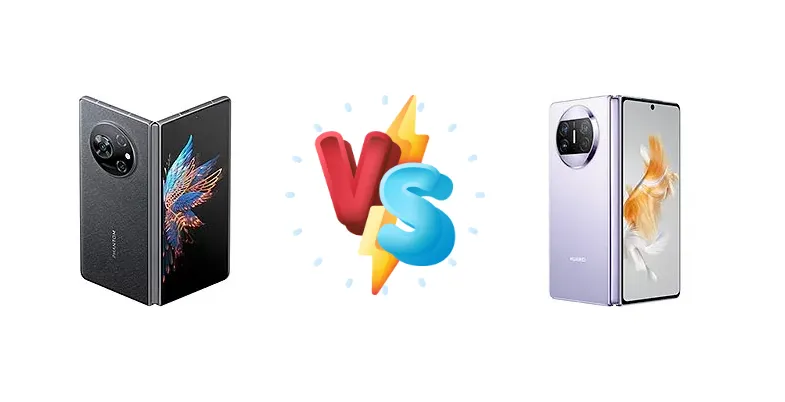
|
🏆 Quick Verdict
The Tecno Phantom V Fold boasts impressive battery life and a powerful chipset, while the Huawei Mate X3 shines with its significantly brighter display and faster wireless charging. Ultimately, the Mate X3 offers a more premium experience, but the Phantom V Fold provides excellent value.
| PHONES | ||
|---|---|---|
| Phone Names | Tecno Phantom V Fold | Huawei Mate X3 |
| Network | ||
|---|---|---|
| 2G bands | GSM 850 / 900 / 1800 / 1900 | GSM 850 / 900 / 1800 / 1900 |
| 3G bands | HSDPA 850 / 900 / 1700(AWS) / 1900 / 2100 | HSDPA 800 / 850 / 900 / 1700(AWS) / 1900 / 2100 |
| 4G bands | LTE | 1, 2, 3, 4, 5, 7, 8, 12, 17, 18, 19, 20, 26, 28, 34, 38, 39, 40, 41 |
| 5G bands | SA/NSA | - |
| Speed | HSPA, LTE, 5G | HSPA, LTE |
| Technology | GSM / HSPA / LTE / 5G | GSM / CDMA / HSPA / EVDO / LTE |
| - | CDMA2000 1xEV-DO | |
| Launch | ||
|---|---|---|
| Announced | 2023, February 28 | 2023, March 23 |
| Status | Available. Released 2023, April 12 | Available. Released 2023, April 08 |
| Body | ||
|---|---|---|
| Build | Glass front folded (Gorilla Glass Victus), plastic back, aluminum frame | Glass front, glass back or eco leather back, aluminum frame |
| Dimensions | Unfolded: 159.4 x 140.4 x 6.9 mmFolded: 159.4 x 72 x 14.2-14.5 mm | Unfolded: 156.9 x 141.5 x 5.3 mmFolded: 156.9 x 72.4 x 11.1 mm |
| SIM | Nano-SIM + Nano-SIM | Nano-SIM + Nano-SIM |
| Weight | 299 g (10.55 oz) | 239 g or 241 g (8.43 oz) |
| - | IPX8 dust/water resistant (up to 1.5m for 30 min) | |
| Display | ||
|---|---|---|
| Protection | - | Kunlun Glass (cover display only) |
| Resolution | 2000 x 2296 pixels (~388 ppi density) | 2224 x 2496 pixels (~426 ppi density) |
| Size | 7.85 inches, 196.9 cm2 (~88.0% screen-to-body ratio) | 7.85 inches, 197.5 cm2 (~88.9% screen-to-body ratio) |
| Type | Foldable LTPO AMOLED, 1B colors, 120Hz, 1100 nits (peak) | Foldable OLED, 1B colors, 120Hz |
| Cover display: LTPO AMOLED, 1B colors, 120Hz, 1100 nits (peak), Corning Gorilla Glass Victus 6.42 inches, 1080 x 2550 pixels, 431 PPI | Cover display: OLED, 120Hz, 6.4 inches, 1080 x 2504 pixels | |
| Platform | ||
|---|---|---|
| CPU | Octa-core (1x3.20 GHz Cortex-X2 & 3x2.85 GHz Cortex-A710 & 4x1.80 GHz Cortex-A510) | Octa-core (1x3.19 GHz Cortex-X2 & 3x2.75 GHz Cortex-A710 & 4x2.0 GHz Cortex-A510) |
| Chipset | Mediatek Dimensity 9000+ (4 nm) | Qualcomm SM8475 Snapdragon 8+ Gen 1 4G (4 nm) |
| GPU | Mali-G710 MC10 | Adreno 730 |
| OS | Android 13, HiOS 13 Fold | HarmonyOS 3.1 (China), EMUI 13.1 (Europe), no Google Play Services |
| Memory | ||
|---|---|---|
| Card slot | No | Nano Memory (uses shared SIM slot) |
| Internal | 256GB 12GB RAM, 512GB 12GB RAM | 256GB 12GB RAM, 512GB 12GB RAM, 1TB 12GB RAM |
| UFS 3.1 | UFS | |
| Main Camera | ||
|---|---|---|
| Features | Dual-LED flash, HDR, panorama | Laser AF, color spectrum sensor, LED flash, panorama, HDR |
| Single | 16 MP, f/2.5, (wide), 1/2.8", 1.12µm Cover camera: 32 MP, f/2.5, (wide), 1/2.8", 0.8µm | - |
| Triple | 50 MP, f/1.9, (wide), 1/1.3", 1.2µm, PDAF 50 MP, f/2.0, (telephoto), 1/2.8", 0.64µm, PDAF, 2x optical zoom 13 MP, f/2.2, 120˚ (ultrawide), 1/3.0", 1.12µm, PDAF | 50 MP, f/1.8, 23mm (wide), PDAF, OIS 12 MP, f/3.4, 125mm (periscope telephoto), PDAF, OIS, 5x optical zoom 13 MP, f/2.2, 13mm (ultrawide), AF |
| Video | 4K@30fps, 1080p@30/60fps | 4K@30/60fps, 1080p@30/60fps, gyro-EIS |
| Selfie camera | ||
|---|---|---|
| Features | - | HDR, panorama |
| Single | 16 MP, f/2.5, (wide), 1/2.8", 1.12µm Cover camera: 32 MP, f/2.5, (wide), 1/2.8", 0.8µm | 8 MP, f/2.4, (wide) Cover camera: 8 MP, f/2.4, (wide) |
| Video | 1080p@60fps | 4K@30fps, 1080p@30fps |
| Sound | ||
|---|---|---|
| 3.5mm jack | No | No |
| 35mm jack | No | No |
| Loudspeaker | Yes, with stereo speakers | Yes, with stereo speakers |
| Comms | ||
|---|---|---|
| Bluetooth | 5.2, A2DP, LE | 5.2, A2DP, LE |
| Infrared port | - | Yes |
| NFC | Yes | Yes |
| Positioning | GPS, GLONASS, GALILEO, BDS | GPS (L1+L5), GLONASS (B1I+B1c+B2a), BDS (B1I+B1c+B2a), GALILEO (E1+E5a), QZSS (L1+L5), NavIC |
| Radio | FM radio, recording | No |
| USB | USB Type-C, OTG | USB Type-C 3.1, DisplayPort 1.2, OTG |
| WLAN | Wi-Fi 802.11 a/b/g/n/ac, dual-band | Wi-Fi 802.11 a/b/g/n/ac/6, dual-band, Wi-Fi Direct |
| Features | ||
|---|---|---|
| Sensors | Fingerprint (side-mounted), accelerometer, gyro, proximity, compass | Fingerprint (side-mounted), accelerometer, gyro, proximity, compass, barometer, altimeter |
| - | BDS Satellite Message | |
| Battery | ||
|---|---|---|
| Charging | 45W wired, 40% in 15 min, 100% in 55 min | 66W wired 50W wireless 7.5W reverse wireless |
| Type | 5000 mAh | Market-dependent versions:· Li-Po 4800 mAh (Global)· Si/C Li-Ion 5060 mAh (China only) |
| Misc | ||
|---|---|---|
| Colors | Black, White | Black, White, Violet, Dark Green, Gold |
| Models | AD10 | ALT-AL00, ALT-L29 |
| Price | About 1030 EUR | About 1500 EUR |
| Tests | ||
|---|---|---|
| Battery life | Endurance rating 92h | Endurance rating 81h |
| Camera | Photo / Video | Photo / Video |
| Display | Contrast ratio: Infinite (nominal) | Contrast ratio: Infinite (nominal) |
| Loudspeaker | -24.3 LUFS (Very good) | -26.3 LUFS (Good) |
| Performance | AnTuTu: 999348 (v9) GeekBench: 3963 (v5.1), 3748 (v6) GFXBench: 45fps (ES 3.1 onscreen) | AnTuTu: 993592 (v9) GeekBench: 4283 (v5.5), 4512 (v6) GFXBench: 41fps (ES 3.1 onscreen) |
Tecno Phantom V Fold
- Exceptional battery life
- Powerful Dimensity 9000+ chipset
- Competitive pricing
- Fast wired charging
- Lower display brightness
- Camera details are unclear
- Potential software optimization concerns
Huawei Mate X3
- Brighter, more vibrant display
- Premium design and build quality
- Wireless and reverse wireless charging
- Reputable camera performance (expected)
- Higher price point
- Slightly shorter battery life
- 4G connectivity only
Display Comparison
The Huawei Mate X3 takes a clear lead in the display department. Its measured peak brightness of 926 nits is substantially higher than the Phantom V Fold's 492 nits, resulting in better outdoor visibility and a more vibrant viewing experience. Both devices claim an 'infinite' contrast ratio, a nominal value, but the Mate X3's brightness advantage is undeniable. The foldable nature of both screens introduces potential crease visibility, which should be considered.
Camera Comparison
Camera performance is difficult to definitively assess without detailed testing. Both devices are advertised as having 'Photo / Video' capabilities, but specifics like sensor sizes, aperture values, and video recording resolutions are missing. We anticipate the Mate X3, given Huawei's reputation for camera excellence, may offer slightly superior image quality, particularly in challenging lighting conditions. However, the Phantom V Fold's camera hardware is likely capable of producing competitive results.
Performance
Both phones utilize powerful chipsets – the Phantom V Fold with the Mediatek Dimensity 9000+ and the Mate X3 with the Snapdragon 8+ Gen 1. While both are based on a 4nm process, the Snapdragon generally holds a slight edge in overall performance and optimization. However, the Phantom V Fold's CPU configuration (1x3.20 GHz Cortex-X2) suggests strong single-core performance. Real-world performance will depend on software optimization and usage scenarios.
Battery Life
The Tecno Phantom V Fold dominates in battery life, boasting an impressive endurance rating of 92 hours compared to the Mate X3's 81 hours. This suggests significantly longer usage between charges. The Phantom V Fold also offers faster wired charging (45W vs 66W), though the Mate X3 compensates with wireless and reverse wireless charging capabilities.
Buying Guide
The Tecno Phantom V Fold is ideal for users prioritizing battery life and raw performance on a budget. The Huawei Mate X3 is best suited for those seeking a premium foldable experience with a stunning display, faster charging, and a more refined design, willing to pay a premium.