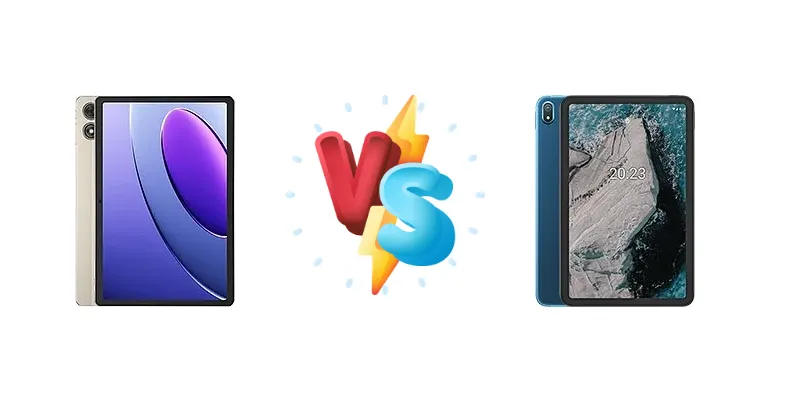
The tablet market has a new wave of affordable options, and the Tecno Megapad and Nokia T20 represent compelling choices for users seeking a larger screen experience without breaking the bank. Both tablets aim for the sub-$200 price point, but they take different approaches to achieving that affordability, particularly in their core processing and display technologies. This comparison dives deep into the specifications to determine which tablet delivers the best overall experience.
🏆 Quick Verdict
For most users, the Tecno Megapad emerges as the stronger choice. Its Mediatek Helio G80 chipset, while not a flagship performer, offers a noticeable performance edge over the Nokia T20’s Unisoc T610, translating to smoother multitasking and gaming. While the Nokia T20 boasts a brighter display, the performance difference is more impactful for everyday use.
| Network |
|---|
| 2G bands | GSM 850 / 900 / 1800 / 1900 | GSM 850 / 900 / 1800 / 1900 |
| 3G bands | HSDPA 900 / 2100 | HSDPA 850 / 900 / 1700(AWS) / 1900 / 2100 - US, LATAM |
| 4G bands | LTE | 1, 2, 3, 4, 5, 7, 8, 12, 13, 17, 20, 28, 40, 66 - US, LATAM |
| Speed | HSPA, LTE - cellular model only | HSPA, LTE Cat4 150/50 Mbps - cellular model only |
| Technology | GSM / HSPA / LTE | GSM / HSPA / LTE |
| | - | 1, 3, 5, 7, 8, 20, 28, 38, 40, 41 - International |
| Launch |
|---|
| Announced | 2024, October | 2021, October 06 |
| Status | Available. Released 2024, November | Available. Released 2021, November 02 |
| Body |
|---|
| Build | - | Glass front, aluminum back |
| Dimensions | 240.7 x 159.5 x 7.4 mm (9.48 x 6.28 x 0.29 in) | 247.6 x 157.5 x 7.8 mm (9.75 x 6.20 x 0.31 in) |
| SIM | Nano-SIM (cellular model only) | Nano-SIM (cellular model only) |
| Weight | 447 g (15.77 oz) | 465 g (Wi-Fi), 470 g (LTE) (1.03 lb) |
| | - | Splash resistant |
| Display |
|---|
| Protection | - | Scratch-resistant glass |
| Resolution | 800 x 1280 pixels, 16:10 ratio (~149 ppi density) | 1200 x 2000 pixels, 5:3 ratio (~224 ppi density) |
| Size | 10.1 inches, 295.8 cm2 (~77.0% screen-to-body ratio) | 10.4 inches, 307.9 cm2 (~78.9% screen-to-body ratio) |
| Type | IPS LCD, 450 nits | IPS LCD, 400 nits (typ) |
| Platform |
|---|
| CPU | Octa-core (2x2.0 GHz Cortex-A75 & 6x1.8 GHz Cortex-A55) | Octa-core (2x1.8 GHz Cortex-A75 & 6x1.8 GHz Cortex-A55) |
| Chipset | Mediatek Helio G80 (12 nm) | Unisoc T610 (12 nm) |
| GPU | Mali-G52 MC2 | Mali-G52 MP2 |
| OS | Android 14 | Android 11, upgradable to Android 13 |
| Memory |
|---|
| Card slot | microSDXC | microSDXC (dedicated slot) |
| Internal | 128GB 4GB RAM, 256GB 4GB RAM | 32GB 3GB RAM, 64GB 4GB RAM |
| | - | eMMC 5.1 |
| Main Camera |
|---|
| Features | LED flash | LED flash |
| Single | 13 MP | 8 MP, AF |
| Video | 1080p@30fps | 1080p@30fps |
| Selfie camera |
|---|
| Single | 5 MP | 5 MP |
| Video | Yes | Yes |
| Sound |
|---|
| 3.5mm jack | - | Yes |
| 35mm jack | Yes | Yes |
| Loudspeaker | Yes, with stereo speakers | Yes, with stereo speakers |
| Comms |
|---|
| Bluetooth | 5.1, A2DP, LE | 5.0, A2DP, LE |
| NFC | No | No |
| Positioning | Unspecified | GPS - cellular model only |
| Radio | Unspecified | FM radio |
| USB | USB Type-C | USB Type-C 2.0 |
| WLAN | Wi-Fi 802.11 a/b/g/n/ac, dual-band | Wi-Fi 802.11 a/b/g/n/ac, dual-band |
| Features |
|---|
| Sensors | Accelerometer | Accelerometer |
| Battery |
|---|
| Charging | 18W wired | 15W wired |
| Type | 7000 mAh | Li-Po 8200 mAh |
| Misc |
|---|
| Colors | Champagne Gold, Space Grey | Deep Ocean |
| Models | - | TA-1397, TA-1394, TA-1392 |
| Price | - | About 200 EUR |
| SAR | - | 1.34 W/kg (body) |
| SAR EU | - | 1.35 W/kg (body) |
Tecno Megapad
- Faster processor (Helio G80)
- Faster charging (18W)
- Potentially better gaming performance
- Display specifications unknown
- Likely lower display brightness than Nokia T20
Nokia T20
- Brighter display (422 nits)
- Higher contrast ratio (1786:1)
- Nokia’s reputation for software updates
- Slower processor (Unisoc T610)
- Slower charging (15W)
- Potentially less responsive user experience
Display Comparison
The Nokia T20 distinguishes itself with a measured peak brightness of 422 nits and a 1786:1 contrast ratio, suggesting a more vibrant and visible display, especially in challenging lighting conditions. The Tecno Megapad’s display specifications are currently unavailable, but given its price point, it likely utilizes an IPS LCD panel with lower peak brightness. The Nokia T20’s higher contrast ratio will result in deeper blacks and a more immersive viewing experience. However, without knowing the Tecno Megapad’s panel technology and color accuracy, it’s difficult to assess the overall visual quality beyond brightness.
Camera Comparison
Neither tablet is positioned as a photography powerhouse, and detailed camera specifications are limited. It’s safe to assume both feature basic camera setups suitable for casual snapshots and video calls. Without specific sensor size or aperture information, a meaningful comparison is impossible. Focusing on camera performance in this segment is often misleading, as image quality is heavily reliant on software processing, which is often a weak point in budget tablets.
Performance
The core difference lies in the chipsets. The Tecno Megapad utilizes the Mediatek Helio G80, featuring a CPU configuration of 2x2.0 GHz Cortex-A75 cores and 6x1.8 GHz Cortex-A55 cores. The Nokia T20, conversely, is powered by the Unisoc T610, with a CPU layout of 2x1.8 GHz Cortex-A75 cores and 6x1.8 GHz Cortex-A55 cores. While both employ the same core architecture, the Helio G80’s higher clock speed on the performance cores provides a tangible advantage in CPU-intensive tasks. This translates to faster app loading times and smoother multitasking. The G80 also benefits from a more mature driver ecosystem, potentially leading to better optimization. Both chipsets are 12nm, so thermal efficiency differences are likely minimal.
Battery Life
The Tecno Megapad supports 18W wired charging, while the Nokia T20 is limited to 15W. While battery capacity isn’t specified for either device, the faster charging speed of the Tecno Megapad offers a convenience advantage. A 3W difference may not seem significant, but it can translate to a noticeably quicker top-up time, especially for users who frequently use their tablets on the go. Without knowing the battery capacity, it’s difficult to predict real-world battery life, but the faster charging could offset a slightly smaller battery.
Buying Guide
Buy the Tecno Megapad if you prioritize responsiveness and the ability to handle moderately demanding apps and games. It’s ideal for users who want a tablet for streaming, light gaming, and productivity tasks. Buy the Nokia T20 if display brightness is paramount, particularly if you frequently use the tablet outdoors or in brightly lit environments, and your usage is primarily focused on media consumption and basic tasks where raw processing power isn't critical.
Frequently Asked Questions
❓ Will the Unisoc T610 in the Nokia T20 struggle with demanding apps like video editors or resource-intensive games?
The Unisoc T610 is an entry-level chipset. While it can handle basic tasks and light gaming, it will likely exhibit noticeable slowdowns and lag when running demanding applications. Video editing and graphically intensive games will likely be a frustrating experience on the Nokia T20.
❓ How much of a real-world difference will the 3W charging speed difference make between the Tecno Megapad and Nokia T20?
While 3W doesn't sound like much, it can accumulate over time. The Tecno Megapad's 18W charging will likely shave off around 15-30 minutes from a full 0-100% charge compared to the Nokia T20's 15W charging, depending on battery capacity. This is particularly noticeable for quick top-ups.
❓ Is the Nokia T20 a good choice for reading ebooks or browsing the web?
Yes, the Nokia T20's brighter display and higher contrast ratio make it well-suited for reading ebooks and browsing the web, especially in well-lit environments. However, the slower processor might introduce slight delays when loading complex webpages.