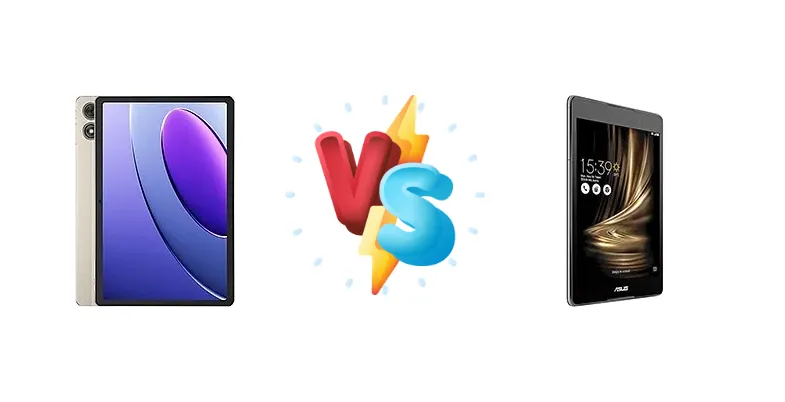
The tablet market offers a compelling alternative to smartphones for media consumption and light productivity. We pit the Tecno Megapad, powered by the Mediatek Helio G80, against the older but still relevant Asus Zenpad 3s 8.0, featuring the Qualcomm Snapdragon 652. This comparison focuses on how these chipsets translate into real-world performance and value for the user.
🏆 Quick Verdict
For the average user prioritizing responsiveness and future-proofing, the Tecno Megapad emerges as the better choice. Its Helio G80 chipset, built on a more modern 12nm process, delivers superior CPU and GPU performance compared to the aging Snapdragon 652 in the Asus Zenpad 3s 8.0, despite the Asus's slightly more refined software history.
| Network |
|---|
| 2G bands | GSM 850 / 900 / 1800 / 1900 | GSM 850 / 900 / 1800 / 1900 |
| 3G bands | HSDPA 900 / 2100 | HSDPA 850 / 900 / 2100 |
| 4G bands | LTE | LTE |
| Speed | HSPA, LTE - cellular model only | HSPA 42.2/5.76 Mbps, LTE (2CA) Cat6 300/50 Mbps |
| Technology | GSM / HSPA / LTE | GSM / HSPA / LTE |
| Launch |
|---|
| Announced | 2024, October | 2017, May. Released 2017, November |
| Status | Available. Released 2024, November | Discontinued |
| Body |
|---|
| Dimensions | 240.7 x 159.5 x 7.4 mm (9.48 x 6.28 x 0.29 in) | 6.9 mm thickness |
| SIM | Nano-SIM (cellular model only) | Micro-SIM |
| Weight | 447 g (15.77 oz) | - |
| Display |
|---|
| Resolution | 800 x 1280 pixels, 16:10 ratio (~149 ppi density) | 1536 x 2048 pixels, 4:3 ratio (~324 ppi density) |
| Size | 10.1 inches, 295.8 cm2 (~77.0% screen-to-body ratio) | 7.9 inches, 193.3 cm2 |
| Type | IPS LCD, 450 nits | IPS LCD |
| Platform |
|---|
| CPU | Octa-core (2x2.0 GHz Cortex-A75 & 6x1.8 GHz Cortex-A55) | Octa-core (4x1.8 GHz Cortex-A72 & 4x1.4 GHz Cortex-A53) |
| Chipset | Mediatek Helio G80 (12 nm) | Qualcomm MSM8976 Snapdragon 652 (28 nm) |
| GPU | Mali-G52 MC2 | Adreno 510 |
| OS | Android 14 | Android 7.1 (Nougat) |
| Memory |
|---|
| Card slot | microSDXC | microSDXC (dedicated slot) |
| Internal | 128GB 4GB RAM, 256GB 4GB RAM | 32GB 3GB RAM, 64GB 4GB RAM |
| | - | eMMC 5.1 |
| Main Camera |
|---|
| Features | LED flash | - |
| Single | 13 MP | 13 MP, f/2.0, AF |
| Video | 1080p@30fps | 1080p@30fps |
| Selfie camera |
|---|
| Single | 5 MP | 5 MP |
| Video | Yes | - |
| Sound |
|---|
| 3.5mm jack | - | Yes |
| 35mm jack | Yes | Yes |
| Loudspeaker | Yes, with stereo speakers | Yes, with stereo speakers |
| | - | 24-bit/192kHz audio |
| Comms |
|---|
| Bluetooth | 5.1, A2DP, LE | 4.1, A2DP, LE, aptX |
| NFC | No | No |
| Positioning | Unspecified | GPS, GLONASS |
| Radio | Unspecified | No |
| USB | USB Type-C | USB Type-C |
| WLAN | Wi-Fi 802.11 a/b/g/n/ac, dual-band | Wi-Fi 802.11 a/b/g/n/ac, dual-band, Wi-Fi Direct |
| Features |
|---|
| Sensors | Accelerometer | Accelerometer, gyro, proximity, compass |
| Battery |
|---|
| Charging | 18W wired | - |
| Type | 7000 mAh | Li-Ion 4680 mAh, non-removable (18 Wh) |
| Misc |
|---|
| Colors | Champagne Gold, Space Grey | Black |
| Price | - | About 250 EUR |
Tecno Megapad
- More powerful and efficient Helio G80 chipset
- Faster 18W wired charging
- Likely benefits from newer software optimizations
- Display specifications are unknown
- Brand recognition may be lower than Asus
Asus Zenpad 3s 8.0 Z582KL
- Asus has a history of good software support
- Potentially more compact form factor
- Established brand reputation
- Older and less efficient Snapdragon 652 chipset
- Slower charging speeds (likely)
- Performance limitations in demanding tasks
Display Comparison
Unfortunately, detailed display specifications are unavailable for both devices. However, given the Zenpad 3s 8.0's age, it likely utilizes an IPS LCD panel. The Megapad, being a more recent device, *may* incorporate improvements in color accuracy and viewing angles. Bezels are likely to be more substantial on the Zenpad 3s 8.0 due to its older design. Without specific nit ratings, it's difficult to assess brightness, but newer tablets generally offer better outdoor visibility.
Camera Comparison
Camera details are limited. Given the market segment, neither tablet is expected to excel in photography. The focus should be on basic image capture for casual use. Without sensor size or aperture information, a direct comparison is impossible. However, the Megapad, being newer, likely benefits from improved image processing algorithms, potentially leading to slightly better image quality in favorable lighting conditions. We can assume both devices will feature basic camera capabilities suitable for quick snapshots.
Performance
The core difference lies in the chipsets. The Tecno Megapad’s Mediatek Helio G80 (12nm) features an octa-core configuration with 2x2.0 GHz Cortex-A75 and 6x1.8 GHz Cortex-A55 cores. This contrasts with the Asus Zenpad 3s 8.0’s Qualcomm Snapdragon 652 (28nm) with 4x1.8 GHz Cortex-A72 and 4x1.4 GHz Cortex-A53 cores. The Helio G80 benefits from a smaller manufacturing process (12nm vs 28nm), leading to improved power efficiency and reduced heat generation. The Cortex-A75 cores in the G80 also offer a significant architectural advantage over the A72 cores in the 652, resulting in faster single-core performance. This translates to snappier app launches and smoother multitasking. While both are octa-core, the G80’s architecture provides a clear performance edge.
Battery Life
Battery capacity is unspecified for both devices. However, the Tecno Megapad’s 18W wired charging offers a faster charging experience than what was typical for the Zenpad 3s 8.0. The Snapdragon 652’s less efficient 28nm process likely results in higher power consumption compared to the Helio G80’s 12nm process. This means the Megapad could potentially offer comparable or even better battery life despite having a similar or smaller battery capacity, and will recharge significantly faster.
Buying Guide
Buy the Tecno Megapad if you need a tablet for everyday tasks like browsing, streaming video, and casual gaming, and value a more responsive experience. Its newer chipset provides a noticeable performance boost. Buy the Asus Zenpad 3s 8.0 if you prioritize a potentially more polished software experience (based on Asus's historical software support) and are willing to accept a performance compromise, particularly in demanding applications. It may also appeal to those seeking a smaller form factor.
Frequently Asked Questions
❓ Will the Tecno Megapad handle demanding games like PUBG Mobile smoothly?
The Mediatek Helio G80 is capable of running PUBG Mobile, but you'll likely need to use medium graphics settings for a consistently smooth experience. The Snapdragon 652 in the Zenpad 3s 8.0 will struggle with higher settings and may exhibit noticeable frame drops.
❓ Is the software experience on the Tecno Megapad significantly different from Asus's ZenUI?
Tecno's HiOS is based on Android, but it typically includes more pre-installed apps and a different aesthetic compared to Asus's ZenUI. Asus has a reputation for relatively clean software with useful additions, while Tecno's software can be more heavily customized. User preference will play a large role here.
❓ How much of a performance difference will I notice in everyday tasks like browsing and video streaming?
You'll likely notice a significant improvement in responsiveness with the Tecno Megapad. App launch times will be faster, multitasking will be smoother, and web pages will load more quickly due to the Helio G80's superior CPU performance.