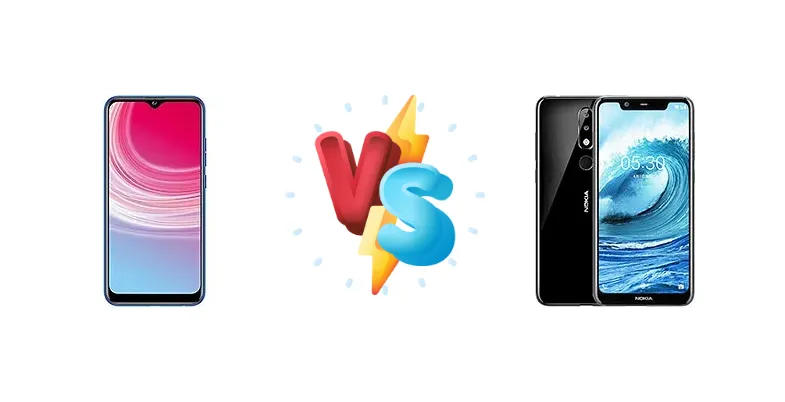
The Tecno Camon i4 and Nokia 5.1 Plus (also known as the Nokia X5) represent distinct approaches to the budget smartphone market. The Camon i4 prioritizes affordability, while the Nokia 5.1 Plus aims for a more balanced experience with a more powerful chipset. This comparison dissects their key differences to help you determine which device best suits your needs.
🏆 Quick Verdict
For the average user prioritizing responsiveness and multitasking, the Nokia 5.1 Plus is the clear winner. Its Helio P60 chipset, featuring Cortex-A73 cores, delivers significantly better performance than the Camon i4’s Helio A22. However, the Camon i4 remains a viable option for those on an extremely tight budget and with basic smartphone needs.
| Network |
|---|
| 2G bands | GSM 850 / 900 / 1800 / 1900 | GSM 850 / 900 / 1800 / 1900 |
| 3G bands | HSDPA 2100 | HSDPA 850 / 900 / 1900 / 2100 |
| 4G bands | LTE | 1, 2, 3, 4, 5, 7, 8, 12, 13, 17, 28, 38, 40, 66 - USA |
| Speed | HSPA, LTE | HSPA 42.2/5.76 Mbps, LTE Cat4 150/50 Mbps |
| Technology | GSM / HSPA / LTE | GSM / CDMA / HSPA / LTE |
| | - | 1, 3, 5, 8, 40, 41 - India |
| Launch |
|---|
| Announced | 2019, April 03. Released 2019, April 03 | 2018, July 18. Released 2018, December 05 |
| Status | Discontinued | Discontinued |
| Body |
|---|
| Build | - | Glass front, glass back, plastic frame |
| Dimensions | 156.9 x 75.8 x 8 mm (6.18 x 2.98 x 0.31 in) | 149.5 x 72 x 8.1 mm (5.89 x 2.83 x 0.32 in) |
| SIM | Dual SIM | Nano-SIM + Nano-SIM |
| Weight | 140 g (4.94 oz) | 160 g (5.64 oz) |
| Display |
|---|
| Resolution | 720 x 1520 pixels, 19:9 ratio (~271 ppi density) | 720 x 1520 pixels, 19:9 ratio (~287 ppi density) |
| Size | 6.2 inches, 95.9 cm2 (~80.7% screen-to-body ratio) | 5.86 inches, 85.7 cm2 (~79.6% screen-to-body ratio) |
| Type | IPS LCD | IPS LCD |
| Platform |
|---|
| CPU | Quad-core 2.0 GHz Cortex-A53 | Octa-core (4x1.8 GHz Cortex-A73 & 4x1.8 GHz Cortex-A53) - GlobalOcta-core (4x2.0 GHz Cortex-A73 & 4x2.0 GHz Cortex-A53) - China |
| Chipset | Mediatek MT6761 Helio A22 (12 nm) | Mediatek MT6771 Helio P60 (12 nm) |
| GPU | PowerVR GE8320 | Mali-G72 MP3 |
| OS | Android 9.0 (Pie) | Android 8.1 (Oreo), upgradable to Android 10, Android One |
| Memory |
|---|
| Card slot | microSDXC (dedicated slot) | microSDXC (uses shared SIM slot) |
| Internal | 32GB 2GB RAM, 32GB 3GB RAM, 64GB 4GB RAM | 32GB 3GB RAM, 64GB 4GB RAM, 64GB 6GB RAM |
| | - | eMMC 5.1 |
| Main Camera |
|---|
| Dual | - | 13 MP, f/2.0, PDAF
Auxiliary lens |
| Features | Quad-LED flash, HDR | LED flash, HDR, panorama |
| Triple | 13 MP, f/1.8, AF
8 MP
2 MP | - |
| Video | 1080p@30fps | 1080p@30fps |
| Selfie camera |
|---|
| Single | 16 MP | 8 MP, f/2.2, 26mm (wide) |
| Video | Yes | 1080p@30fps |
| Sound |
|---|
| 3.5mm jack | - | Yes |
| 35mm jack | Yes | Yes |
| Loudspeaker | Yes | Yes |
| Comms |
|---|
| Bluetooth | 5.0, A2DP, LE | 4.2, A2DP, LE |
| NFC | No | No |
| Positioning | GPS | GPS, GLONASS, BDS, GALILEO |
| Radio | FM radio | FM radio |
| USB | microUSB 2.0 | USB Type-C 2.0, OTG |
| WLAN | Wi-Fi 802.11 b/g/n | Wi-Fi 802.11 a/b/g/n/ac, dual-band, Wi-Fi Direct |
| Features |
|---|
| Sensors | Fingerprint (rear-mounted), accelerometer, gyro, proximity, compass | Fingerprint (rear-mounted), accelerometer, gyro, proximity, compass |
| Battery |
|---|
| Type | 3500 mAh | Li-Ion 3060 mAh, non-removable |
| Misc |
|---|
| Colors | Aqua Blue, Champagne Gold, Midnight Black, Nebula Black | Night black, Glacier white, Baltic sea blue |
| Models | - | TA-1120, TA-1105, TA-1102 |
| Price | About 150 EUR | About 190 EUR |
| SAR | - | 1.10 W/kg (head) |
| SAR EU | - | 0.78 W/kg (head) 1.89 W/kg (body) |
| Tests |
|---|
| Performance | - |
AnTuTu: 119428 (v7)
GFXBench: 7.4fps (ES 3.1 onscreen) |
Tecno Camon i4
- Extremely affordable price point
- Functional for basic smartphone tasks
- Potentially longer battery life during minimal use
- Significantly slower performance
- Limited multitasking capabilities
- Inferior camera image processing
Nokia 5.1 Plus (Nokia X5)
- Much faster and more responsive performance
- Better multitasking and app handling
- Superior camera image processing capabilities
- Higher price compared to the Tecno Camon i4
- Potentially slightly shorter battery life under heavy load
- May be harder to find new in 2024
Display Comparison
Neither device boasts a standout display. Both likely utilize LCD panels, common in this price bracket. However, detailed display specs (resolution, brightness) are missing. The Nokia 5.1 Plus’s advantage lies in its potential for better image processing due to the more powerful chipset driving the display pipeline. Bezels are likely comparable, reflecting the design trends of their release periods.
Camera Comparison
Camera details are sparse, but the chipset difference hints at superior image processing capabilities on the Nokia 5.1 Plus. While both phones likely feature a primary camera, the P60’s ISP (Image Signal Processor) will be more advanced, resulting in better dynamic range, noise reduction, and overall image quality. The presence of a more powerful GPU on the P60 also aids in post-processing tasks. Without specific sensor details, it’s difficult to make definitive claims, but the Nokia 5.1 Plus is expected to deliver more consistently pleasing photos.
Performance
The performance gap is the most significant differentiator. The Nokia 5.1 Plus’s Mediatek Helio P60, with its octa-core configuration (4x1.8 GHz Cortex-A73 & 4x1.8 GHz Cortex-A53), offers a substantial upgrade over the Tecno Camon i4’s quad-core 2.0 GHz Cortex-A53-based Helio A22. The Cortex-A73 cores in the P60 provide significantly better single-core performance, crucial for app launch speeds and general responsiveness. The P60’s 12nm process node is identical to the A22, meaning power efficiency differences will be minimal, but the P60’s architectural advantages will shine through in sustained workloads. The Nokia 5.1 Plus will handle multitasking and moderately demanding apps with far greater ease.
Battery Life
Battery capacity details are missing for both devices. However, the Helio P60 in the Nokia 5.1 Plus, despite being more powerful, is also relatively efficient. The A22 in the Camon i4 will likely offer slightly better battery life during *very* light usage, but the P60’s ability to complete tasks faster means less time spent with the screen on, potentially offsetting the power difference. Charging wattage is also unknown, making it difficult to assess 0-100% charging times.
Buying Guide
Buy the Tecno Camon i4 if you need a functional smartphone for essential tasks like calls, messaging, and light social media use, and your budget is extremely limited. Buy the Nokia 5.1 Plus (Nokia X5) if you prefer a smoother, more responsive experience for multitasking, moderate gaming, and a generally more capable device, even if it means spending a bit more.
Frequently Asked Questions
❓ Will the Nokia 5.1 Plus handle popular games like PUBG Mobile?
The Nokia 5.1 Plus, with its Helio P60, can run PUBG Mobile, but likely at lower graphics settings and frame rates to maintain a playable experience. The Helio A22 in the Camon i4 would struggle significantly with PUBG Mobile, offering a poor gaming experience.
❓ Is the Nokia 5.1 Plus still receiving software updates?
As a Nokia device, the 5.1 Plus was part of the Android One program, promising regular security updates. However, support may be limited or ended depending on the region and Nokia’s current update schedule. Check Nokia’s official website for the latest information.
❓ How much storage does each phone have, and is it expandable?
Storage details are missing. However, both phones likely offered expandable storage via microSD card, a common feature in this price segment. Check specific model variants for exact storage configurations.