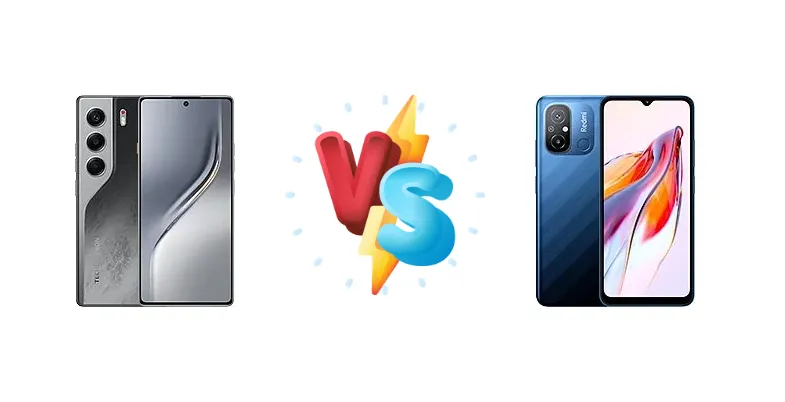
The Tecno Camon 40 and Xiaomi Redmi 12C represent two compelling options in the ultra-competitive budget smartphone space. While both aim to deliver essential smartphone functionality at an accessible price, they take different approaches to achieving this. The Camon 40 prioritizes processing power and charging speed, while the Redmi 12C focuses on affordability and a familiar user experience. This comparison dissects their key differences to determine which device best suits your needs.
🏆 Quick Verdict
For users prioritizing performance and faster charging, the Tecno Camon 40 is the clear winner. Its Helio G100 Ultimate chipset and 45W charging significantly outperform the Redmi 12C’s Helio G85 and 10W charging. However, the Redmi 12C remains a viable option for those on a tighter budget who prioritize simplicity and brand recognition.
| Network |
|---|
| 2G bands | GSM 850 / 900 / 1800 / 1900 | GSM 850 / 900 / 1800 / 1900 |
| 3G bands | HSDPA 850 / 900 / 1700(AWS) / 1900 / 2100 | HSDPA 850 / 900 / 2100 |
| 4G bands | LTE | 1, 3, 5, 7, 8, 20, 28, 38, 40, 41 - International |
| Speed | HSPA, LTE | HSPA, LTE |
| Technology | GSM / HSPA / LTE | GSM / CDMA / HSPA / EVDO / LTE |
| | - | CDMA2000 1xEV-DO |
| Launch |
|---|
| Announced | 2025, March 03 | 2022, December 31 |
| Status | Available. Released 2025, May | Available. Released 2023, January 01 |
| Body |
|---|
| Dimensions | 164.1 x 74.6 x 7.3 mm (6.46 x 2.94 x 0.29 in) | 168.8 x 76.4 x 8.8 mm (6.65 x 3.01 x 0.35 in) |
| SIM | Nano-SIM + Nano-SIM | Nano-SIM + Nano-SIM |
| Weight | 177.2 g (6.24 oz) | 192 g (6.77 oz) |
| Display |
|---|
| Protection | Panda King Glass | - |
| Resolution | 1080 x 2436 pixels (~393 ppi density) | 720 x 1650 pixels (~268 ppi density) |
| Size | 6.78 inches, 109.9 cm2 (~89.8% screen-to-body ratio) | 6.71 inches, 106.5 cm2 (~82.6% screen-to-body ratio) |
| Type | AMOLED, 120Hz | IPS LCD, 500 nits (typ) |
| Platform |
|---|
| CPU | Octa-core (2x2.2 GHz Cortex-A76 & 6x2.0 GHz Cortex-A55) | Octa-core (2x2.0 GHz Cortex-A75 & 6x1.8 GHz Cortex-A55) |
| Chipset | Mediatek Helio G100 Ultimate (6 nm) | Mediatek MT6769Z Helio G85 (12 nm) |
| GPU | Mali-G57 MC2 | Mali-G52 MC2 |
| OS | Android 15, up to 3 major Android upgrades, HIOS 15 | Android 12, MIUI 13 |
| Memory |
|---|
| Card slot | Unspecified | microSDXC (dedicated slot) |
| Internal | 128GB 8GB RAM, 128GB 12GB RAM, 256GB 8GB RAM, 256GB 12GB RAM | 32GB 2GB RAM, 32GB 3GB RAM, 32GB 4GB RAM, 64GB 3GB RAM, 64GB 4GB RAM, 128GB 3GB RAM, 128GB 4GB RAM, 128GB 6GB RAM |
| | - | eMMC 5.1 |
| Main Camera |
|---|
| Dual | 50 MP, f/1.9, 23mm (wide), 1/1.56", 1.0µm, PDAF, OIS
8 MP, (ultrawide) | 50 MP, (wide), PDAF
0.08 MP (depth) |
| Features | Dual-LED flash, HDR, panorama | LED flash, HDR |
| Single | - | 50 MP, f/1.8, (wide), 1/2.76", PDAF
Auxiliary lens |
| Video | Yes | 1080p@30fps |
| Selfie camera |
|---|
| Single | 32 MP, (wide) | 5 MP, f/2.2, (wide) |
| Video | Yes | 1080p@30fps |
| Sound |
|---|
| 3.5mm jack | - | Yes |
| 35mm jack | No | Yes |
| Loudspeaker | Yes, with stereo speakers | Yes |
| Comms |
|---|
| Bluetooth | Yes | 5.1, A2DP, LE |
| Infrared port | Yes | - |
| NFC | Yes | Yes (market/region dependent) |
| Positioning | GPS | GPS, GLONASS, BDS, GALILEO |
| Radio | FM radio | FM radio |
| USB | USB Type-C 2.0, OTG | microUSB 2.0 |
| WLAN | Yes | Wi-Fi 802.11 a/b/g/n/ac, dual-band, Wi-Fi Direct |
| Features |
|---|
| Sensors | Fingerprint (under display, optical), accelerometer, gyro, proximity, compass | Fingerprint (rear-mounted), accelerometer |
| | - | Virtual proximity sensing |
| Battery |
|---|
| Charging | 45W wired, 50% in 23 min, 100% in 43 min | 10W wired |
| Type | 5200 mAh | Li-Po 5000 mAh |
| Misc |
|---|
| Colors | Emerald Lake Green, Galaxy Black, Glacier White, Emerald Glow Green | Graphite Gray, Ocean Blue, Mint Green, Lavender Purple |
| Models | CM5 | 22120RN86G, 22120RN86I, 22126RN91Y, 2212ARNC4L |
| Price | - | £ 132.99 / € 107.41 |
| SAR | - | 1.08 W/kg (head) 0.64 W/kg (body) |
| SAR EU | - | 0.98 W/kg (head) 0.99 W/kg (body) |
Tecno Camon 40
- Significantly faster charging (45W)
- More powerful processor (Helio G100 Ultimate)
- Potentially better thermal management due to 6nm process
- Likely higher price point
- May lack features found in more expensive phones
Xiaomi Redmi 12C
- More affordable price
- Familiar Xiaomi ecosystem
- Simple and user-friendly interface
- Slow charging (10W)
- Less powerful processor (Helio G85)
- Potentially noticeable performance limitations with demanding apps
Display Comparison
Neither device boasts a standout display. Both likely utilize LCD panels, common in this price bracket. However, the focus here is on the underlying processing power impacting the user experience *with* the display. While specific display specs are missing, the Camon 40’s more powerful chipset will likely translate to smoother scrolling and faster app loading times, enhancing the perceived visual experience.
Camera Comparison
Without detailed camera specifications, a direct comparison is difficult. However, it’s reasonable to assume both phones feature basic camera setups geared towards casual photography. The Redmi 12C is known to include a 50MP main sensor, while the Camon 40’s sensor resolution is unknown. The more powerful ISP (Image Signal Processor) within the Helio G100 Ultimate could potentially offer better image processing capabilities, leading to improved dynamic range and noise reduction in the Camon 40. The presence of a more powerful chipset also allows for faster image capture and processing speeds.
Performance
The Tecno Camon 40’s Mediatek Helio G100 Ultimate (6nm) represents a significant leap over the Redmi 12C’s Helio G85 (12nm). The 6nm process node is inherently more efficient, leading to better thermal management and potentially sustained performance under load. The Camon 40’s CPU configuration – 2x2.2 GHz Cortex-A76 & 6x2.0 GHz Cortex-A55 – also offers a performance advantage over the Redmi 12C’s 2x2.0 GHz Cortex-A75 & 6x1.8 GHz Cortex-A55. The Cortex-A76 cores in the Camon 40 are a generation newer and more capable than the A75 cores in the Redmi 12C, resulting in faster single-core performance. This translates to snappier app launches and a more responsive user interface.
Battery Life
The Redmi 12C’s 10W charging is a significant drawback compared to the Tecno Camon 40’s 45W wired charging. The Camon 40 can reach 50% charge in just 23 minutes and 100% in 43 minutes, a substantial time saving. While battery capacity isn’t specified for either device, the faster charging of the Camon 40 mitigates the impact of a potentially smaller battery. Users who frequently find themselves needing to top up their phone will greatly benefit from the Camon 40’s charging speed.
Buying Guide
Buy the Tecno Camon 40 if you need a phone capable of handling more demanding apps and games, and if minimizing charging wait times is crucial. This phone is ideal for users who frequently multitask or enjoy mobile gaming. Buy the Xiaomi Redmi 12C if you prefer a simple, reliable smartphone experience with a well-established ecosystem, and if your usage primarily revolves around basic communication and light social media browsing. It’s the better choice for first-time smartphone users or those seeking maximum value for their money.
Frequently Asked Questions
❓ Will the Tecno Camon 40 handle demanding games like PUBG Mobile smoothly?
The Helio G100 Ultimate chipset in the Camon 40 is a significant upgrade over the G85, offering a better chance of running PUBG Mobile at medium settings with playable frame rates. However, don't expect flagship-level performance; optimization and settings adjustments will be key.
❓ Is the 10W charging on the Redmi 12C realistically usable for someone who uses their phone heavily throughout the day?
10W charging is quite slow by today's standards. For heavy users, the Redmi 12C will require overnight charging or frequent top-ups throughout the day. It's best suited for users who don't mind planning their charging around their usage.
❓ Does the Tecno Camon 40 support any form of fast charging protocols beyond its 45W wired charging?
Information on additional fast charging protocol support (like Power Delivery or Quick Charge) is currently unavailable. However, given its 45W capability, it's likely to support at least some form of fast charging standard for optimal performance with compatible chargers.