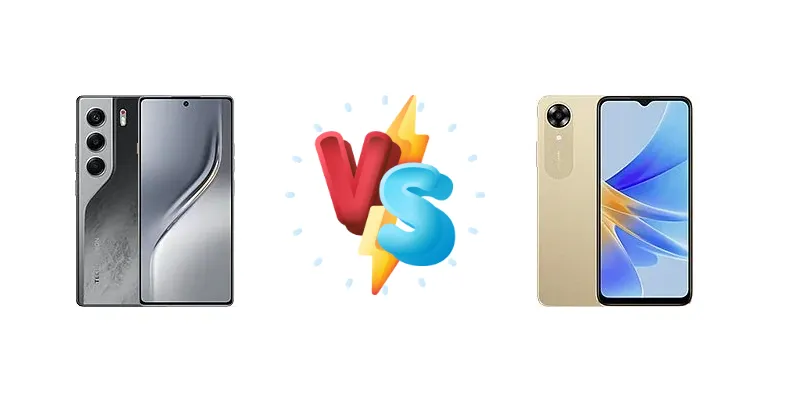
The Tecno Camon 40 and Oppo A17k represent compelling options in the ultra-budget smartphone segment. While both aim to deliver essential smartphone functionality at an accessible price, they diverge significantly in their internal hardware, particularly in their chipsets and charging capabilities. This comparison dissects these differences to determine which device offers the best value for your money.
🏆 Quick Verdict
For the average user prioritizing responsiveness and faster charging, the Tecno Camon 40 is the clear winner. Its Mediatek Helio G100 Ultimate chipset, built on a more efficient 6nm process, provides a noticeable performance advantage over the Oppo A17k’s Helio G35. The 45W charging further solidifies its lead, offering significantly quicker top-ups.
| Network |
|---|
| 2G bands | GSM 850 / 900 / 1800 / 1900 | GSM 850 / 900 / 1800 / 1900 |
| 3G bands | HSDPA 850 / 900 / 1700(AWS) / 1900 / 2100 | HSDPA 850 / 900 / 2100 |
| 4G bands | LTE | 1, 3, 5, 8, 38, 40, 41 |
| Speed | HSPA, LTE | HSPA, LTE |
| Technology | GSM / HSPA / LTE | GSM / HSPA / LTE |
| Launch |
|---|
| Announced | 2025, March 03 | 2022, October 13 |
| Status | Available. Released 2025, May | Available. Released 2022, October 18 |
| Body |
|---|
| Dimensions | 164.1 x 74.6 x 7.3 mm (6.46 x 2.94 x 0.29 in) | 164.2 x 75.6 x 8.3 mm (6.46 x 2.98 x 0.33 in) |
| SIM | Nano-SIM + Nano-SIM | Nano-SIM + Nano-SIM |
| Weight | 177.2 g (6.24 oz) | 189 g (6.67 oz) |
| | - | IPX4 water resistance |
| Display |
|---|
| Protection | Panda King Glass | Panda Glass |
| Resolution | 1080 x 2436 pixels (~393 ppi density) | 720 x 1612 pixels, 20:9 ratio (~269 ppi density) |
| Size | 6.78 inches, 109.9 cm2 (~89.8% screen-to-body ratio) | 6.56 inches, 103.4 cm2 (~83.3% screen-to-body ratio) |
| Type | AMOLED, 120Hz | IPS LCD, 480 nits (typ), 600 nits (HBM) |
| Platform |
|---|
| CPU | Octa-core (2x2.2 GHz Cortex-A76 & 6x2.0 GHz Cortex-A55) | Octa-core (4x2.3 GHz Cortex-A53 & 4x1.8 GHz Cortex-A53) |
| Chipset | Mediatek Helio G100 Ultimate (6 nm) | Mediatek MT6765 Helio G35 (12 nm) |
| GPU | Mali-G57 MC2 | PowerVR GE8320 |
| OS | Android 15, up to 3 major Android upgrades, HIOS 15 | Android 12, ColorOS 12.1 |
| Memory |
|---|
| Card slot | Unspecified | microSDXC |
| Internal | 128GB 8GB RAM, 128GB 12GB RAM, 256GB 8GB RAM, 256GB 12GB RAM | 64GB 3GB RAM |
| | - | eMMC 5.1 |
| Main Camera |
|---|
| Dual | 50 MP, f/1.9, 23mm (wide), 1/1.56", 1.0µm, PDAF, OIS
8 MP, (ultrawide) | - |
| Features | Dual-LED flash, HDR, panorama | LED flash, panorama |
| Single | - | 8 MP, f/2.0, (wide), AF |
| Video | Yes | 1080p@30fps |
| Selfie camera |
|---|
| Single | 32 MP, (wide) | 5 MP, f/2.2, (wide) |
| Video | Yes | 1080p@30fps |
| Sound |
|---|
| 3.5mm jack | - | Yes |
| 35mm jack | No | Yes |
| Loudspeaker | Yes, with stereo speakers | Yes |
| Comms |
|---|
| Bluetooth | Yes | 5.3, A2DP, LE, aptX HD |
| Infrared port | Yes | - |
| NFC | Yes | No |
| Positioning | GPS | GPS, GLONASS, BDS, GALILEO |
| Radio | FM radio | Unspecified |
| USB | USB Type-C 2.0, OTG | microUSB 2.0, OTG |
| WLAN | Yes | Wi-Fi 802.11 a/b/g/n/ac, dual-band |
| Features |
|---|
| Sensors | Fingerprint (under display, optical), accelerometer, gyro, proximity, compass | Fingerprint (side-mounted), accelerometer, proximity, compass |
| Battery |
|---|
| Charging | 45W wired, 50% in 23 min, 100% in 43 min | - |
| Type | 5200 mAh | Li-Po 5000 mAh |
| Misc |
|---|
| Colors | Emerald Lake Green, Galaxy Black, Glacier White, Emerald Glow Green | Navy Blue, Gold |
| Models | CM5 | CPH2471 |
| Price | - | About 130 EUR |
Tecno Camon 40
- Faster and more efficient Mediatek Helio G100 Ultimate chipset
- Significantly faster 45W charging
- Potentially better image processing due to a more powerful ISP
- May be slightly more expensive than the Oppo A17k
- Battery capacity not specified, potentially smaller than A17k
Oppo A17k
- Potentially lower price point
- May offer slightly longer battery life due to less power-hungry chipset
- Simple and straightforward user experience
- Slower and less efficient Mediatek Helio G35 chipset
- Significantly slower charging speeds
- Limited performance for demanding tasks
Display Comparison
Neither device's display specifications are provided, so a direct comparison is limited. However, given the market positioning, both likely feature LCD panels with 720p+ resolution. The focus here is on internal components, not display quality. Expect similar viewing experiences, but potentially differing color calibrations based on brand tuning.
Camera Comparison
Without detailed camera specifications, a comprehensive comparison is impossible. However, both phones likely feature a primary camera and potentially a depth or macro sensor. The image processing capabilities will heavily influence the final image quality. Given the chipset difference, the Camon 40 likely has a more powerful ISP (Image Signal Processor) allowing for faster image processing and potentially better low-light performance. The Oppo A17k will likely rely more on software enhancements, which may not be as effective.
Performance
The core difference lies in the chipsets. The Tecno Camon 40’s Mediatek Helio G100 Ultimate (6nm) boasts a more modern architecture with its Cortex-A76 cores clocked at 2.2 GHz, paired with six Cortex-A55 cores at 2.0 GHz. This contrasts sharply with the Oppo A17k’s Helio G35 (12nm), which utilizes four older Cortex-A53 cores at 2.3 GHz and another four at 1.8 GHz. The 6nm fabrication process of the G100 is significantly more efficient, translating to better thermal management and sustained performance. While the G35’s higher clock speeds on the A53 cores might show a slight advantage in single-core tasks, the G100’s superior architecture will dominate in multi-threaded workloads and gaming. The G100's architecture is a generation ahead, offering a more fluid user experience.
Battery Life
Battery capacity isn't specified for either device. However, the Tecno Camon 40’s 45W wired charging is a significant advantage. It can reach 50% charge in just 23 minutes and 100% in 43 minutes. The Oppo A17k likely supports a much slower charging rate (typically 10W-18W in this segment), resulting in considerably longer charging times. While the A17k might have a slightly larger battery, the Camon 40’s faster charging mitigates the impact of a potentially smaller capacity, offering more convenient top-ups throughout the day.
Buying Guide
Buy the Tecno Camon 40 if you need a phone that feels snappy for everyday tasks, handles multitasking with ease, and charges quickly. This phone is ideal for users who frequently use social media, stream videos, or play casual games. Buy the Oppo A17k if you prioritize a potentially longer battery life due to the less powerful chipset and are willing to trade performance for a slightly lower price point. It's best suited for users with very basic smartphone needs – calls, texts, and light browsing.
Frequently Asked Questions
❓ Will the Tecno Camon 40 handle popular games like PUBG Mobile smoothly?
The Helio G100 Ultimate is capable of running PUBG Mobile, but likely at medium settings to maintain a stable frame rate. The 6nm process and Cortex-A76 cores provide a performance boost over the Helio G35, but it's not a gaming-focused chipset. Expect playable, but not necessarily flawless, performance.
❓ How much slower is the charging on the Oppo A17k compared to the Tecno Camon 40?
The Oppo A17k likely supports standard 10W-18W charging. The Tecno Camon 40’s 45W charging is over twice as fast. This translates to a significant time saving – the Camon 40 can reach 100% in 43 minutes, while the A17k could take over 3 hours with a similar battery capacity.
❓ Is the difference between the Helio G100 and Helio G35 noticeable in everyday tasks like browsing and social media?
Yes, the difference is noticeable. The Helio G100’s more modern architecture and efficient process will result in smoother app launches, faster webpage loading, and a more responsive overall user experience. The A17k may exhibit slight lag or stuttering during multitasking.