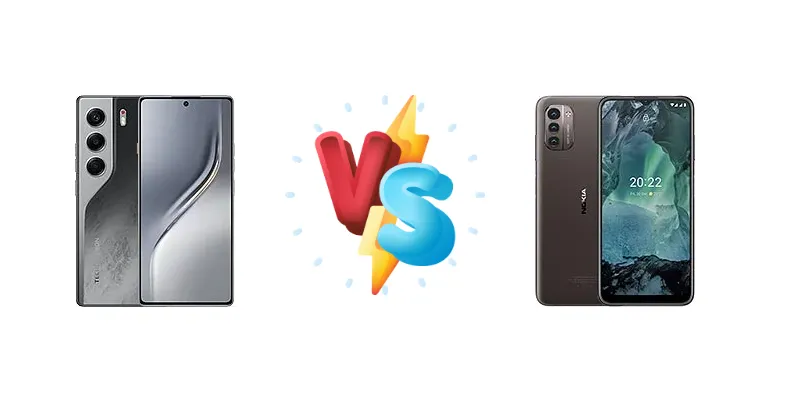
The Tecno Camon 40 and Nokia G21 represent two distinct approaches to the budget smartphone market. The Camon 40 prioritizes processing power with its newer Mediatek Helio G100, while the Nokia G21 focuses on longevity and a user-friendly experience, boasting a claimed 126-hour endurance rating. This comparison dissects their key differences to determine which device delivers the best value.
🏆 Quick Verdict
For most users, the Tecno Camon 40 emerges as the stronger choice. Its Mediatek Helio G100 Ultimate chipset, built on a 6nm process, offers a significant performance advantage over the Nokia G21’s 12nm Unisoc T606, translating to smoother multitasking and gaming. While the Nokia G21’s battery endurance is commendable, the Camon 40’s faster 45W charging mitigates any potential battery anxiety.
| Network |
|---|
| 2G bands | GSM 850 / 900 / 1800 / 1900 | GSM 850 / 900 / 1800 / 1900 |
| 3G bands | HSDPA 850 / 900 / 1700(AWS) / 1900 / 2100 | HSDPA 850 / 900 / 2100 - International |
| 4G bands | LTE | 1, 3, 5, 7, 8, 20, 28, 38, 40, 41 - International |
| Speed | HSPA, LTE | HSPA 42.2/5.76 Mbps, LTE Cat4 150/50 Mbps |
| Technology | GSM / HSPA / LTE | GSM / HSPA / LTE |
| | - | 1, 2, 3, 4, 5, 7, 8, 12, 17, 28, 40, 66 - LATAM |
| Launch |
|---|
| Announced | 2025, March 03 | 2022, February 14 |
| Status | Available. Released 2025, May | Available. Released 2022, February 15 |
| Body |
|---|
| Build | - | Glass front, plastic frame, plastic back |
| Dimensions | 164.1 x 74.6 x 7.3 mm (6.46 x 2.94 x 0.29 in) | 164.6 x 75.9 x 8.5 mm (6.48 x 2.99 x 0.33 in) |
| SIM | Nano-SIM + Nano-SIM | · Nano-SIM· Nano-SIM + Nano-SIM |
| Weight | 177.2 g (6.24 oz) | 190 g (6.70 oz) |
| Display |
|---|
| Protection | Panda King Glass | - |
| Resolution | 1080 x 2436 pixels (~393 ppi density) | 720 x 1600 pixels, 20:9 ratio (~270 ppi density) |
| Size | 6.78 inches, 109.9 cm2 (~89.8% screen-to-body ratio) | 6.5 inches, 102.0 cm2 (~81.6% screen-to-body ratio) |
| Type | AMOLED, 120Hz | IPS LCD, 90Hz, 400 nits (typ) |
| Platform |
|---|
| CPU | Octa-core (2x2.2 GHz Cortex-A76 & 6x2.0 GHz Cortex-A55) | Octa-core (2x1.6 GHz Cortex-A75 & 6x1.6 GHz Cortex-A55) |
| Chipset | Mediatek Helio G100 Ultimate (6 nm) | Unisoc T606 (12 nm) |
| GPU | Mali-G57 MC2 | Mali-G57 MP1 |
| OS | Android 15, up to 3 major Android upgrades, HIOS 15 | Android 11, upgradable to Android 13 |
| Memory |
|---|
| Card slot | Unspecified | microSDXC (dedicated slot) |
| Internal | 128GB 8GB RAM, 128GB 12GB RAM, 256GB 8GB RAM, 256GB 12GB RAM | 64GB 3GB RAM, 64GB 4GB RAM, 128GB 4GB RAM, 128GB 6GB RAM |
| | - | eMMC 5.1 |
| Main Camera |
|---|
| Dual | 50 MP, f/1.9, 23mm (wide), 1/1.56", 1.0µm, PDAF, OIS
8 MP, (ultrawide) | - |
| Features | Dual-LED flash, HDR, panorama | LED flash, HDR, panorama |
| Single | - | 8 MP, f/2.0, (wide) |
| Triple | - | 50 MP, f/1.8, 28mm (wide), 1/2.76", 0.64µm, PDAF
2 MP (macro)
Auxiliary lens |
| Video | Yes | 1080p@30fps |
| Selfie camera |
|---|
| Single | 32 MP, (wide) | 8 MP, f/2.0, (wide) |
| Video | Yes | 1080p@30fps |
| Sound |
|---|
| 3.5mm jack | - | Yes |
| 35mm jack | No | Yes |
| Loudspeaker | Yes, with stereo speakers | Yes |
| Comms |
|---|
| Bluetooth | Yes | 5.0, A2DP, LE |
| Infrared port | Yes | - |
| NFC | Yes | Yes (market/region dependent) |
| Positioning | GPS | GPS, GLONASS, GALILEO |
| Radio | FM radio | FM radio, RDS |
| USB | USB Type-C 2.0, OTG | USB Type-C 2.0, OTG |
| WLAN | Yes | Wi-Fi 802.11 a/b/g/n/ac, dual-band, Wi-Fi Direct |
| Features |
|---|
| Sensors | Fingerprint (under display, optical), accelerometer, gyro, proximity, compass | Fingerprint (side-mounted), accelerometer, proximity |
| Battery |
|---|
| Charging | 45W wired, 50% in 23 min, 100% in 43 min | 18W wired, PD3.0 |
| Type | 5200 mAh | Li-Po 5050 mAh |
| Misc |
|---|
| Colors | Emerald Lake Green, Galaxy Black, Glacier White, Emerald Glow Green | Nordic Blue, Dusk |
| Models | CM5 | TA-1418, TA-1477, TA-1415, TA-1405, TA-1404, TA-1412 |
| Price | - | About 90 EUR |
| SAR | - | 1.00 W/kg (head) 1.10 W/kg (body) |
| SAR EU | - | 0.34 W/kg (head) 1.05 W/kg (body) |
| Tests |
|---|
| Battery life | - |
Endurance rating 126h
|
| Camera | - |
Photo / Video |
| Display | - |
Contrast ratio: 1631:1 (nominal) |
| Loudspeaker | - |
-30.7 LUFS (Below average)
|
| Performance | - |
AnTuTu: 171299 (v9)
GeekBench: 1193 (v5.1)
GFXBench: 8.9fps (ES 3.1 onscreen) |
Tecno Camon 40
- Significantly faster processor for smoother performance
- Faster 45W charging reduces downtime
- More efficient 6nm chipset for better thermal management
- Battery capacity not specified, potentially smaller than Nokia G21
- Camera specifications are unknown
Nokia G21
- Exceptional 126-hour battery endurance
- 500 nits peak brightness for better outdoor visibility
- Clean and simple software experience (typical of Nokia)
- Slower Unisoc T606 processor limits performance
- Slower 18W charging takes longer to replenish battery
Display Comparison
Both the Tecno Camon 40 and Nokia G21 share a contrast ratio of 1631:1, suggesting similar visual depth. However, the Nokia G21’s display is explicitly measured at 500 nits of peak brightness, while the Camon 40’s brightness is not specified. This suggests the Nokia G21 will likely perform better in direct sunlight. The absence of refresh rate information for both devices indicates they likely utilize standard 60Hz panels, which is typical for this price segment. The lack of details on panel technology (IPS, AMOLED) prevents a deeper analysis of color accuracy and viewing angles.
Camera Comparison
Both phones are listed as having Photo/Video capabilities, but lack specific details regarding sensor size, aperture, or image processing features. Without this information, a direct comparison is difficult. The absence of any mention of Optical Image Stabilization (OIS) on either device suggests reliance on software stabilization. The lack of detail makes it impossible to assess the quality of the camera systems beyond basic functionality.
Performance
The core difference lies in the chipsets. The Tecno Camon 40’s Mediatek Helio G100 Ultimate (6nm) boasts a more modern architecture with two Cortex-A76 cores clocked at 2.2 GHz, paired with six Cortex-A55 cores at 2.0 GHz. This contrasts with the Nokia G21’s Unisoc T606 (12nm), featuring two older Cortex-A75 cores at 1.6 GHz and six Cortex-A55 cores also at 1.6 GHz. The 6nm fabrication process of the Helio G100 offers superior power efficiency and thermal performance compared to the 12nm Unisoc T606, meaning the Camon 40 is less likely to throttle under sustained load. This translates to a noticeably smoother experience in demanding applications and games.
Battery Life
The Nokia G21’s standout feature is its claimed 126-hour endurance rating, indicating exceptional battery life for basic usage. However, the Tecno Camon 40 compensates with significantly faster charging. Its 45W wired charging can reach 50% in 23 minutes and 100% in 43 minutes, a substantial improvement over the Nokia G21’s 18W PD3.0 charging. While the G21 may last longer on a single charge, the Camon 40’s rapid charging minimizes downtime, making it more convenient for power users.
Buying Guide
Buy the Tecno Camon 40 if you need a phone capable of handling demanding apps, enjoy mobile gaming, and value faster charging speeds. Buy the Nokia G21 if you prioritize extremely long battery life, prefer a simple and clean software experience, and are less concerned with peak performance. The G21 is ideal for users who primarily use their phone for calls, texts, and light social media.
Frequently Asked Questions
❓ How much of a performance difference will I see between the Helio G100 and the Unisoc T606 in everyday tasks?
The Mediatek Helio G100 Ultimate offers a substantial performance advantage, particularly in multitasking and app loading times. The newer Cortex-A76 cores and 6nm process provide a smoother experience when switching between apps, browsing the web, and using social media. The Unisoc T606 will handle basic tasks adequately, but may exhibit lag or slowdowns with more demanding applications.
❓ Is the 45W charging on the Tecno Camon 40 compatible with Power Delivery (PD) chargers I might already own?
While the Tecno Camon 40 supports 45W wired charging, it doesn't explicitly state full PD compatibility. It's likely to work with many PD chargers, but may not achieve the full 45W charging speed if the charger doesn't fully support the Tecno's charging protocol. Using a compatible charger is recommended for optimal charging speeds.
❓ Given the lack of camera details, should I be concerned about image quality on either phone?
Yes, the lack of camera specifications is a concern. Both phones likely feature basic camera setups suitable for casual photography. However, without knowing sensor size, aperture, or image processing capabilities, it's difficult to assess their performance in low-light conditions or their ability to capture detailed images. Expect average results from both devices.