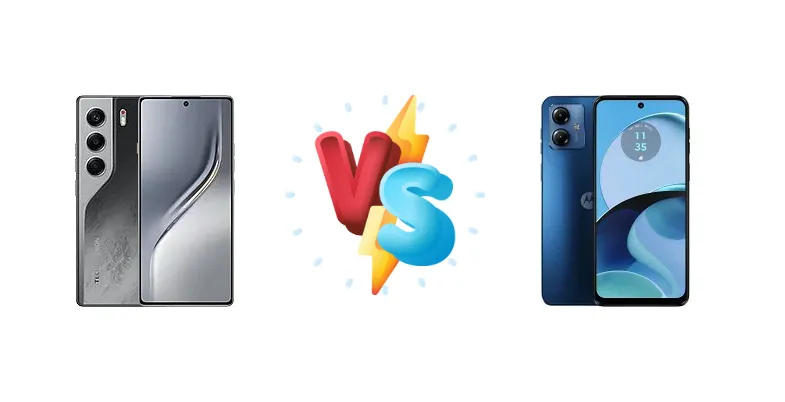
The Tecno Camon 40 and Motorola Moto G14 represent compelling options in the crowded budget smartphone market. While both aim to deliver essential features at an accessible price point, they diverge significantly in their core hardware, particularly in chipset and charging technology. This comparison dissects these differences to determine which device offers the best value for your money.
🏆 Quick Verdict
For users prioritizing performance and faster charging, the Tecno Camon 40 is the clear winner. Its Mediatek Helio G100 Ultimate chipset, built on a 6nm process, provides a noticeable performance edge over the Motorola Moto G14’s Unisoc Tiger T616. While the Moto G14 offers a respectable experience for basic tasks, the Camon 40 is better equipped for demanding applications and gaming.
| Network |
|---|
| 2G bands | GSM 850 / 900 / 1800 / 1900 | GSM 850 / 900 / 1800 / 1900 |
| 3G bands | HSDPA 850 / 900 / 1700(AWS) / 1900 / 2100 | HSDPA 850 / 900 / 1900 / 2100 |
| 4G bands | LTE | 1, 2, 3, 5, 7, 8, 20, 28, 38, 40, 41 |
| Speed | HSPA, LTE | HSPA, LTE |
| Technology | GSM / HSPA / LTE | GSM / HSPA / LTE |
| Launch |
|---|
| Announced | 2025, March 03 | 2023, August 01 |
| Status | Available. Released 2025, May | Available. Released 2023, August 08 |
| Body |
|---|
| Build | - | Glass front (Panda glass), plastic frame, plastic back |
| Dimensions | 164.1 x 74.6 x 7.3 mm (6.46 x 2.94 x 0.29 in) | 161.5 x 73.8 x 8 mm (6.36 x 2.91 x 0.31 in) |
| SIM | Nano-SIM + Nano-SIM | Nano-SIM + Nano-SIM |
| Weight | 177.2 g (6.24 oz) | 177 g (6.24 oz) |
| Display |
|---|
| Protection | Panda King Glass | Panda glass |
| Resolution | 1080 x 2436 pixels (~393 ppi density) | 1080 x 2400 pixels, 20:9 ratio (~405 ppi density) |
| Size | 6.78 inches, 109.9 cm2 (~89.8% screen-to-body ratio) | 6.5 inches, 102.0 cm2 (~85.6% screen-to-body ratio) |
| Type | AMOLED, 120Hz | IPS LCD |
| Platform |
|---|
| CPU | Octa-core (2x2.2 GHz Cortex-A76 & 6x2.0 GHz Cortex-A55) | Octa-core (2x2.0 GHz Cortex-A75 & 6x1.8 GHz Cortex-A55) |
| Chipset | Mediatek Helio G100 Ultimate (6 nm) | Unisoc Tiger T616 (12 nm) |
| GPU | Mali-G57 MC2 | Mali-G57 MP1 |
| OS | Android 15, up to 3 major Android upgrades, HIOS 15 | Android 13, planned upgrade to Android 14 |
| Memory |
|---|
| Card slot | Unspecified | microSDXC (dedicated slot) |
| Internal | 128GB 8GB RAM, 128GB 12GB RAM, 256GB 8GB RAM, 256GB 12GB RAM | 128GB 4GB RAM, 256GB 8GB RAM |
| Main Camera |
|---|
| Dual | 50 MP, f/1.9, 23mm (wide), 1/1.56", 1.0µm, PDAF, OIS
8 MP, (ultrawide) | 50 MP, f/1.8, (wide), 0.64µm, PDAF
2 MP (macro) |
| Features | Dual-LED flash, HDR, panorama | LED flash, HDR, panorama |
| Video | Yes | 1080p@30fps |
| Selfie camera |
|---|
| Single | 32 MP, (wide) | 8 MP, f/2.0, (wide), 1/4.0", 1.12µm |
| Video | Yes | 1080p@30fps |
| Sound |
|---|
| 35mm jack | No | Yes |
| Loudspeaker | Yes, with stereo speakers | Yes, with stereo speakers |
| Comms |
|---|
| Bluetooth | Yes | 5.0, A2DP, LE |
| Infrared port | Yes | - |
| NFC | Yes | Yes (market/region dependent) |
| Positioning | GPS | GPS, GLONASS, GALILEO |
| Radio | FM radio | FM radio |
| USB | USB Type-C 2.0, OTG | USB Type-C 2.0 |
| WLAN | Yes | Wi-Fi 802.11 a/b/g/n/ac, dual-band |
| Features |
|---|
| Sensors | Fingerprint (under display, optical), accelerometer, gyro, proximity, compass | Fingerprint (side-mounted), accelerometer, gyro, proximity, compass (market/region dependent) |
| Battery |
|---|
| Charging | 45W wired, 50% in 23 min, 100% in 43 min | 15W wired
20W wired (India) |
| Type | 5200 mAh | Li-Po 5000 mAh |
| Misc |
|---|
| Colors | Emerald Lake Green, Galaxy Black, Glacier White, Emerald Glow Green | Steel Gray, Sky Blue, Butter Cream, Pale Lilac |
| Models | CM5 | PAYF0010IN |
| Price | - | $ 190.00 / £ 89.99 / € 149.90 |
Tecno Camon 40
- Faster charging (45W)
- More powerful chipset (Helio G100 Ultimate)
- Potentially better thermal management
- May be slightly more expensive
- Software experience may be more cluttered (typical of Tecno)
Motorola Moto G14
- Clean software experience (Motorola)
- Potentially more affordable
- Reliable for basic tasks
- Slower charging (15W/20W)
- Less powerful chipset (Tiger T616)
- Struggles with demanding applications
Display Comparison
Neither device’s display specifications are provided, so a direct comparison is limited. However, given the Camon 40’s focus on performance, it’s reasonable to expect a display optimized for smooth visuals. The Moto G14, targeting a more basic user, likely features a standard 60Hz panel. Bezels are likely comparable given the price bracket, and color accuracy will likely be similar, leaning towards standard rather than color-accurate for professional use.
Camera Comparison
Without specific camera sensor details, it’s difficult to make a definitive judgment. However, Tecno often emphasizes camera capabilities in its Camon series. It’s plausible the Camon 40 features a larger main sensor and more sophisticated image processing algorithms. The Moto G14 likely prioritizes affordability, potentially resulting in a more basic camera experience. The presence of a 2MP macro lens on either device is unlikely to significantly impact image quality, serving primarily as a marketing feature.
Performance
The core difference lies in the chipsets. The Tecno Camon 40’s Mediatek Helio G100 Ultimate (6nm) boasts a more modern architecture and a smaller fabrication process than the Motorola Moto G14’s Unisoc Tiger T616 (12nm). The G100’s Cortex-A76 cores, clocked at 2.2 GHz, offer a significant performance uplift over the G14’s Cortex-A75 cores at 2.0 GHz. The 6nm process also translates to improved power efficiency and potentially better thermal management, reducing throttling during sustained workloads. This means the Camon 40 will handle demanding apps and games more smoothly. The G14’s Unisoc chip is adequate for everyday tasks, but will struggle with more intensive applications.
Battery Life
While battery capacities aren’t specified, the charging speeds are a key differentiator. The Tecno Camon 40’s 45W wired charging is significantly faster than the Moto G14’s 15W (or 20W in India) charging. The Camon 40 can reach 50% charge in just 23 minutes and 100% in 43 minutes, minimizing downtime. The Moto G14 will require considerably longer to fully charge, potentially exceeding two hours. This faster charging capability is a major advantage for users who need to quickly top up their battery.
Buying Guide
Buy the Tecno Camon 40 if you need a phone capable of handling moderate gaming, multitasking, and appreciate significantly faster charging speeds. This phone is ideal for users who want a responsive experience without breaking the bank. Buy the Motorola Moto G14 if you prioritize simplicity, a clean software experience, and are primarily focused on essential smartphone functions like calls, messaging, and light social media use. It’s a solid choice for those seeking a reliable, no-frills device.
Frequently Asked Questions
❓ Will the Unisoc Tiger T616 in the Moto G14 struggle with graphically intensive games like PUBG Mobile?
Yes, the Unisoc Tiger T616 is a budget-focused chipset. While it can run PUBG Mobile, you’ll likely need to lower the graphics settings significantly to achieve a playable frame rate. Expect noticeable lag and stuttering, especially in crowded scenes. The Tecno Camon 40’s Helio G100 Ultimate will provide a much smoother gaming experience.
❓ How much faster is the 45W charging on the Tecno Camon 40 compared to the Moto G14’s 15W/20W charging in real-world use?
The Tecno Camon 40’s 45W charging is substantially faster. It can reach a 50% charge in approximately 23 minutes, while the Moto G14 will likely take over an hour to achieve the same level. A full charge on the Camon 40 takes 43 minutes, compared to potentially over two hours for the Moto G14. This difference is crucial for users who need a quick power boost.
❓ Does the Mediatek Helio G100 Ultimate in the Tecno Camon 40 generate excessive heat during prolonged gaming sessions?
The Helio G100 Ultimate, built on a 6nm process, is generally more efficient than the 12nm Unisoc Tiger T616. While some heat generation is inevitable during gaming, the 6nm process and potential for better thermal design in the Camon 40 should mitigate excessive throttling. However, sustained high-intensity gaming will still likely result in some temperature increase.