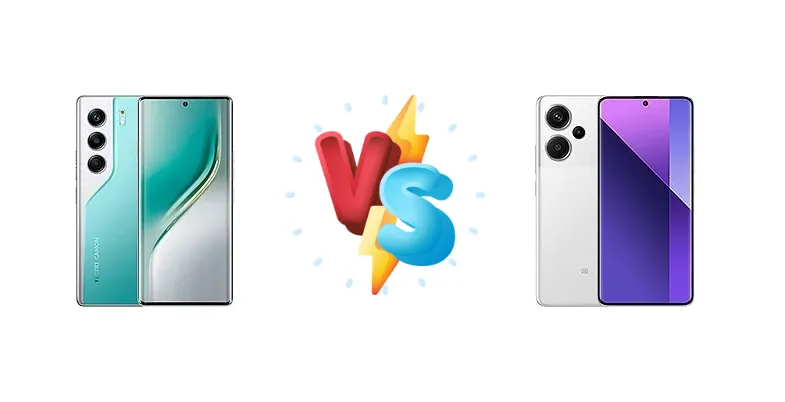
The Tecno Camon 40 Pro and Xiaomi Redmi Note 13 Pro+ represent compelling options in the increasingly competitive mid-range smartphone market. While both leverage Mediatek's Dimensity series for performance, they diverge significantly in charging speed and battery endurance, creating a clear trade-off for potential buyers. This comparison dives deep into the specifics to determine which device best suits your needs.
🏆 Quick Verdict
For the average user prioritizing longevity, the Tecno Camon 40 Pro emerges as the winner. Its impressive 13:51h active use battery life significantly outlasts the Redmi Note 13 Pro+'s 10:38h, making it ideal for power users. While the Redmi Note 13 Pro+ boasts blazing-fast 120W charging, the Camon 40 Pro’s more efficient power consumption offers a more practical daily experience.
| Network |
|---|
| 2G bands | GSM 850 / 900 / 1800 / 1900 | GSM 850 / 900 / 1800 / 1900 |
| 3G bands | HSDPA 850 / 900 / 1700(AWS) / 1900 / 2100 | HSDPA 800 / 850 / 900 / 1700(AWS) / 1900 / 2100 - International |
| 4G bands | LTE | 1, 2, 3, 4, 5, 7, 8, 12, 13, 17, 18, 19, 20, 26, 28, 32, 38, 40, 41, 66 - International |
| 5G bands | SA/NSA | 1, 3, 5, 7, 8, 20, 28, 38, 40, 41, 66, 77, 78 SA/NSA- International |
| Speed | HSPA, LTE, 5G | HSPA, LTE, 5G |
| Technology | GSM / HSPA / LTE / 5G | GSM / CDMA / HSPA / EVDO / LTE / 5G |
| Launch |
|---|
| Announced | 2025, March 03 | 2023, September 21 |
| Status | Available. Released 2025, May | Available. Released 2023, September 21 |
| Body |
|---|
| Build | Glass front (Gorilla Glass 7i), plastic back, plastic frame | Glass front (Gorilla Glass Victus), glass back or silicone polymer back (eco leather) |
| Dimensions | 164.3 x 74.6 x 7.3 mm (6.47 x 2.94 x 0.29 in) | 161.4 x 74.2 x 8.9 mm (6.35 x 2.92 x 0.35 in) |
| SIM | Nano-SIM + Nano-SIM | · Nano-SIM + eSIM· Nano-SIM + Nano-SIM |
| Weight | 179 g (6.31 oz) | 199 g or 204.5 g (7.02 oz) |
| Display |
|---|
| Protection | Corning Gorilla Glass 7i | Corning Gorilla Glass Victus |
| Resolution | 1080 x 2436 pixels (~393 ppi density) | 1220 x 2712 pixels, 20:9 ratio (~446 ppi density) |
| Size | 6.78 inches, 109.9 cm2 (~89.7% screen-to-body ratio) | 6.67 inches, 107.4 cm2 (~89.7% screen-to-body ratio) |
| Type | AMOLED, 144Hz | AMOLED, 68B colors, 120Hz, 1920Hz PWM, Dolby Vision, HDR10+, 1800 nits (peak) |
| Platform |
|---|
| CPU | Octa-core (4x2.5 GHz Cortex-A78 & 4x2.0 GHz Cortex-A55) | Octa-core (2x2.8 GHz Cortex-A715 & 6x2.0 GHz Cortex-A510) |
| Chipset | Mediatek Dimensity 7300 (4 nm) | Mediatek Dimensity 7200 Ultra (4 nm) |
| GPU | Mali-G615 MC2 | Mali-G610 MC4 |
| OS | Android 15, up to 3 major Android upgrades, HIOS 15 | Android 13, up to 3 major Android upgrades, HyperOS |
| Memory |
|---|
| Card slot | No | No |
| Internal | 256GB 8GB RAM, 256GB 12GB RAM | 256GB 8GB RAM, 256GB 12GB RAM, 512GB 8GB RAM, 512GB 12GB RAM, 512GB 16GB RAM |
| Main Camera |
|---|
| Dual | 50 MP, f/1.9, 23mm (wide), 1/1.56", 1.0µm, PDAF, OIS
8 MP, (ultrawide), 1/4.0", 1.12µm, AF | - |
| Features | Dual-LED flash, HDR, panorama | Dual-LED dual-tone flash, HDR, panorama |
| Triple | - | 200 MP, f/1.7, 23mm (wide), 1/1.4", 0.56µm, multi-directional PDAF, OIS
8 MP, f/2.2, 16mm, 120˚ (ultrawide), 1/4.0", 1.12µm
2 MP (macro) |
| Video | 4K@30/60fps (HDR), 1080p@30fps | 4K@24/30fps, 1080p@30/60/120fps, gyro-EIS |
| Selfie camera |
|---|
| Features | - | HDR, panorama |
| Single | 50 MP, f/2.5, 24mm (wide), 1/2.8", 0.64µm, PDAF | 16 MP, f/2.4, (wide) |
| Video | 4K@30fps, 1080p@30/60fps | 1080p@30/60fps |
| Sound |
|---|
| 35mm jack | No | No |
| Loudspeaker | Yes, with stereo speakers | Yes, with stereo speakers |
| Comms |
|---|
| Bluetooth | Yes | 5.3, A2DP, LE |
| Infrared port | Yes | Yes |
| NFC | Yes | Yes (market/region dependent) |
| Positioning | GPS | GPS, GLONASS, BDS, GALILEO, QZSS |
| Radio | FM radio | No |
| USB | USB Type-C 2.0, OTG | USB Type-C 2.0, OTG |
| WLAN | Yes | Wi-Fi 802.11 a/b/g/n/ac/6, dual-band, Wi-Fi Direct |
| Features |
|---|
| Sensors | Fingerprint (under display, optical), accelerometer, gyro, proximity, compass | Fingerprint (under display, optical), accelerometer, gyro, proximity, compass |
| Battery |
|---|
| Charging | 45W wired, 50% in 23 min, 100% in 43 min | 120W wired, PD3.0, 100% in 19 min |
| Type | 5200 mAh | Li-Po 5000 mAh |
| Misc |
|---|
| Colors | Emerald Lake Green, Galaxy Black, Glacier White | Midnight Black (Fushion Black), Moonlight White (Fushion White), Aurora Purple, Fushion Purple, Camo Green |
| Models | CM7 | 23090RA98C, 23090RA98G, 23090RA98I |
| Price | - | $ 299.98 / £ 299.00 / € 208.98 / ₹ 24,999 |
| SAR | - | 1.09 W/kg (head) 0.85 W/kg (body) |
| SAR EU | - | 0.98 W/kg (head) 1.00 W/kg (body) |
Tecno Camon 40 Pro
- Exceptional battery life (13:51h active use)
- Potentially better single-core performance with Dimensity 7300
- Respectable 45W fast charging
- Lower peak display brightness compared to Redmi Note 13 Pro+
- Charging speed is slower than the Redmi Note 13 Pro+
Xiaomi Redmi Note 13 Pro+
- Blazing-fast 120W charging (0-100% in 19 minutes)
- Higher peak display brightness (1283 nits)
- PD3.0 charging support
- Significantly shorter battery life (10:38h active use)
- Dimensity 7200 Ultra may offer slightly lower single-core performance
Display Comparison
Both the Tecno Camon 40 Pro and Xiaomi Redmi Note 13 Pro+ feature vibrant displays, but differ in peak brightness. The Redmi Note 13 Pro+ reaches 1283 nits, while the Camon 40 Pro achieves 1045 nits. While the Redmi is brighter, the difference is unlikely to be dramatically noticeable in most real-world scenarios. Neither specification details refresh rate or panel technology (OLED/LCD), which are crucial for a complete display assessment. However, given the price point, it's reasonable to assume both utilize AMOLED panels. Bezels and color accuracy would require hands-on testing to determine a clear winner.
Camera Comparison
Without detailed camera specifications beyond the main sensor, a comprehensive comparison is limited. However, the chipset's ISP capabilities play a significant role in image processing. Both phones likely offer capable camera systems, but the absence of information regarding sensor size, OIS (Optical Image Stabilization), and lens apertures makes it difficult to assess image quality. Ignoring the ubiquitous 2MP macro cameras, the performance of the primary sensor and its associated image processing algorithms will be the deciding factor for most users.
Performance
The chipset choice is a key differentiator. The Tecno Camon 40 Pro utilizes the Mediatek Dimensity 7300 (4nm), featuring a core configuration of 4x2.5 GHz Cortex-A78 and 4x2.0 GHz Cortex-A55. The Xiaomi Redmi Note 13 Pro+ employs the Dimensity 7200 Ultra (4nm) with 2x2.8 GHz Cortex-A715 and 6x2.0 GHz Cortex-A510 cores. The Cortex-A78 cores in the Camon 40 Pro generally offer slightly better single-core performance than the A715, potentially translating to snappier app launches and smoother multitasking. Both chips are built on a 4nm process, suggesting comparable efficiency, but the core architecture gives the Tecno a slight edge. RAM speed (LPDDR5x) is not specified for either device, but is a critical factor in overall system responsiveness.
Battery Life
Battery life is where the Tecno Camon 40 Pro truly shines. Achieving an active use score of 13:51h, it significantly outperforms the Redmi Note 13 Pro+'s 10:38h. This difference of over three hours is substantial and will be noticeable in daily use. While the Redmi Note 13 Pro+ compensates with incredibly fast 120W wired charging (0-100% in 19 minutes), the Camon 40 Pro’s 45W charging (50% in 23 min, 100% in 43 min) is still respectable. The Redmi’s charging speed is a convenience, but the Camon 40 Pro’s superior battery endurance reduces the need to constantly seek out a power outlet.
Buying Guide
Buy the Tecno Camon 40 Pro if you need all-day battery life and prioritize sustained performance over the absolute fastest charging speeds. It’s the better choice for users who frequently travel or rely heavily on their phone throughout the day. Buy the Xiaomi Redmi Note 13 Pro+ if you value incredibly rapid charging – getting to 100% in just 19 minutes – and don’t mind potentially needing to top up the battery before the end of a heavy usage day. It’s ideal for users who want to quickly recover from low battery situations.
Frequently Asked Questions
❓ Does the Dimensity 7200 Ultra in the Redmi Note 13 Pro+ throttle under sustained gaming loads?
While the Dimensity 7200 Ultra is a capable chipset, its thermal performance under prolonged gaming sessions is not specified. However, Mediatek's Dimensity chips generally exhibit good thermal management, but the Redmi Note 13 Pro+'s thin profile might limit its cooling capacity. Expect some performance reduction after extended gameplay.
❓ Is the 45W charging on the Tecno Camon 40 Pro slow compared to the 120W on the Redmi Note 13 Pro+?
While 45W is slower than 120W, it's still a respectable charging speed. The Tecno Camon 40 Pro reaches 100% in 43 minutes, which is sufficient for overnight charging or a quick top-up during downtime. The significantly longer battery life of the Camon 40 Pro also reduces the need for frequent fast charging.
❓ What type of display technology does each phone use (LCD vs AMOLED)?
The provided specifications do not explicitly state the display technology. However, given the price range and features, it's highly probable that both the Tecno Camon 40 Pro and the Xiaomi Redmi Note 13 Pro+ utilize AMOLED displays for vibrant colors and deep blacks.