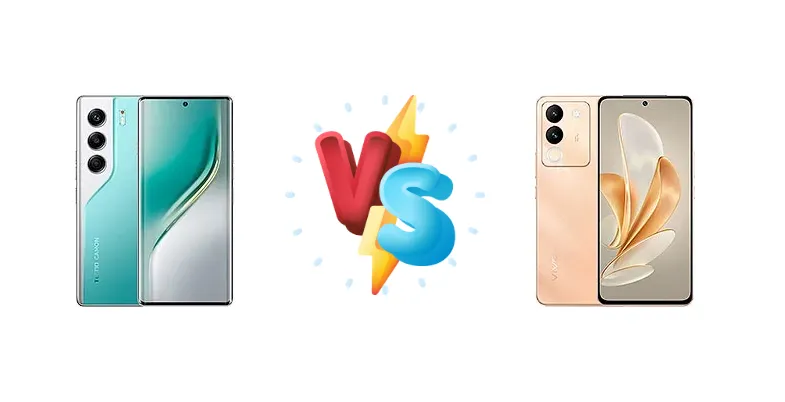
The Tecno Camon 40 Pro and vivo V29e represent compelling options in the increasingly competitive mid-range smartphone market. While both aim to deliver a balanced experience, they take distinctly different approaches to processing power and efficiency. This comparison dissects their key specifications to determine which device best suits your priorities.
🏆 Quick Verdict
For users prioritizing performance and future-proofing, the Tecno Camon 40 Pro emerges as the stronger contender. Its Mediatek Dimensity 7300 chipset offers a significant performance leap over the Snapdragon 695 in the vivo V29e, coupled with faster charging and a brighter display, making it the better all-rounder.
| Network |
|---|
| 2G bands | GSM 850 / 900 / 1800 / 1900 | GSM 850 / 900 / 1800 / 1900 |
| 3G bands | HSDPA 850 / 900 / 1700(AWS) / 1900 / 2100 | HSDPA 850 / 900 / 1700(AWS) / 1900 / 2100 |
| 4G bands | LTE | 1, 2, 3, 4, 5, 7, 8, 18, 19, 20, 26, 28, 38, 39, 40, 41 |
| 5G bands | SA/NSA | 1, 3, 5, 7, 8, 28, 38, 40, 41, 77, 78 SA/NSA |
| Speed | HSPA, LTE, 5G | HSPA, LTE, 5G |
| Technology | GSM / HSPA / LTE / 5G | GSM / HSPA / LTE / 5G |
| Launch |
|---|
| Announced | 2025, March 03 | 2023, October 23 |
| Status | Available. Released 2025, May | Available. Released 2023, October 23 |
| Body |
|---|
| Build | Glass front (Gorilla Glass 7i), plastic back, plastic frame | Glass front, plastic frame, glass back |
| Dimensions | 164.3 x 74.6 x 7.3 mm (6.47 x 2.94 x 0.29 in) | 162.4 x 74.9 x 7.7 mm (6.39 x 2.95 x 0.30 in) |
| SIM | Nano-SIM + Nano-SIM | Nano-SIM + Nano-SIM |
| Weight | 179 g (6.31 oz) | 190 g (6.70 oz) |
| Display |
|---|
| Protection | Corning Gorilla Glass 7i | - |
| Resolution | 1080 x 2436 pixels (~393 ppi density) | 1080 x 2400 pixels, 20:9 ratio (~395 ppi density) |
| Size | 6.78 inches, 109.9 cm2 (~89.7% screen-to-body ratio) | 6.67 inches, 107.4 cm2 (~88.3% screen-to-body ratio) |
| Type | AMOLED, 144Hz | AMOLED, 120Hz, 1150 nits (peak) |
| Platform |
|---|
| CPU | Octa-core (4x2.5 GHz Cortex-A78 & 4x2.0 GHz Cortex-A55) | Octa-core (2x2.2 GHz Kryo 660 Gold & 6x1.8 GHz Kryo 660 Silver) |
| Chipset | Mediatek Dimensity 7300 (4 nm) | Qualcomm SM6375 Snapdragon 695 5G (6 nm) |
| GPU | Mali-G615 MC2 | Adreno 619 |
| OS | Android 15, up to 3 major Android upgrades, HIOS 15 | Android 13, Funtouch 13 |
| Memory |
|---|
| Card slot | No | No |
| Internal | 256GB 8GB RAM, 256GB 12GB RAM | 256GB 8GB RAM, 256GB 12GB RAM |
| Main Camera |
|---|
| Dual | 50 MP, f/1.9, 23mm (wide), 1/1.56", 1.0µm, PDAF, OIS
8 MP, (ultrawide), 1/4.0", 1.12µm, AF | 64 MP, f/1.8, (wide), PDAF, OIS
8 MP, f/2.2, (ultrawide) |
| Features | Dual-LED flash, HDR, panorama | Ring-LED flash, panorama, HDR |
| Video | 4K@30/60fps (HDR), 1080p@30fps | 1080p@30fps |
| Selfie camera |
|---|
| Single | 50 MP, f/2.5, 24mm (wide), 1/2.8", 0.64µm, PDAF | 50 MP, f/2.0, 22mm (wide), AF |
| Video | 4K@30fps, 1080p@30/60fps | 1080p@30fps |
| Sound |
|---|
| 35mm jack | No | No |
| Loudspeaker | Yes, with stereo speakers | Yes |
| Comms |
|---|
| Bluetooth | Yes | 5.1, A2DP, LE |
| Infrared port | Yes | - |
| NFC | Yes | No |
| Positioning | GPS | GPS, GLONASS, GALILEO, BDS, QZSS |
| Radio | FM radio | No |
| USB | USB Type-C 2.0, OTG | USB Type-C 2.0, OTG |
| WLAN | Yes | Wi-Fi 802.11 a/b/g/n/ac, dual-band |
| Features |
|---|
| Sensors | Fingerprint (under display, optical), accelerometer, gyro, proximity, compass | Fingerprint (under display, optical), accelerometer, gyro, proximity, compass |
| Battery |
|---|
| Charging | 45W wired, 50% in 23 min, 100% in 43 min | 44W wired |
| Type | 5200 mAh | Li-Ion 4800 mAh |
| Misc |
|---|
| Colors | Emerald Lake Green, Galaxy Black, Glacier White | Forest Black, Rose Gold, Ice Creek Blue |
| Models | CM7 | V2317 |
| Price | - | About 320 EUR |
Tecno Camon 40 Pro
- Superior processing power with Dimensity 7300
- Brighter display for better outdoor visibility
- Faster charging speeds (45W)
- Software experience may not be as refined as vivo
- Larger size potentially less comfortable for some users
vivo V29e
- Potentially more refined software experience (vivo's Funtouch OS)
- Likely more compact design
- Established brand reputation for user experience
- Significantly weaker processor (Snapdragon 695)
- Likely lower peak display brightness
- Slower overall performance
Display Comparison
The Tecno Camon 40 Pro boasts a display capable of reaching 1045 nits of peak brightness, ensuring excellent visibility even in direct sunlight. While the vivo V29e’s display specifications aren’t provided, it’s likely to fall short of this peak brightness. The brightness difference is crucial for outdoor usability. Furthermore, the absence of information regarding PWM dimming frequency on the V29e raises potential concerns for users sensitive to screen flicker, a detail often addressed in Tecno’s offerings.
Camera Comparison
Without detailed camera specifications for both devices, a direct comparison is limited. However, the chipset difference indirectly impacts camera performance. The Dimensity 7300’s more powerful ISP (Image Signal Processor) in the Tecno Camon 40 Pro allows for faster image processing, better noise reduction, and potentially more advanced computational photography features. While both phones likely feature multi-camera setups, the processing power of the Dimensity 7300 gives the Tecno an edge in image quality and video recording capabilities.
Performance
The core difference lies in the chipsets. The Tecno Camon 40 Pro’s Mediatek Dimensity 7300, fabricated on a 4nm process, represents a substantial upgrade over the vivo V29e’s Qualcomm Snapdragon 695 (6nm). The Dimensity 7300’s octa-core configuration, featuring four high-performance Cortex-A78 cores clocked at 2.5 GHz, delivers significantly faster CPU performance. This translates to snappier app launches, smoother multitasking, and improved gaming performance. The Snapdragon 695, while capable for everyday tasks, will struggle with graphically intensive games and demanding applications compared to the Dimensity 7300.
Battery Life
The Tecno Camon 40 Pro demonstrates impressive battery life, achieving 13:51 hours of active use. While the vivo V29e’s battery capacity isn’t specified, the Tecno’s result sets a high benchmark. The Camon 40 Pro also features 45W wired charging, reaching 50% charge in 23 minutes and 100% in 43 minutes. The vivo V29e offers 44W charging, which is comparable, but the Tecno’s slightly faster charging speed provides a marginal convenience advantage.
Buying Guide
Buy the Tecno Camon 40 Pro if you need a phone capable of handling demanding applications, enjoy mobile gaming, and value faster charging speeds. Its Dimensity 7300 chipset provides a noticeable performance advantage. Buy the vivo V29e if you prioritize a streamlined user experience and are less concerned with raw processing power, potentially benefiting from a slightly more refined software experience typical of vivo devices.
Frequently Asked Questions
❓ Is the Mediatek Dimensity 7300 in the Tecno Camon 40 Pro capable of handling demanding games like Genshin Impact?
Yes, the Dimensity 7300 is a capable chipset for gaming. Its Cortex-A78 cores and improved GPU performance allow for playable frame rates in demanding titles like Genshin Impact, though you may need to adjust graphics settings for optimal performance. The Snapdragon 695 in the vivo V29e will struggle with these titles.
❓ How does the 4nm process of the Dimensity 7300 impact the Tecno Camon 40 Pro's thermal performance during extended gaming sessions?
The 4nm process node is significantly more efficient than the 6nm node used in the Snapdragon 695. This means the Dimensity 7300 generates less heat for the same level of performance, resulting in less thermal throttling during prolonged gaming or demanding tasks. This allows the Tecno Camon 40 Pro to maintain higher sustained performance levels.
❓ Does the vivo V29e support 5G connectivity, and how does its 5G performance compare to the Tecno Camon 40 Pro?
Yes, the vivo V29e utilizes the Snapdragon 695 5G, which includes 5G modem capabilities. However, the Dimensity 7300 in the Tecno Camon 40 Pro generally offers faster 5G download and upload speeds, as well as broader 5G band support, providing a more robust 5G experience.