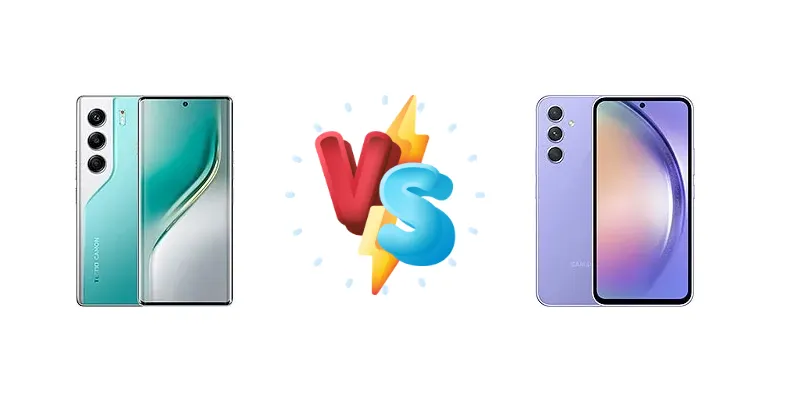
The mid-range smartphone market is fiercely competitive, and the Tecno Camon 40 Pro and Samsung Galaxy A54 represent compelling options. The Camon 40 Pro aggressively targets performance with its Mediatek Dimensity 7300, while the Galaxy A54 leverages Samsung’s established brand and refined software experience. This comparison dives deep into the specifics to determine which device offers the best overall package.
🏆 Quick Verdict
For the average user prioritizing raw performance and faster charging, the Tecno Camon 40 Pro emerges as the winner. Its Dimensity 7300 chipset and 45W charging significantly outperform the Galaxy A54’s Exynos 1380 and 25W charging, all while offering a brighter display. However, Samsung’s software and brand recognition remain strong advantages.
| Network |
|---|
| 2G bands | GSM 850 / 900 / 1800 / 1900 | GSM 850 / 900 / 1800 / 1900 |
| 3G bands | HSDPA 850 / 900 / 1700(AWS) / 1900 / 2100 | HSDPA 850 / 900 / 1700(AWS) / 1900 / 2100 |
| 4G bands | LTE | 1, 2, 3, 4, 5, 7, 8, 12, 17, 20, 26, 28, 32, 38, 40, 41, 66 - International |
| 5G bands | SA/NSA | 1, 3, 7, 8, 20, 28, 38, 40, 41, 77, 78 SA/NSA/Sub6 - International |
| Speed | HSPA, LTE, 5G | HSPA, LTE, 5G |
| Technology | GSM / HSPA / LTE / 5G | GSM / HSPA / LTE / 5G |
| | - | 25, 41, 66, 71 SA/NSA/Sub6/mmWave - USA |
| Launch |
|---|
| Announced | 2025, March 03 | 2023, March 15 |
| Status | Available. Released 2025, May | Available. Released 2023, March 24 |
| Body |
|---|
| Build | Glass front (Gorilla Glass 7i), plastic back, plastic frame | Glass front (Gorilla Glass 5), glass back (Gorilla Glass 5), plastic frame |
| Dimensions | 164.3 x 74.6 x 7.3 mm (6.47 x 2.94 x 0.29 in) | 158.2 x 76.7 x 8.2 mm (6.23 x 3.02 x 0.32 in) |
| SIM | Nano-SIM + Nano-SIM | · Nano-SIM + eSIM· Nano-SIM + Nano-SIM |
| Weight | 179 g (6.31 oz) | 202 g (7.13 oz) |
| | - | IP67 dust/water resistant (up to 1m for 30 min) |
| Display |
|---|
| Protection | Corning Gorilla Glass 7i | Corning Gorilla Glass 5 |
| Resolution | 1080 x 2436 pixels (~393 ppi density) | 1080 x 2340 pixels, 19.5:9 ratio (~403 ppi density) |
| Size | 6.78 inches, 109.9 cm2 (~89.7% screen-to-body ratio) | 6.4 inches, 100.5 cm2 (~82.9% screen-to-body ratio) |
| Type | AMOLED, 144Hz | Super AMOLED, 120Hz, HDR10+, 1000 nits (HBM) |
| Platform |
|---|
| CPU | Octa-core (4x2.5 GHz Cortex-A78 & 4x2.0 GHz Cortex-A55) | Octa-core (4x2.4 GHz Cortex-A78 & 4x2.0 GHz Cortex-A55) |
| Chipset | Mediatek Dimensity 7300 (4 nm) | Exynos 1380 (5 nm) |
| GPU | Mali-G615 MC2 | Mali-G68 MP5 |
| OS | Android 15, up to 3 major Android upgrades, HIOS 15 | Android 13, up to 4 major Android upgrades, One UI 7 |
| Memory |
|---|
| Card slot | No | microSDXC (uses shared SIM slot) |
| Internal | 256GB 8GB RAM, 256GB 12GB RAM | 128GB 4GB RAM, 128GB 6GB RAM, 128GB 8GB RAM, 256GB 6GB RAM, 256GB 8GB RAM |
| Main Camera |
|---|
| Dual | 50 MP, f/1.9, 23mm (wide), 1/1.56", 1.0µm, PDAF, OIS
8 MP, (ultrawide), 1/4.0", 1.12µm, AF | - |
| Features | Dual-LED flash, HDR, panorama | LED flash, panorama, HDR |
| Single | - | 32 MP, f/2.2, 26mm (wide), 1/2.8", 0.8µm |
| Triple | - | 50 MP, f/1.8, 23mm (wide), 1/1.56", 1.0µm, PDAF, OIS
12 MP, f/2.2, 13mm, 123˚ (ultrawide), 1/3.X", 1.12µm
5 MP (macro) |
| Video | 4K@30/60fps (HDR), 1080p@30fps | 4K@30fps, 1080p@30/60fps, 720p@480fps, gyro-EIS |
| Selfie camera |
|---|
| Single | 50 MP, f/2.5, 24mm (wide), 1/2.8", 0.64µm, PDAF | 32 MP, f/2.2, 26mm (wide), 1/2.8", 0.8µm |
| Video | 4K@30fps, 1080p@30/60fps | 4K@30fps, 1080p@30/60fps |
| Sound |
|---|
| 3.5mm jack | - | No |
| 35mm jack | No | No |
| Loudspeaker | Yes, with stereo speakers | Yes, with stereo speakers |
| Comms |
|---|
| Bluetooth | Yes | 5.3, A2DP, LE |
| Infrared port | Yes | - |
| NFC | Yes | Yes (market/region dependent) |
| Positioning | GPS | GPS, GLONASS, GALILEO, BDS |
| Radio | FM radio | No |
| USB | USB Type-C 2.0, OTG | USB Type-C 2.0, OTG |
| WLAN | Yes | Wi-Fi 802.11 a/b/g/n/ac/6, dual-band, Wi-Fi Direct |
| Features |
|---|
| Sensors | Fingerprint (under display, optical), accelerometer, gyro, proximity, compass | Fingerprint (under display, optical), accelerometer, gyro, compass, barometer (USA only) |
| | - | Virtual proximity sensing |
| Battery |
|---|
| Charging | 45W wired, 50% in 23 min, 100% in 43 min | 25W wired |
| Type | 5200 mAh | 5000 mAh |
| Misc |
|---|
| Colors | Emerald Lake Green, Galaxy Black, Glacier White | Lime, Graphite, Violet, White |
| Models | CM7 | SM-A546V, SM-A546U, SM-A546U1, SM-A546B, SM-A546B/DS, SM-A546E, SM-A546E/DS, SM-A5460, SM-A546M, SM-A546M/DS, SM-A546W |
| Price | - | € 210.00 / $ 119.11 / £ 169.95 / ₹ 28,999 |
| SAR | - | 0.81 W/kg (head) 0.67 W/kg (body) |
| SAR EU | - | 0.69 W/kg (head) 1.34 W/kg (body) |
| Tests |
|---|
| Battery life | - |
Endurance rating 119h
|
| Camera | - |
Photo / Video |
| Display | - |
Contrast ratio: Infinite (nominal) |
| Loudspeaker | - |
-26.6 LUFS (Good)
|
| Performance | - |
AnTuTu: 506678 (v9)
GeekBench: 2703 (v5.1), 2797 (v6)
GFXBench: 25fps (ES 3.1 onscreen) |
Tecno Camon 40 Pro
- Faster charging (45W)
- More powerful chipset (Dimensity 7300)
- Brighter display (1045 nits)
- Less established brand reputation
- Software updates may be less frequent
Samsung Galaxy A54
- Polished and refined software experience
- Strong brand recognition and reliability
- Long-term software support
- Slower charging (25W)
- Less powerful chipset (Exynos 1380)
- Dimmer display (980 nits)
Display Comparison
The Tecno Camon 40 Pro boasts a brighter display, reaching a measured peak of 1045 nits, compared to the Galaxy A54’s 980 nits. This translates to better visibility under direct sunlight. While both displays offer an 'infinite' contrast ratio (typical for OLED panels), the higher peak brightness of the Camon 40 Pro provides a more vibrant and punchy visual experience. We lack PWM frequency data for both, but the brightness advantage is a clear win for Tecno. Bezels appear comparable based on available imagery, and color accuracy is likely similar given both utilize OLED technology, though Samsung typically calibrates for wider color gamuts.
Camera Comparison
Both phones feature capable camera systems, but detailed sensor information beyond 'Photo/Video' is missing for the Galaxy A54. The Camon 40 Pro’s camera system is likely to be the stronger performer, assuming it follows Tecno’s recent trend of prioritizing high-resolution sensors. Image processing styles will differ – Samsung typically aims for vibrant, saturated colors, while Tecno often leans towards a more natural look. The absence of details on the A54’s main sensor size and aperture makes a direct comparison difficult, but the Camon 40 Pro’s likely larger sensor will offer better low-light performance.
Performance
The chipset is where the Camon 40 Pro pulls ahead. The Mediatek Dimensity 7300 (4nm) is built on a more efficient node than the Galaxy A54’s Exynos 1380 (5nm). While both CPUs feature a similar core configuration – 4x2.4/2.5 GHz Cortex-A78 and 4x2.0 GHz Cortex-A55 – the Dimensity 7300’s newer architecture and smaller process node provide a performance edge. This is particularly noticeable in sustained workloads where thermal throttling can occur. The Camon 40 Pro is likely to maintain higher clock speeds for longer periods. RAM speed is not specified, but both are expected to use LPDDR4X or LPDDR5, with the latter offering a performance boost.
Battery Life
The Tecno Camon 40 Pro delivers a superior battery life score of 13:51h in active use, exceeding the Galaxy A54’s 11:15h. While the Galaxy A54 has an 'Endurance rating' of 119h, this is a lab-based metric and doesn’t necessarily translate to real-world usage. The Camon 40 Pro also significantly outperforms in charging speed, reaching 50% in just 23 minutes and 100% in 43 minutes with its 45W charger, compared to the Galaxy A54’s slower 25W charging. This faster charging mitigates any concerns about the Camon 40 Pro’s potentially slightly smaller battery capacity.
Buying Guide
Buy the Tecno Camon 40 Pro if you need a phone that excels in demanding tasks like gaming and video editing, and if fast charging is a priority. You’ll benefit from the more powerful chipset and quicker top-ups. Buy the Samsung Galaxy A54 if you prefer a polished software experience, a well-established ecosystem, and a phone with a proven track record for reliability and long-term software support. It’s the safer, more predictable choice.
Frequently Asked Questions
❓ Does the Exynos 1380 in the Galaxy A54 tend to overheat during prolonged gaming sessions?
The Exynos 1380 is a capable chip, but it's known to throttle under sustained load, particularly in graphically demanding games. While not severe, users may experience frame rate drops after extended gaming. The Dimensity 7300 in the Camon 40 Pro, with its more efficient 4nm process, is better equipped to handle thermal management during long gaming sessions.
❓ How does the charging speed of the Camon 40 Pro compare to other phones in its price range?
The Camon 40 Pro’s 45W charging is exceptionally fast for its price bracket. Many competitors in the sub-$300 range offer 18W or 25W charging, making the Camon 40 Pro a clear winner in terms of charging speed. Reaching 100% in 43 minutes is significantly quicker than the Galaxy A54’s charging time.
❓ Is the software experience on the Tecno Camon 40 Pro heavily customized, and does it include a lot of bloatware?
Tecno’s HiOS is a heavily customized Android skin. While it offers features like game mode and various customization options, it does come pre-installed with a noticeable amount of bloatware. However, many of these apps can be uninstalled, and HiOS has improved in recent iterations, becoming more refined and less intrusive.