
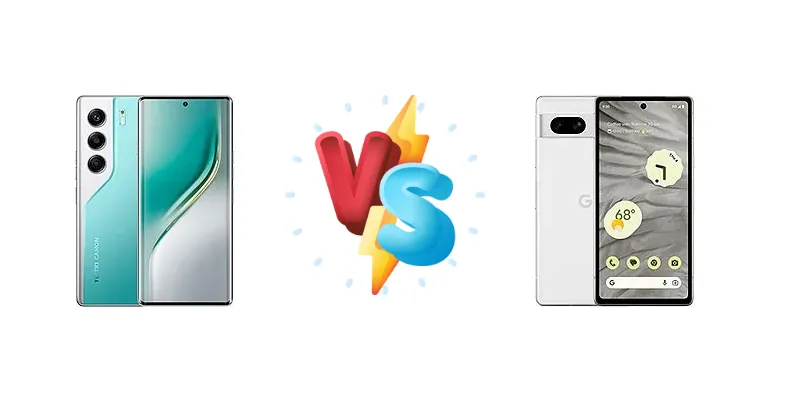
Tecno Camon 40 Pro vs Google Pixel 7a: A Detailed Comparison
| Phones Images | |||||
|---|---|---|---|---|---|
|
🏆 Quick Verdict
For the average user prioritizing camera quality and software experience, the Google Pixel 7a remains the stronger choice. However, the Tecno Camon 40 Pro delivers significantly faster charging and a comparable processor for those who value speed and battery top-ups over Google’s ecosystem.
| PHONES | ||
|---|---|---|
| Phone Names | Tecno Camon 40 Pro | Google Pixel 7a |
| Network | ||
|---|---|---|
| 2G bands | GSM 850 / 900 / 1800 / 1900 | GSM 850 / 900 / 1800 / 1900 |
| 3G bands | HSDPA 850 / 900 / 1700(AWS) / 1900 / 2100 | HSDPA 800 / 850 / 900 / 1700(AWS) / 1900 / 2100 |
| 4G bands | LTE | 1, 2, 3, 4, 5, 7, 8, 12, 13, 14, 17, 20, 25, 26, 28, 29, 30, 38, 40, 41, 48, 66, 71 - GWKK3, G0DZQ |
| 5G bands | SA/NSA | 1, 2, 3, 5, 7, 8, 12, 14, 20, 25, 28, 30, 38, 41, 48, 66, 71, 77, 78 SA/NSA/Sub6 - GWKK3 |
| Speed | HSPA, LTE, 5G | HSPA, LTE, 5G |
| Technology | GSM / HSPA / LTE / 5G | GSM / HSPA / LTE / 5G |
| - | 1, 2, 3, 5, 7, 8, 12, 20, 25, 28, 38, 40, 41, 66, 75, 76, 77, 78, 79 SA/NSA/Sub6 - GHL1X, G82U8 | |
| Launch | ||
|---|---|---|
| Announced | 2025, March 03 | 2023, May 10 |
| Status | Available. Released 2025, May | Available. Released 2023, May 10 |
| Body | ||
|---|---|---|
| Build | Glass front (Gorilla Glass 7i), plastic back, plastic frame | Glass front (Gorilla Glass 3), aluminum frame, plastic back |
| Dimensions | 164.3 x 74.6 x 7.3 mm (6.47 x 2.94 x 0.29 in) | 152 x 72.9 x 9 mm (5.98 x 2.87 x 0.35 in) |
| SIM | Nano-SIM + Nano-SIM | Nano-SIM + eSIM |
| Weight | 179 g (6.31 oz) | 193.5 g (6.84 oz) |
| - | IP67 dust/water resistant (up to 1m for 30 min) | |
| Display | ||
|---|---|---|
| Protection | Corning Gorilla Glass 7i | Corning Gorilla Glass 3 |
| Resolution | 1080 x 2436 pixels (~393 ppi density) | 1080 x 2400 pixels, 20:9 ratio (~429 ppi density) |
| Size | 6.78 inches, 109.9 cm2 (~89.7% screen-to-body ratio) | 6.1 inches, 90.7 cm2 (~81.8% screen-to-body ratio) |
| Type | AMOLED, 144Hz | OLED, HDR, 90Hz |
| - | Always-on display | |
| Platform | ||
|---|---|---|
| CPU | Octa-core (4x2.5 GHz Cortex-A78 & 4x2.0 GHz Cortex-A55) | Octa-core (2x2.85 GHz Cortex-X1 & 2x2.35 GHz Cortex-A78 & 4x1.80 GHz Cortex-A55) |
| Chipset | Mediatek Dimensity 7300 (4 nm) | Google Tensor G2 (5 nm) |
| GPU | Mali-G615 MC2 | Mali-G710 MP7 |
| OS | Android 15, up to 3 major Android upgrades, HIOS 15 | Android 13, upgradable to Android 15, up to 5 major Android upgrades |
| Memory | ||
|---|---|---|
| Card slot | No | No |
| Internal | 256GB 8GB RAM, 256GB 12GB RAM | 128GB 8GB RAM |
| - | UFS 3.1 | |
| Main Camera | ||
|---|---|---|
| Dual | 50 MP, f/1.9, 23mm (wide), 1/1.56", 1.0µm, PDAF, OIS 8 MP, (ultrawide), 1/4.0", 1.12µm, AF | 64 MP, f/1.9, 26mm (wide), 1/1.73", 0.8µm, dual pixel PDAF, OIS 13 MP, f/2.2, 120˚ (ultrawide), 1.12µm |
| Features | Dual-LED flash, HDR, panorama | Dual-LED flash, Pixel Shift, Auto-HDR, panorama |
| Video | 4K@30/60fps (HDR), 1080p@30fps | 4K@30/60fps, 1080p@30/60/120/240fps, OIS |
| Selfie camera | ||
|---|---|---|
| Features | - | HDR, panorama |
| Single | 50 MP, f/2.5, 24mm (wide), 1/2.8", 0.64µm, PDAF | 13 MP, f/2.2, 20mm (ultrawide), 1.12µm |
| Video | 4K@30fps, 1080p@30/60fps | 4K@30fps, 1080p@30fps |
| Sound | ||
|---|---|---|
| 3.5mm jack | - | No |
| 35mm jack | No | No |
| Loudspeaker | Yes, with stereo speakers | Yes, with stereo speakers |
| Comms | ||
|---|---|---|
| Bluetooth | Yes | 5.3, A2DP, LE |
| Infrared port | Yes | - |
| NFC | Yes | Yes |
| Positioning | GPS | GPS, GLONASS, GALILEO, BDS, QZSS, NavIC |
| Radio | FM radio | No |
| USB | USB Type-C 2.0, OTG | USB Type-C 3.2 |
| WLAN | Yes | Wi-Fi 802.11 a/b/g/n/ac/6e, tri-band |
| Features | ||
|---|---|---|
| Sensors | Fingerprint (under display, optical), accelerometer, gyro, proximity, compass | Fingerprint (under display, optical), accelerometer, gyro, proximity, compass, barometer |
| Battery | ||
|---|---|---|
| Charging | 45W wired, 50% in 23 min, 100% in 43 min | 18W wired, PD3.0 7.5W wireless |
| Type | 5200 mAh | Li-Po 4385 mAh |
| Misc | ||
|---|---|---|
| Colors | Emerald Lake Green, Galaxy Black, Glacier White | Charcoal, Snow, Sea, Coral |
| Models | CM7 | GWKK3, GHL1X, G0DZQ, G82U8 |
| Price | - | € 179.90 / $ 150.00 / £ 170.00 / ₹ 25,980 |
Tecno Camon 40 Pro
- Significantly faster 45W charging
- Potentially better thermal management with 4nm Dimensity 7300
- Strong CPU performance for demanding tasks
- Camera performance is unknown and likely trails the Pixel 7a
- Software support and updates may be less frequent than the Pixel 7a
Google Pixel 7a
- Exceptional camera image processing and quality
- Seamless software experience with guaranteed updates
- Strong AI and machine learning capabilities
- Slow 18W charging
- Chipset is older generation (Tensor G2)
Display Comparison
Both the Tecno Camon 40 Pro and Google Pixel 7a feature displays capable of reaching over 1000 nits of peak brightness, with the Pixel 7a marginally edging out the Camon 40 Pro at 1070 nits versus 1045 nits. While both are excellent for outdoor visibility, the specific panel technology and refresh rate (not provided for the Camon 40 Pro) will impact smoothness and power consumption. The Pixel 7a’s display is known for its color accuracy, a key benefit for content creators. Without knowing the Camon 40 Pro’s panel type, it’s difficult to assess its color gamut coverage or PWM dimming frequency, which impacts eye strain.
Camera Comparison
The Pixel 7a is renowned for its computational photography prowess, leveraging Google’s image processing algorithms to deliver consistently excellent photos, even in challenging lighting conditions. While the Camon 40 Pro’s camera specifications aren’t provided, the Pixel 7a’s strength lies in its software optimization, producing natural-looking images with accurate colors and excellent dynamic range. The Pixel 7a’s video capabilities are also highly regarded. Without knowing the Camon 40 Pro’s sensor size, aperture, and OIS implementation, it’s difficult to directly compare image quality, but the Pixel 7a’s established track record gives it a clear advantage in this category.
Performance
The chipset is where a significant difference emerges. The Google Pixel 7a’s Tensor G2, fabricated on a 5nm process, prioritizes AI and machine learning tasks, enhancing features like voice recognition and image processing. The Tecno Camon 40 Pro utilizes the Mediatek Dimensity 7300, a 4nm chip, which generally translates to better power efficiency and sustained performance under load. The Dimensity 7300’s octa-core configuration (4x2.5 GHz Cortex-A78 & 4x2.0 GHz Cortex-A55) is geared towards raw CPU power, while the Tensor G2 (2x2.85 GHz Cortex-X1 & 2x2.35 GHz Cortex-A78 & 4x1.80 GHz Cortex-A55) balances CPU and AI processing. The Cortex-X1 cores in the Pixel 7a offer peak performance advantages, but the 4nm process of the Dimensity 7300 may provide better thermal management during extended gaming sessions.
Battery Life
The Tecno Camon 40 Pro boasts a significant advantage in charging speed with its 45W wired charging, achieving 50% charge in 23 minutes and 100% in 43 minutes. The Pixel 7a’s 18W wired charging is considerably slower. While the Pixel 7a has an older endurance rating of 76h, this is a broad estimate. The Camon 40 Pro’s active use score of 13:51h provides a more concrete measure of real-world battery performance. The Dimensity 7300’s 4nm process may contribute to better power efficiency, potentially offsetting any capacity differences.
Buying Guide
Buy the Tecno Camon 40 Pro if you need blazing-fast 45W charging and prioritize raw processing power for demanding tasks. This phone is ideal for users who frequently game or transfer large files. Buy the Google Pixel 7a if you prefer a seamless software experience, exceptional camera image processing, and long-term software support, even if it means slower charging and a slightly older chipset.