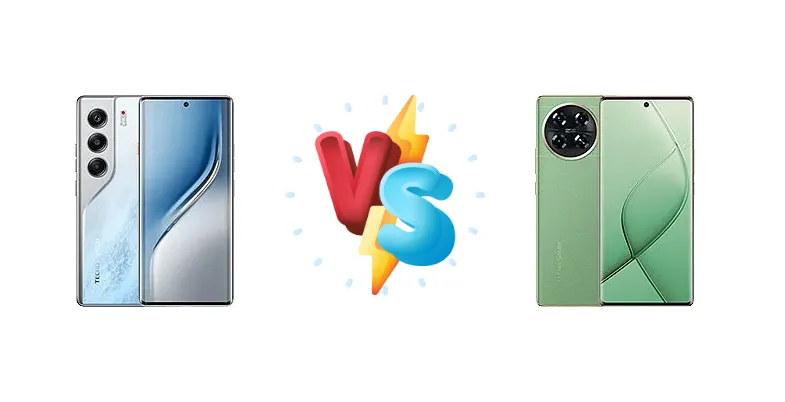
Tecno is rapidly expanding its presence in the mid-range smartphone market, offering compelling features at aggressive price points. The Camon 40 Pro 4G and Spark 20 Pro+ represent two distinct approaches: the Camon 40 Pro 4G prioritizes a newer chipset, while the Spark 20 Pro+ focuses on maximizing battery endurance. This comparison dissects their key differences to help you choose the right device.
🏆 Quick Verdict
For most users, the Tecno Spark 20 Pro+ emerges as the better overall choice. Its significantly longer battery life – nearly 12 hours of active use – outweighs the Camon 40 Pro 4G’s slightly newer chipset, especially considering both phones share the same CPU core configuration. The Spark 20 Pro+ delivers a more consistently usable experience throughout the day.
| Network |
|---|
| 2G bands | GSM 850 / 900 / 1800 / 1900 | GSM 850 / 900 / 1800 / 1900 |
| 3G bands | HSDPA 850 / 900 / 1700(AWS) / 1900 / 2100 | HSDPA 900 / 2100 |
| 4G bands | LTE | LTE |
| Speed | HSPA, LTE | HSPA, LTE |
| Technology | GSM / HSPA / LTE | GSM / HSPA / LTE |
| Launch |
|---|
| Announced | 2025, March 03 | 2023, December 29 |
| Status | Available. Released 2025, May | Available. Released 2024, February 09 |
| Body |
|---|
| Build | - | Glass front (Gorilla Glass 5), plastic back, plastic frame |
| Dimensions | 164.4 x 74.3 x 7.3 mm (6.47 x 2.93 x 0.29 in) | 164.7 x 75 x 7.6 mm (6.48 x 2.95 x 0.30 in) |
| SIM | Nano-SIM + Nano-SIM | Nano-SIM + Nano-SIM |
| Weight | 178 g (6.28 oz) | 179 g (6.31 oz) |
| Display |
|---|
| Protection | Corning Gorilla Glass 7i | Corning Gorilla Glass 5 |
| Resolution | 1080 x 2436 pixels (~393 ppi density) | 1080 x 2436 pixels (~393 ppi density) |
| Size | 6.78 inches, 109.9 cm2 (~90.0% screen-to-body ratio) | 6.78 inches, 109.9 cm2 (~89.0% screen-to-body ratio) |
| Type | AMOLED, 120Hz | AMOLED, 1B colors, 120Hz, 1000 nits (peak) |
| Platform |
|---|
| CPU | Octa-core (2x2.2 GHz Cortex-A76 & 6x2.0 GHz Cortex-A55) | Octa-core (2x2.2 GHz Cortex-A76 & 6x2.0 GHz Cortex-A55) |
| Chipset | Mediatek Helio G100 Ultimate (6 nm) | Mediatek Helio G99 Ultimate |
| GPU | Mali-G57 MC2 | Mali-G57 MC2 |
| OS | Android 15, up to 3 major Android upgrades, HIOS 15 | Android 14 |
| Memory |
|---|
| Card slot | Unspecified | No |
| Internal | 256GB 8GB RAM | 256GB 8GB RAM |
| Main Camera |
|---|
| Dual | 50 MP, f/1.9, 23mm (wide), 1/1.56", 1.0µm, PDAF, OIS
8 MP, (ultrawide) | 108 MP, f/1.8, (wide), 1/1.67", 0.64µm, PDAF
2 MP (macro) |
| Features | Dual-LED flash, HDR, panorama | Quad-LED flash, HDR |
| Video | 4K@30/60fps (HDR), 1080p@30fps | 1440p@30fps, 1080p@30fps |
| Selfie camera |
|---|
| Features | - | Dual-LED flash |
| Single | 50 MP, f/2.5, 24mm (wide), 1/2.8", 0.64µm, PDAF | 32 MP, f/2.2, (wide), 1/3.1", 0.7µm |
| Video | Yes | 1440p@30fps, 1080p@30/60fps |
| Sound |
|---|
| 35mm jack | No | No |
| Loudspeaker | Yes, with stereo speakers | Yes, with stereo speakers |
| Comms |
|---|
| Bluetooth | Yes | 5.2, A2DP, LE |
| Infrared port | Yes | - |
| NFC | Yes | Yes |
| Positioning | GPS | GPS, GLONASS |
| Radio | FM radio | FM radio |
| USB | USB Type-C 2.0, OTG | USB Type-C |
| WLAN | Yes | Wi-Fi 802.11 a/b/g/n/ac, dual-band |
| Features |
|---|
| Sensors | Fingerprint (under display, optical), accelerometer, gyro, proximity, compass | Fingerprint (under display, optical), accelerometer, gyro, proximity, compass |
| Battery |
|---|
| Charging | 45W wired, 50% in 23 min, 100% in 43 min | 33W wired |
| Type | 5200 mAh | 5000 mAh |
| Misc |
|---|
| Colors | Emerald Lake Green, Galaxy Black, Glacier White | Temporal Orbits, Lunar Frost, Radiant Starstream, Magic Skin 2.0 Green |
| Models | CM6 | KJ7 |
Tecno Camon 40 Pro 4G
- Faster 45W charging
- Potentially slightly more efficient chipset (Helio G100)
- Newer chipset generation
- Likely shorter battery life
- Unknown display specifications
- Camera details are limited
Tecno Spark 20 Pro+
- Exceptional 11:56h active battery life
- Brighter 549 nit display
- Proven Helio G99 performance
- Slower 33W charging
- Older chipset generation
- May not be ideal for intensive gaming
Display Comparison
The Tecno Spark 20 Pro+ boasts a measured peak brightness of 549 nits, a crucial advantage for outdoor visibility. While both phones likely utilize similar LCD panel technology given their price bracket, the Spark 20 Pro+'s higher brightness translates to a more usable experience in direct sunlight. Details regarding refresh rates, resolution, and color gamut are missing, but both likely target a standard 6.67-inch FHD+ experience common in this segment. The Camon 40 Pro 4G’s display specifications remain unknown, making a direct comparison difficult.
Camera Comparison
Without detailed camera specifications beyond the main sensor, a comprehensive comparison is challenging. Both phones likely feature multi-camera setups with a focus on versatility. The absence of information regarding sensor size, aperture, and optical image stabilization (OIS) makes it difficult to assess image quality. The presence of a 2MP macro lens on either device is unlikely to significantly impact the overall camera experience, serving primarily as a marketing feature. Image processing algorithms will play a crucial role in differentiating the two, but this requires hands-on testing.
Performance
Both the Tecno Camon 40 Pro 4G and Spark 20 Pro+ are powered by an octa-core CPU configuration featuring 2x2.2 GHz Cortex-A76 cores and 6x2.0 GHz Cortex-A55 cores. However, the underlying chipsets differ: the Camon 40 Pro 4G utilizes the Mediatek Helio G100 Ultimate (6nm), while the Spark 20 Pro+ employs the Helio G99 Ultimate. The G99, despite being an older generation, is known for its efficiency and optimized performance. The 6nm process of the G100 *should* offer slightly better power efficiency, but the real-world impact is likely minimal given the shared CPU architecture. The G99’s mature drivers and optimization may provide a smoother experience in some scenarios.
Battery Life
The Tecno Spark 20 Pro+ clearly wins in battery endurance, achieving an impressive 11:56h of active use. The Camon 40 Pro 4G’s battery capacity is unknown, but its 45W charging capability is faster than the Spark 20 Pro+'s 33W charging. The Camon 40 Pro 4G can reach 50% charge in 23 minutes and 100% in 43 minutes. While faster charging is convenient, the Spark 20 Pro+'s extended battery life minimizes the need for frequent top-ups, making it more practical for users who prioritize longevity.
Buying Guide
Buy the Tecno Camon 40 Pro 4G if you prioritize the latest chipset iteration and anticipate needing the marginally improved processing power for demanding tasks, even at the cost of battery life. Buy the Tecno Spark 20 Pro+ if you value all-day battery life and consistent performance for everyday tasks, making it ideal for users who are frequently on the go or rely heavily on their phone throughout the day.
Frequently Asked Questions
❓ Does the Helio G99 in the Spark 20 Pro+ struggle with demanding games like PUBG or Call of Duty?
The Helio G99 is a capable chipset for mid-range gaming. While it won't deliver flagship-level performance, it can handle PUBG and Call of Duty at medium settings with reasonable frame rates. Expect some frame drops during intense action, but the overall experience should be playable. The Camon 40 Pro 4G's G100 might offer a slight edge, but the difference is unlikely to be substantial.
❓ How significant is the difference in charging speed between 33W and 45W in real-world use?
While 45W charging (Camon 40 Pro 4G) is faster on paper, the difference isn't always dramatic. The Camon 40 Pro 4G gains about 22 minutes to a full charge. The Spark 20 Pro+'s longer battery life means you'll likely need to charge it less frequently, mitigating the slower charging speed. For many users, the convenience of less frequent charging outweighs the benefit of faster charging.
❓ Is the lack of OIS on either phone a major drawback for video recording?
The absence of Optical Image Stabilization (OIS) will likely result in shakier videos, especially when shooting handheld. Electronic Image Stabilization (EIS) will be present, but it's less effective than OIS. If video recording is a priority, consider a phone with OIS, but for casual use, the lack of OIS is manageable.