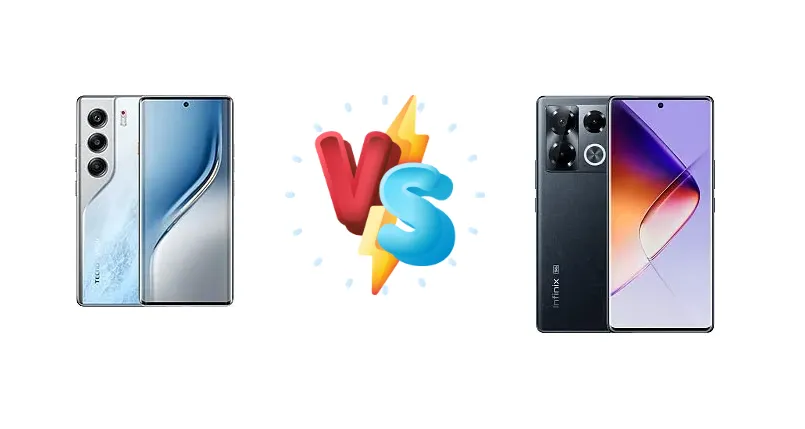
Tecno and Infinix consistently deliver compelling mid-range smartphones, often pushing boundaries in charging technology and camera capabilities. The Tecno Camon 40 Pro 4G and the Infinix Note 40 Pro+ represent distinct approaches: the Camon 40 Pro 4G focuses on a balanced experience, while the Note 40 Pro+ aggressively targets charging speed and convenience with its 100W wired and 20W MagCharge wireless capabilities. This comparison dissects their key differences to determine which device best suits your needs.
🏆 Quick Verdict
For the average user prioritizing rapid charging and a brighter display, the Infinix Note 40 Pro+ is the clear winner. Its 100W charging significantly reduces downtime, and the 1130 nits peak brightness provides excellent outdoor visibility. However, the Tecno Camon 40 Pro 4G remains a strong contender for those seeking a more balanced package at a potentially lower price point.
| Network |
|---|
| 2G bands | GSM 850 / 900 / 1800 / 1900 | GSM 850 / 900 / 1800 / 1900 |
| 3G bands | HSDPA 850 / 900 / 1700(AWS) / 1900 / 2100 | HSDPA 850 / 900 / 1700(AWS) / 1900 / 2100 |
| 4G bands | LTE | 1, 2, 3, 4, 5, 7, 8, 12, 17, 20, 28, 38, 40, 41, 42, 66 |
| 5G bands | - | 1, 3, 5, 7, 8, 12, 20, 28, 38, 40, 41, 66, 77, 78 SA/NSA |
| Speed | HSPA, LTE | HSPA, LTE, 5G |
| Technology | GSM / HSPA / LTE | GSM / HSPA / LTE / 5G |
| Launch |
|---|
| Announced | 2025, March 03 | 2024, March 18 |
| Status | Available. Released 2025, May | Available. Released 2024, March 19 |
| Body |
|---|
| Build | - | Glass front, plastic frame, silicone polymer (eco leather) back |
| Dimensions | 164.4 x 74.3 x 7.3 mm (6.47 x 2.93 x 0.29 in) | 164.3 x 74.5 x 8.1 mm (6.47 x 2.93 x 0.32 in) |
| SIM | Nano-SIM + Nano-SIM | Nano-SIM + Nano-SIM |
| Weight | 178 g (6.28 oz) | 190 g or 196 g (6.70 oz) |
| Display |
|---|
| Protection | Corning Gorilla Glass 7i | Corning Gorilla Glass |
| Resolution | 1080 x 2436 pixels (~393 ppi density) | 1080 x 2436 pixels (~393 ppi density) |
| Size | 6.78 inches, 109.9 cm2 (~90.0% screen-to-body ratio) | 6.78 inches, 109.9 cm2 (~89.8% screen-to-body ratio) |
| Type | AMOLED, 120Hz | AMOLED, 1B colors, 120Hz, 1300 nits (peak) |
| Platform |
|---|
| CPU | Octa-core (2x2.2 GHz Cortex-A76 & 6x2.0 GHz Cortex-A55) | Octa-core (2x2.2 GHz Cortex-A78 & 6x2.0 GHz Cortex-A55) |
| Chipset | Mediatek Helio G100 Ultimate (6 nm) | Mediatek Dimensity 7020 (6 nm) |
| GPU | Mali-G57 MC2 | IMG BXM-8-256 |
| OS | Android 15, up to 3 major Android upgrades, HIOS 15 | Android 14, up to 2 major Android upgrades, XOS 14 |
| Memory |
|---|
| Card slot | Unspecified | No |
| Internal | 256GB 8GB RAM | 256GB 12GB RAM, 512GB 12GB RAM |
| Main Camera |
|---|
| Dual | 50 MP, f/1.9, 23mm (wide), 1/1.56", 1.0µm, PDAF, OIS
8 MP, (ultrawide) | - |
| Features | Dual-LED flash, HDR, panorama | Dual-LED flash, HDR, panorama |
| Triple | - | 108 MP, f/1.8, 24mm (wide), 1/1.67", 0.64µm, PDAF, OIS
2 MP, f/2.4
2 MP, f/2.4 |
| Video | 4K@30/60fps (HDR), 1080p@30fps | 1440p@30fps, 1080p@30/60fps |
| Selfie camera |
|---|
| Features | - | Dual-LED flash |
| Single | 50 MP, f/2.5, 24mm (wide), 1/2.8", 0.64µm, PDAF | 32 MP, f/2.2, (wide), 1/3.1", 0.7µm |
| Video | Yes | 1440p@30fps, 1080p@30/60fps |
| Sound |
|---|
| 35mm jack | No | No |
| Loudspeaker | Yes, with stereo speakers | Yes, with stereo speakers |
| Comms |
|---|
| Bluetooth | Yes | Yes |
| Infrared port | Yes | Yes |
| NFC | Yes | Yes (market/region dependent) |
| Positioning | GPS | GPS |
| Radio | FM radio | FM radio |
| USB | USB Type-C 2.0, OTG | USB Type-C 2.0, OTG |
| WLAN | Yes | Wi-Fi 802.11 a/b/g/n/ac, dual-band |
| Features |
|---|
| Sensors | Fingerprint (under display, optical), accelerometer, gyro, proximity, compass | Fingerprint (under display, optical), accelerometer, gyro, proximity, compass |
| Battery |
|---|
| Charging | 45W wired, 50% in 23 min, 100% in 43 min | 100W wired, 50% in 12 min
20W wireless MagCharge
Reverse wired
Reverse wireless |
| Type | 5200 mAh | 4600 mAh |
| Misc |
|---|
| Colors | Emerald Lake Green, Galaxy Black, Glacier White | Obsidian Black, Vintage Green, Racing Edition |
| Models | CM6 | X6851B |
| Price | - | About 290 EUR |
Tecno Camon 40 Pro 4G
- Potentially more affordable price point
- Balanced feature set
- Reliable Mediatek Helio G100 Ultimate performance
- Slower charging speeds (45W)
- Likely less bright display
- Less advanced chipset compared to Dimensity 7020
Infinix Note 40 Pro+
- Ultra-fast 100W wired charging
- 20W MagCharge wireless charging
- Brighter 1130 nits display
- Potentially higher price
- Dimensity 7020 may run hotter under sustained load
- Image processing may be overly aggressive
Display Comparison
The Infinix Note 40 Pro+ boasts a significantly brighter display, reaching a measured 1130 nits peak brightness, compared to an unstated value for the Tecno Camon 40 Pro 4G. This brightness advantage translates to superior visibility in direct sunlight. While both likely utilize AMOLED panels given their brand tendencies, the Note 40 Pro+’s brightness is a tangible benefit. We expect both to have FHD+ resolutions, but the Note 40 Pro+’s brightness is a clear differentiator. Details on PWM dimming rates are missing, but this is a crucial factor for users sensitive to flicker.
Camera Comparison
Without detailed camera specs beyond the main sensors, a direct comparison is difficult. However, the market positioning suggests the Infinix Note 40 Pro+ may prioritize camera features more heavily. Both brands often include high-resolution sensors, but image processing algorithms and optical image stabilization (OIS) are critical differentiators. The aperture of the main lens will also impact low-light performance. We anticipate both phones will include a suite of AI-powered camera modes, but the quality of these modes will vary.
Performance
The core performance difference lies in the chipsets. The Infinix Note 40 Pro+ utilizes the Mediatek Dimensity 7020 (6nm), featuring Cortex-A78 cores, which offer a performance uplift over the Cortex-A76 cores found in the Tecno Camon 40 Pro 4G’s Helio G100 Ultimate (6nm). The A78 architecture generally provides better single-core performance, impacting app launch speeds and responsiveness. While both chips are 6nm, the Dimensity 7020’s more modern core design gives it an edge in demanding tasks. Both phones share 6x2.0 GHz Cortex-A55 efficiency cores, meaning multi-core performance will be closer, but the Note 40 Pro+ will likely maintain a lead. RAM configurations are not specified, but LPDDR5x would be a significant advantage for either device.
Battery Life
The Infinix Note 40 Pro+’s 100W wired charging is its standout feature, achieving a 50% charge in just 12 minutes and a full charge in under an hour. The Tecno Camon 40 Pro 4G’s 45W charging, while respectable, takes significantly longer – 23 minutes for 50% and 43 minutes for a full charge. The Note 40 Pro+ also adds 20W MagCharge wireless charging and reverse wired/wireless charging, offering unparalleled versatility. The Note 40 Pro+ also has a reported active use score of 12:23h, suggesting excellent battery optimization, though the Camon 40 Pro 4G’s battery capacity is unknown, making a direct comparison challenging.
Buying Guide
Buy the Tecno Camon 40 Pro 4G if you need a reliable all-rounder with decent performance and don't prioritize the absolute fastest charging speeds. It's ideal for users who value a consistent experience over cutting-edge features. Buy the Infinix Note 40 Pro+ if you prioritize minimizing charging time, appreciate a very bright display, and are drawn to the convenience of MagCharge wireless charging – especially if you already use magnetic accessories.
Frequently Asked Questions
❓ Does the Dimensity 7020 in the Infinix Note 40 Pro+ tend to overheat during prolonged gaming sessions?
While the Dimensity 7020 is a capable chip, its thermal performance depends heavily on the phone's cooling system. Without specific thermal testing data, it's difficult to say definitively. However, the 6nm process and the Note series' history suggest Infinix has implemented adequate cooling to mitigate throttling during moderate gaming. Sustained, high-graphics gaming may still lead to some heat buildup.
❓ Is the MagCharge wireless charging on the Infinix Note 40 Pro+ compatible with all magnetic accessories?
The Infinix Note 40 Pro+ utilizes the MagCharge standard, which is based on the MagSafe technology popularized by Apple. While it's generally compatible with MagSafe accessories, full functionality (like data transfer) isn't guaranteed with all third-party accessories. It's best to check compatibility with specific accessories before purchasing.
❓ How does the 45W charging on the Tecno Camon 40 Pro 4G compare to other phones in its price range?
45W charging is fairly standard for phones in the mid-range segment. While not as fast as the 100W on the Infinix Note 40 Pro+, it's still significantly faster than the 15W-25W charging found on many competing devices. It provides a reasonable balance between charging speed and cost.