
Tecno Camon 40 Premier vs. Google Pixel 7a: A Deep Dive Comparison
| Phones Images | |||||
|---|---|---|---|---|---|
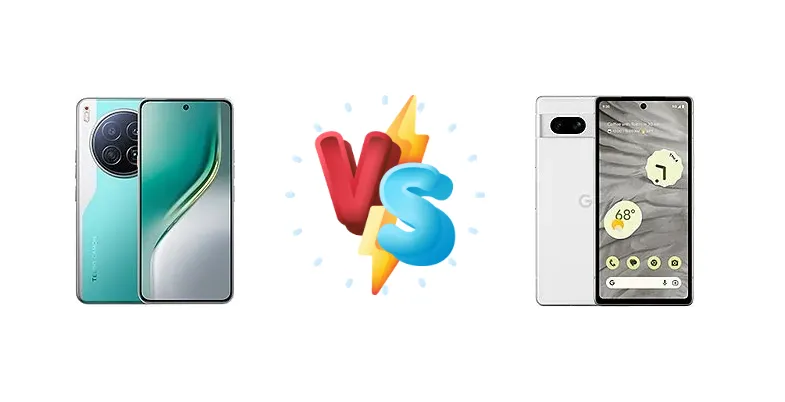
|
🏆 Quick Verdict
For users prioritizing raw performance and fast charging, the Tecno Camon 40 Premier emerges as the winner. Its Dimensity 8350 chipset and 70W charging significantly outperform the Pixel 7a’s Tensor G2 and 18W charging. However, the Pixel 7a retains an edge in camera image processing and software experience.
| PHONES | ||
|---|---|---|
| Phone Names | Tecno Camon 40 Premier | Google Pixel 7a |
| Network | ||
|---|---|---|
| 2G bands | GSM 850 / 900 / 1800 / 1900 | GSM 850 / 900 / 1800 / 1900 |
| 3G bands | HSDPA 850 / 900 / 1700(AWS) / 1900 / 2100 | HSDPA 800 / 850 / 900 / 1700(AWS) / 1900 / 2100 |
| 4G bands | LTE | 1, 2, 3, 4, 5, 7, 8, 12, 13, 14, 17, 20, 25, 26, 28, 29, 30, 38, 40, 41, 48, 66, 71 - GWKK3, G0DZQ |
| 5G bands | SA/NSA | 1, 2, 3, 5, 7, 8, 12, 14, 20, 25, 28, 30, 38, 41, 48, 66, 71, 77, 78 SA/NSA/Sub6 - GWKK3 |
| Speed | HSPA, LTE, 5G | HSPA, LTE, 5G |
| Technology | GSM / HSPA / LTE / 5G | GSM / HSPA / LTE / 5G |
| - | 1, 2, 3, 5, 7, 8, 12, 20, 25, 28, 38, 40, 41, 66, 75, 76, 77, 78, 79 SA/NSA/Sub6 - GHL1X, G82U8 | |
| Launch | ||
|---|---|---|
| Announced | 2025, March 03 | 2023, May 10 |
| Status | Available. Released 2025, May | Available. Released 2023, May 10 |
| Body | ||
|---|---|---|
| Build | Glass front (Gorilla Glass 7i), plastic back, plastic frame | Glass front (Gorilla Glass 3), aluminum frame, plastic back |
| Dimensions | 161 x 75 x 7.7 mm (6.34 x 2.95 x 0.30 in) | 152 x 72.9 x 9 mm (5.98 x 2.87 x 0.35 in) |
| SIM | Nano-SIM + Nano-SIM | Nano-SIM + eSIM |
| Weight | 193 g (7.41 oz) | 193.5 g (6.84 oz) |
| - | IP67 dust/water resistant (up to 1m for 30 min) | |
| Display | ||
|---|---|---|
| Protection | Corning Gorilla Glass 7i | Corning Gorilla Glass 3 |
| Resolution | 1260 x 2800 pixels, 20:9 ratio (~460 ppi density) | 1080 x 2400 pixels, 20:9 ratio (~429 ppi density) |
| Size | 6.67 inches, 107.4 cm2 (~89.0% screen-to-body ratio) | 6.1 inches, 90.7 cm2 (~81.8% screen-to-body ratio) |
| Type | LTPO AMOLED, 1B colors, 144Hz, 2160Hz PWM, HDR, 1600 nits (HBM) | OLED, HDR, 90Hz |
| - | Always-on display | |
| Platform | ||
|---|---|---|
| CPU | Octa-core (1x3.35 GHz Cortex-A715 & 3x3.20 GHz Cortex-A715 & 4x2.20 GHz Cortex-A510) | Octa-core (2x2.85 GHz Cortex-X1 & 2x2.35 GHz Cortex-A78 & 4x1.80 GHz Cortex-A55) |
| Chipset | Mediatek Dimensity 8350 (4 nm) | Google Tensor G2 (5 nm) |
| GPU | Mali G615-MC6 | Mali-G710 MP7 |
| OS | Android 15, up to 3 major Android upgrades, HIOS 15 | Android 13, upgradable to Android 15, up to 5 major Android upgrades |
| Memory | ||
|---|---|---|
| Card slot | No | No |
| Internal | 256GB 12GB RAM | 128GB 8GB RAM |
| - | UFS 3.1 | |
| Main Camera | ||
|---|---|---|
| Dual | - | 64 MP, f/1.9, 26mm (wide), 1/1.73", 0.8µm, dual pixel PDAF, OIS 13 MP, f/2.2, 120˚ (ultrawide), 1.12µm |
| Features | Dual-LED flash, HDR, panorama | Dual-LED flash, Pixel Shift, Auto-HDR, panorama |
| Triple | 50 MP, f/1.9, 23mm (wide), 1/1.56", 1.0µm, PDAF, OIS 50 MP, f/2.2, 70mm (periscope telephoto), 1/2.76", 0.64µm, PDAF (15cm - ∞), 3x optical zoom 50 MP, f/2.2, 14mm, 114˚ (ultrawide), 1/2.76", 0.64µm, PDAF | - |
| Video | 4K@30/60fps (HDR), 1080p@30fps | 4K@30/60fps, 1080p@30/60/120/240fps, OIS |
| Selfie camera | ||
|---|---|---|
| Features | - | HDR, panorama |
| Single | 50 MP, f/2.5, 24mm (wide), 1/2.8", 0.64µm, PDAF | 13 MP, f/2.2, 20mm (ultrawide), 1.12µm |
| Video | 4K@30fps, 1080p | 4K@30fps, 1080p@30fps |
| Sound | ||
|---|---|---|
| 3.5mm jack | - | No |
| 35mm jack | No | No |
| Loudspeaker | Yes, with stereo speakers | Yes, with stereo speakers |
| Comms | ||
|---|---|---|
| Bluetooth | Yes | 5.3, A2DP, LE |
| Infrared port | Yes | - |
| NFC | Yes | Yes |
| Positioning | GPS | GPS, GLONASS, GALILEO, BDS, QZSS, NavIC |
| Radio | FM radio | No |
| USB | USB Type-C 2.0, OTG | USB Type-C 3.2 |
| WLAN | Yes | Wi-Fi 802.11 a/b/g/n/ac/6e, tri-band |
| Features | ||
|---|---|---|
| Sensors | Fingerprint (under display, optical), accelerometer, gyro, proximity, compass | Fingerprint (under display, optical), accelerometer, gyro, proximity, compass, barometer |
| Battery | ||
|---|---|---|
| Charging | 70W wired | 18W wired, PD3.0 7.5W wireless |
| Type | Si/C Li-Ion 5100 mAh | Li-Po 4385 mAh |
| Misc | ||
|---|---|---|
| Colors | Emerald Lake Green, Galaxy Black | Charcoal, Snow, Sea, Coral |
| Models | CM8 | GWKK3, GHL1X, G0DZQ, G82U8 |
| Price | - | € 179.90 / $ 150.00 / £ 170.00 / ₹ 25,980 |
Tecno Camon 40 Premier
- Faster charging with 70W wired support
- Potentially superior raw performance with Dimensity 8350
- Longer battery life in active use
- Display brightness is lower than the Pixel 7a
- Camera image processing likely not as refined as the Pixel 7a
Google Pixel 7a
- Brighter display for better outdoor visibility
- Exceptional camera image processing and AI features
- Smooth software experience with guaranteed updates
- Slower charging speed at 18W
- Less powerful chipset for demanding tasks
Display Comparison
The Pixel 7a boasts a significantly brighter display, reaching 1070 nits compared to the Camon 40 Premier’s 658 nits. This translates to superior visibility under direct sunlight. While both likely utilize OLED panels, the Pixel’s higher peak brightness is a clear advantage for outdoor use. The Camon 40 Premier’s display specifications lack details regarding refresh rate or PWM dimming, potentially impacting smoothness and eye strain for sensitive users, while the Pixel 7a is known for its smooth 90Hz refresh rate.
Camera Comparison
The Pixel 7a’s camera prowess is well-documented, leveraging Google’s computational photography expertise. While the Camon 40 Premier’s camera specs are not provided, the Pixel 7a’s strength lies in its image processing, delivering consistently excellent photos and videos, particularly in challenging lighting conditions. The Pixel 7a’s video capabilities are also a strong point, offering excellent stabilization and dynamic range. Without detailed camera specs for the Camon 40 Premier, it’s difficult to assess its capabilities beyond sensor size and resolution.
Performance
The chipset battle pits MediaTek’s Dimensity 8350 (4nm) against Google’s Tensor G2 (5nm). The Dimensity 8350, with its Cortex-A715 cores clocked up to 3.35 GHz, appears to offer a raw performance advantage over the Tensor G2’s Cortex-X1 cores at 2.85 GHz. The 4nm process node of the Dimensity 8350 also suggests better power efficiency. However, the Tensor G2 excels in AI and machine learning tasks, powering features like Magic Eraser and Real Tone. The Pixel 7a’s LPDDR5 RAM is likely paired with UFS 3.1 storage, while the Camon 40 Premier’s RAM and storage configuration is unspecified, potentially impacting application loading times.
Battery Life
The Tecno Camon 40 Premier demonstrates superior battery endurance with an active use score of 11:36h, significantly exceeding the Pixel 7a’s reported 76-hour endurance rating (which is a different metric). This is further bolstered by the Camon 40 Premier’s 70W wired charging, enabling significantly faster charging times compared to the Pixel 7a’s 18W charging with PD3.0. The Pixel 7a does offer 7.5W wireless charging, a feature absent on the Camon 40 Premier, but the charging speed is considerably slower.
Buying Guide
Buy the Tecno Camon 40 Premier if you need a phone for demanding tasks like gaming, video editing, or heavy multitasking, and value rapid charging speeds. Buy the Google Pixel 7a if you prioritize a streamlined software experience, exceptional camera image quality, and Google’s AI-powered features, even if it means sacrificing some raw processing power and charging speed.