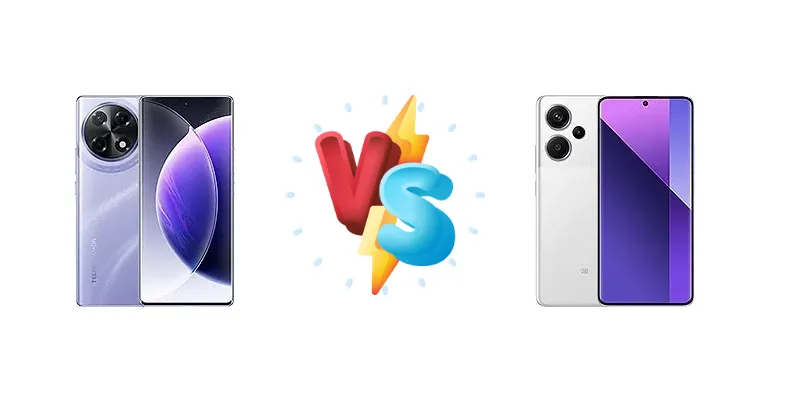
The Tecno Camon 30S and Xiaomi Redmi Note 13 Pro+ represent compelling options in the increasingly competitive mid-range smartphone market. The Camon 30S aims to deliver solid performance at a value price point, while the Redmi Note 13 Pro+ pushes the boundaries with its blazing-fast charging and more powerful chipset. This comparison dissects their key differences to determine which device best suits your needs.
🏆 Quick Verdict
For the average user prioritizing sustained performance and rapid charging, the Xiaomi Redmi Note 13 Pro+ is the clear winner. Its Dimensity 7200 Ultra chipset and 120W charging significantly outperform the Tecno Camon 30S's Helio G100 and 33W charging, despite the Camon 30S offering a potentially lower entry price.
| Network |
|---|
| 2G bands | GSM 850 / 900 / 1800 / 1900 | GSM 850 / 900 / 1800 / 1900 |
| 3G bands | HSDPA 850 / 900 / 2100 | HSDPA 800 / 850 / 900 / 1700(AWS) / 1900 / 2100 - International |
| 4G bands | LTE | 1, 2, 3, 4, 5, 7, 8, 12, 13, 17, 18, 19, 20, 26, 28, 32, 38, 40, 41, 66 - International |
| 5G bands | - | 1, 3, 5, 7, 8, 20, 28, 38, 40, 41, 66, 77, 78 SA/NSA- International |
| Speed | HSPA, LTE | HSPA, LTE, 5G |
| Technology | GSM / HSPA / LTE | GSM / CDMA / HSPA / EVDO / LTE / 5G |
| Launch |
|---|
| Announced | 2024, October 10 | 2023, September 21 |
| Status | Available. Released 2024, October 10 | Available. Released 2023, September 21 |
| Body |
|---|
| Build | - | Glass front (Gorilla Glass Victus), glass back or silicone polymer back (eco leather) |
| Dimensions | 164.5 x 74.6 x 7.6 mm (6.48 x 2.94 x 0.30 in) | 161.4 x 74.2 x 8.9 mm (6.35 x 2.92 x 0.35 in) |
| SIM | Nano-SIM + Nano-SIM | · Nano-SIM + eSIM· Nano-SIM + Nano-SIM |
| Weight | - | 199 g or 204.5 g (7.02 oz) |
| Display |
|---|
| Protection | Corning Gorilla Glass | Corning Gorilla Glass Victus |
| Resolution | 1080 x 2436 pixels (~393 ppi density) | 1220 x 2712 pixels, 20:9 ratio (~446 ppi density) |
| Size | 6.78 inches, 109.9 cm2 (~89.5% screen-to-body ratio) | 6.67 inches, 107.4 cm2 (~89.7% screen-to-body ratio) |
| Type | AMOLED, 120Hz, 1300 nits (HBM) | AMOLED, 68B colors, 120Hz, 1920Hz PWM, Dolby Vision, HDR10+, 1800 nits (peak) |
| Platform |
|---|
| CPU | Octa-core (2x2.2 GHz Cortex-A76 & 6x2.0 GHz Cortex-A55) | Octa-core (2x2.8 GHz Cortex-A715 & 6x2.0 GHz Cortex-A510) |
| Chipset | Mediatek Helio G100 (6 nm) | Mediatek Dimensity 7200 Ultra (4 nm) |
| GPU | Mali-G57 MC2 | Mali-G610 MC4 |
| OS | Android 14, up to 2 major Android upgrades, HIOS 14 | Android 13, up to 3 major Android upgrades, HyperOS |
| Memory |
|---|
| Card slot | Unspecified | No |
| Internal | 128GB 6GB RAM, 128GB 8GB RAM, 256GB 8GB RAM | 256GB 8GB RAM, 256GB 12GB RAM, 512GB 8GB RAM, 512GB 12GB RAM, 512GB 16GB RAM |
| Main Camera |
|---|
| Features | Dual-LED flash, HDR, panorama | Dual-LED dual-tone flash, HDR, panorama |
| Triple | 50 MP, f/1.9, (wide), 1/1.56", 1.0µm, PDAF, OIS
Auxiliary lenses | 200 MP, f/1.7, 23mm (wide), 1/1.4", 0.56µm, multi-directional PDAF, OIS
8 MP, f/2.2, 16mm, 120˚ (ultrawide), 1/4.0", 1.12µm
2 MP (macro) |
| Video | Yes | 4K@24/30fps, 1080p@30/60/120fps, gyro-EIS |
| Selfie camera |
|---|
| Features | Dual-LED flash | HDR, panorama |
| Single | 13 MP | 16 MP, f/2.4, (wide) |
| Video | Yes | 1080p@30/60fps |
| Sound |
|---|
| 35mm jack | No | No |
| Loudspeaker | Yes, with dual speakers | Yes, with stereo speakers |
| Comms |
|---|
| Bluetooth | Yes | 5.3, A2DP, LE |
| Infrared port | Yes | Yes |
| NFC | Yes | Yes (market/region dependent) |
| Positioning | GPS | GPS, GLONASS, BDS, GALILEO, QZSS |
| Radio | FM radio | No |
| USB | USB Type-C 2.0, OTG | USB Type-C 2.0, OTG |
| WLAN | Yes | Wi-Fi 802.11 a/b/g/n/ac/6, dual-band, Wi-Fi Direct |
| Features |
|---|
| Sensors | Fingerprint (under display, optical), accelerometer, gyro, proximity, compass | Fingerprint (under display, optical), accelerometer, gyro, proximity, compass |
| Battery |
|---|
| Charging | 33W wired, 0-100% in 45 min | 120W wired, PD3.0, 100% in 19 min |
| Type | 5000 mAh | Li-Po 5000 mAh |
| Misc |
|---|
| Colors | Nebula Violet, Blue, Celestial Black, Dawn Gold | Midnight Black (Fushion Black), Moonlight White (Fushion White), Aurora Purple, Fushion Purple, Camo Green |
| Models | CLA5 | 23090RA98C, 23090RA98G, 23090RA98I |
| Price | About 200 EUR | $ 299.98 / £ 299.00 / € 208.98 / ₹ 24,999 |
| SAR | - | 1.09 W/kg (head) 0.85 W/kg (body) |
| SAR EU | - | 0.98 W/kg (head) 1.00 W/kg (body) |
Tecno Camon 30S
- Potentially more affordable price point
- Decent performance for everyday tasks
- Functional and reliable
- Slower charging speed (33W)
- Less powerful chipset (Helio G100)
- Likely lower display brightness
Xiaomi Redmi Note 13 Pro+
- Blazing-fast 120W charging
- More powerful chipset (Dimensity 7200 Ultra)
- Brighter display (1283 nits)
- Longer battery life (10:38h active use)
- Higher price tag
- May be overkill for basic users
- Potentially larger and heavier build
Display Comparison
The Redmi Note 13 Pro+ boasts a significantly brighter display, reaching a measured peak of 1283 nits. This is crucial for outdoor visibility, a clear advantage over the Camon 30S (brightness data unavailable, but likely lower given the chipset and price point). While both likely utilize AMOLED panels, the Redmi’s higher brightness and potential for higher refresh rates (not specified in the data, but common for this class) contribute to a more vibrant and responsive viewing experience. The Redmi Note 13 Pro+’s display is geared towards users who consume a lot of media outdoors or demand a premium visual experience.
Camera Comparison
Without detailed camera specs, a direct comparison is limited. However, the Redmi Note 13 Pro+’s chipset provides a more powerful image signal processor (ISP), enabling faster image processing and potentially better low-light performance. While the Camon 30S may offer acceptable image quality in good lighting conditions, the Redmi Note 13 Pro+ is expected to deliver more consistent results across various scenarios. The Redmi Note 13 Pro+’s superior processing power allows for more advanced computational photography features.
Performance
The core difference lies in the chipsets. The Xiaomi Redmi Note 13 Pro+ is powered by the Mediatek Dimensity 7200 Ultra, fabricated on a more efficient 4nm process. This translates to better thermal management and sustained performance compared to the Tecno Camon 30S’s Mediatek Helio G100 (6nm). The Dimensity 7200 Ultra’s Cortex-A715 cores, clocked at 2.8 GHz, offer a substantial performance uplift over the Camon 30S’s Cortex-A76 cores at 2.2 GHz. Gamers and power users will notice a significant difference in frame rates and responsiveness on the Redmi Note 13 Pro+. The Redmi Note 13 Pro+ is likely to handle demanding applications and multitasking with greater ease.
Battery Life
The Redmi Note 13 Pro+ shines in battery and charging. While the battery capacity isn’t specified for the Camon 30S, the Redmi Note 13 Pro+ achieves an impressive 10 hours and 38 minutes of active use. More importantly, the Redmi Note 13 Pro+ supports 120W wired charging, reaching 100% in just 19 minutes. The Tecno Camon 30S’s 33W charging takes 45 minutes to fully charge, a significant difference for users who value convenience. The Redmi Note 13 Pro+’s faster charging mitigates any potential concerns about battery life, allowing for quick top-ups throughout the day.
Buying Guide
Buy the Tecno Camon 30S if you need a functional smartphone for everyday tasks, social media, and light gaming, and are on a strict budget. You'll appreciate its affordability. Buy the Xiaomi Redmi Note 13 Pro+ if you prioritize a smoother user experience, faster app loading times, longer gaming sessions, and the convenience of incredibly fast charging – even if it means spending a bit more.
Frequently Asked Questions
❓ Does the Mediatek Dimensity 7200 Ultra in the Redmi Note 13 Pro+ get hot during prolonged gaming sessions?
The Dimensity 7200 Ultra, built on a 4nm process, is designed for efficiency. While it will generate heat during intensive gaming, the 4nm node and Xiaomi’s thermal management system should prevent significant throttling, allowing for sustained performance over longer periods. The Tecno Camon 30S’s Helio G100, on the other hand, is more likely to throttle under similar conditions.
❓ How much faster is the 120W charging on the Redmi Note 13 Pro+ compared to the 33W charging on the Tecno Camon 30S in real-world use?
The difference is substantial. The Redmi Note 13 Pro+ can fully charge from 0-100% in just 19 minutes, while the Tecno Camon 30S takes 45 minutes. This means you can add several hours of usage to the Redmi Note 13 Pro+ with a quick 10-15 minute charge, a significant convenience factor for busy users.
❓ Is the performance difference between the Helio G100 and Dimensity 7200 Ultra noticeable for everyday tasks like browsing and social media?
For basic tasks, the difference might not be immediately apparent. However, the Dimensity 7200 Ultra provides a smoother and more responsive experience, especially when multitasking or switching between apps. The Redmi Note 13 Pro+ will feel snappier and more future-proof for handling increasingly demanding applications.