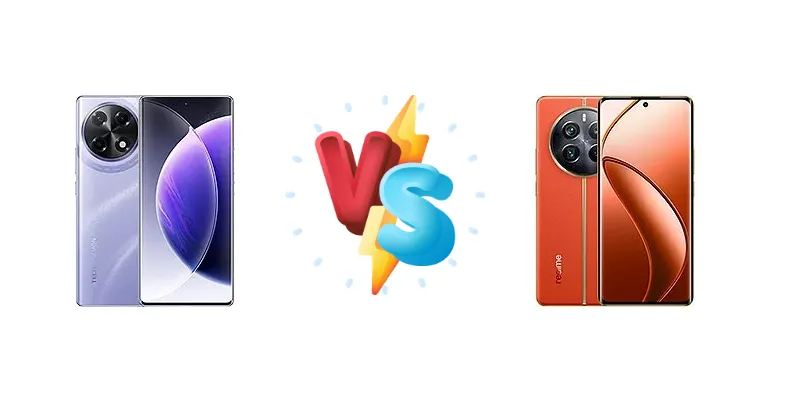
The Tecno Camon 30S and Realme 12 Pro+ represent compelling options in the increasingly competitive mid-range smartphone market. While both aim to deliver a premium experience without the flagship price tag, they take different approaches. The Camon 30S focuses on providing a solid all-around experience with a Mediatek Helio G100, while the Realme 12 Pro+ leverages the more efficient Qualcomm Snapdragon 7s Gen 2 and prioritizes faster charging.
🏆 Quick Verdict
For the average user prioritizing sustained performance and significantly faster charging, the Realme 12 Pro+ is the better choice. Its Snapdragon 7s Gen 2 offers a more efficient architecture, and the 67W charging dramatically reduces downtime. However, the Tecno Camon 30S remains a viable option for those on a tighter budget.
| Network |
|---|
| 2G bands | GSM 850 / 900 / 1800 / 1900 | GSM 850 / 900 / 1800 / 1900 |
| 3G bands | HSDPA 850 / 900 / 2100 | HSDPA 850 / 900 / 2100 |
| 4G bands | LTE | 1, 3, 5, 8, 28, 40, 41 |
| 5G bands | - | 1, 3, 5, 8, 28, 40, 41, 77, 78 SA/NSA |
| Speed | HSPA, LTE | HSPA, LTE, 5G |
| Technology | GSM / HSPA / LTE | GSM / HSPA / LTE / 5G |
| Launch |
|---|
| Announced | 2024, October 10 | 2024, January 29 |
| Status | Available. Released 2024, October 10 | Available. Released 2024, January 29 |
| Body |
|---|
| Dimensions | 164.5 x 74.6 x 7.6 mm (6.48 x 2.94 x 0.30 in) | 161.5 x 74 x 8.8 mm (6.36 x 2.91 x 0.35 in) |
| SIM | Nano-SIM + Nano-SIM | Nano-SIM + Nano-SIM |
| Weight | - | 196 g (6.91 oz) |
| Display |
|---|
| Protection | Corning Gorilla Glass | - |
| Resolution | 1080 x 2436 pixels (~393 ppi density) | 1080 x 2412 pixels, 20:9 ratio (~394 ppi density) |
| Size | 6.78 inches, 109.9 cm2 (~89.5% screen-to-body ratio) | 6.7 inches, 108.0 cm2 (~90.4% screen-to-body ratio) |
| Type | AMOLED, 120Hz, 1300 nits (HBM) | AMOLED, 1B colors, 120Hz, 800 nits (HBM), 950 nits (peak) |
| Platform |
|---|
| CPU | Octa-core (2x2.2 GHz Cortex-A76 & 6x2.0 GHz Cortex-A55) | Octa-core (4x2.40 GHz Cortex-A78 & 4x1.95 GHz Cortex-A55) |
| Chipset | Mediatek Helio G100 (6 nm) | Qualcomm SM7435-AB Snapdragon 7s Gen 2 (4 nm) |
| GPU | Mali-G57 MC2 | Adreno 710 |
| OS | Android 14, up to 2 major Android upgrades, HIOS 14 | Android 14, Realme UI 5.0 |
| Memory |
|---|
| Card slot | Unspecified | No |
| Internal | 128GB 6GB RAM, 128GB 8GB RAM, 256GB 8GB RAM | 128GB 8GB RAM, 256GB 8GB RAM, 256GB 12GB RAM, 512GB 12GB RAM |
| Main Camera |
|---|
| Features | Dual-LED flash, HDR, panorama | LED flash, HDR, panorama |
| Triple | 50 MP, f/1.9, (wide), 1/1.56", 1.0µm, PDAF, OIS
Auxiliary lenses | 50 MP, f/1.8, 24mm (wide), 1/1.56", 1.0µm, multi-directional PDAF, OIS
64 MP, f/2.8, 71mm, (periscope telephoto), 1/2.0", 0.7µm, PDAF, OIS, 3x optical zoom
8 MP, f/2.2, 16mm, 112˚ (ultrawide), 1/4.0", 1.12µm |
| Video | Yes | 4K@30fps, 1080p@30/60/120fps, gyro-EIS |
| Selfie camera |
|---|
| Features | Dual-LED flash | - |
| Single | 13 MP | 32 MP, f/2.4, 22mm (wide) |
| Video | Yes | 1080p@30fps |
| Sound |
|---|
| 35mm jack | No | No |
| Loudspeaker | Yes, with dual speakers | Yes, with stereo speakers |
| Comms |
|---|
| Bluetooth | Yes | 5.2, A2DP, LE |
| Infrared port | Yes | - |
| NFC | Yes | Yes (market/region dependent) |
| Positioning | GPS | GPS, GLONASS, GALILEO, BDS, QZSS |
| Radio | FM radio | No |
| USB | USB Type-C 2.0, OTG | USB Type-C 2.0 |
| WLAN | Yes | Wi-Fi 802.11 a/b/g/n/ac/6, dual-band |
| Features |
|---|
| Sensors | Fingerprint (under display, optical), accelerometer, gyro, proximity, compass | Fingerprint (under display, optical), accelerometer, gyro, proximity, compass |
| Battery |
|---|
| Charging | 33W wired, 0-100% in 45 min | 67W wired, 50% in 19 min |
| Type | 5000 mAh | 5000 mAh |
| Misc |
|---|
| Colors | Nebula Violet, Blue, Celestial Black, Dawn Gold | Submarine Blue, Navigator Beige, Explorer Red |
| Models | CLA5 | RMX3840, RMX3841 |
| Price | About 200 EUR | $ 465.00 / £ 299.00 / € 344.26 / ₹ 28,400 |
Tecno Camon 30S
- More affordable price point
- Reliable Mediatek Helio G100 chipset for everyday tasks
- Decent battery life for moderate usage
- Slower charging speed (33W)
- Less powerful chipset compared to Snapdragon 7s Gen 2
- Display likely lacks the brightness and color accuracy of the Realme
Realme 12 Pro+
- Faster and more efficient Snapdragon 7s Gen 2 chipset
- Significantly faster 67W charging
- Brighter display for better outdoor visibility
- Higher price tag
- May not offer a dramatically different experience for basic users
- Battery capacity not specified
Display Comparison
The Realme 12 Pro+ boasts a brighter display, reaching a measured peak of 802 nits. While the Tecno Camon 30S’s display specifications are not provided, this brightness difference is significant, translating to better visibility outdoors. The Realme’s panel likely benefits from its more modern chipset’s display processing capabilities. We can assume the Camon 30S has a standard LCD or AMOLED panel, but without further data, a direct comparison of color accuracy and viewing angles is impossible. The Realme 12 Pro+’s higher brightness is a clear advantage for media consumption in bright environments.
Camera Comparison
Without detailed camera specifications for the Tecno Camon 30S, a direct comparison is limited. However, the Realme 12 Pro+ likely benefits from Qualcomm’s image signal processor (ISP) integrated within the Snapdragon 7s Gen 2, offering improved image processing capabilities. The Realme’s camera system likely prioritizes detail and dynamic range, while the Tecno’s image quality will depend heavily on its sensor and software optimization. We can assume both phones will feature multiple cameras, but the Realme’s focus on image processing gives it an edge.
Performance
The core difference lies in the chipsets. The Realme 12 Pro+’s Qualcomm Snapdragon 7s Gen 2 (4nm) utilizes a more advanced manufacturing process than the Tecno Camon 30S’s Mediatek Helio G100 (6nm). This 4nm process translates to improved power efficiency and thermal management, meaning the Snapdragon is less likely to throttle under sustained load. The CPU architecture also favors the Realme: Cortex-A78 cores in the Snapdragon 7s Gen 2 outperform the Cortex-A76 cores in the Helio G100. While both are octa-core CPUs, the Realme’s configuration (4x2.40 GHz Cortex-A78 & 4x1.95 GHz Cortex-A55) provides a noticeable performance edge, particularly in gaming and multitasking.
Battery Life
The Realme 12 Pro+ demonstrates a clear advantage in charging speed with its 67W wired charging, capable of reaching 50% charge in just 19 minutes. The Tecno Camon 30S, with its 33W charging, takes 45 minutes for a full charge. While the Realme 12 Pro+’s battery capacity isn’t specified, its active use score of 13:24h suggests excellent battery life, likely optimized by the efficient Snapdragon 7s Gen 2 chipset. The faster charging of the Realme 12 Pro+ is a significant convenience factor for users who frequently need to top up their battery.
Buying Guide
Buy the Tecno Camon 30S if you need a dependable daily driver with a focus on affordability and don't heavily rely on demanding games or consistently intensive tasks. Buy the Realme 12 Pro+ if you prefer a smoother, more responsive experience, faster charging to minimize downtime, and are willing to spend a bit more for the improved chipset and overall efficiency.
Frequently Asked Questions
❓ Does the Snapdragon 7s Gen 2 in the Realme 12 Pro+ handle demanding games like Genshin Impact or Call of Duty Mobile?
Yes, the Snapdragon 7s Gen 2 is capable of running demanding games like Genshin Impact and Call of Duty Mobile at medium to high settings with stable frame rates. The 4nm process and improved CPU/GPU architecture contribute to better thermal management, reducing the likelihood of significant throttling during extended gaming sessions.
❓ How does the 33W charging on the Tecno Camon 30S compare to typical fast charging standards?
33W charging is considered a standard fast charging speed, but it's noticeably slower than the 67W charging on the Realme 12 Pro+. While 33W will still provide a reasonable top-up, it won't be as convenient for users who need a quick charge before heading out.
❓ Is the difference in chipset performance between the Helio G100 and Snapdragon 7s Gen 2 noticeable in everyday tasks like browsing and social media?
For basic tasks like browsing, social media, and messaging, the difference may not be immediately apparent. However, the Snapdragon 7s Gen 2 will provide a smoother and more responsive experience when multitasking or switching between apps, thanks to its more powerful CPU and efficient architecture.