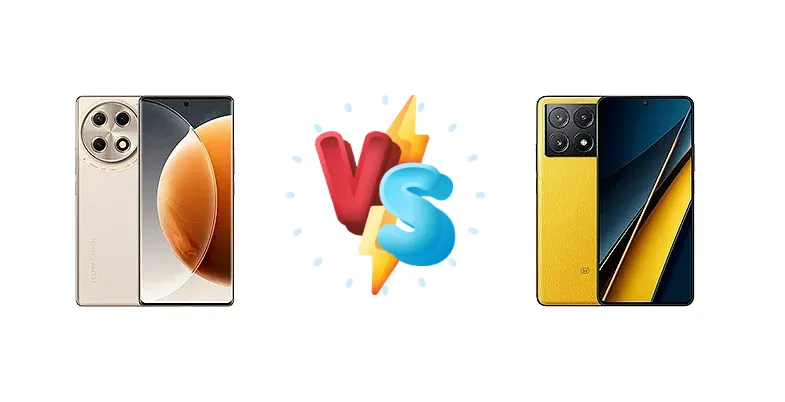
The mid-range smartphone market is fiercely competitive, and the Tecno Camon 30S Pro and Xiaomi Poco X6 Pro represent compelling options for users seeking strong performance without breaking the bank. This comparison dives deep into their specifications, focusing on the core differences between the MediaTek Helio G100 and the Dimensity 8300 Ultra, and how those differences translate into real-world user experience.
🏆 Quick Verdict
For most users, the Xiaomi Poco X6 Pro emerges as the stronger choice. Its significantly more powerful Dimensity 8300 Ultra chipset delivers superior performance in gaming and demanding applications, while the 67W charging offers a faster top-up despite similar 45-minute 0-100% claims. The Tecno Camon 30S Pro remains a viable option for budget-conscious buyers prioritizing wireless charging.
| Network |
|---|
| 2G bands | GSM 850 / 900 / 1800 / 1900 | GSM 850 / 900 / 1800 / 1900 |
| 3G bands | HSDPA 850 / 900 / 2100 | HSDPA 850 / 900 / 1700(AWS) / 1900 / 2100 |
| 4G bands | LTE | 1, 2, 3, 4, 5, 7, 8, 18, 19, 20, 28, 38, 40, 41, 48, 66 |
| 5G bands | - | 1, 2, 3, 5, 7, 8, 20, 28, 38, 40, 41, 48, 77, 78 SA/NSA/Sub6 |
| Speed | HSPA, LTE | HSPA, LTE, 5G |
| Technology | GSM / HSPA / LTE | GSM / HSPA / LTE / 5G |
| Launch |
|---|
| Announced | 2024, July 30 | 2024, January 11 |
| Status | Available. Released 2024, August | Available. Released 2024, January 12 |
| Body |
|---|
| Build | - | Glass front (Gorilla Glass 5), plastic frame, plastic back or silicone polymer back (eco leather) |
| Dimensions | 164.6 x 74.6 x 7.8 mm (6.48 x 2.94 x 0.31 in) | 160.5 x 74.3 x 8.3 mm (6.32 x 2.93 x 0.33 in) |
| SIM | Nano-SIM + Nano-SIM | Nano-SIM + Nano-SIM |
| Weight | - | 186 g or 190 g (6.56 oz) |
| Display |
|---|
| Protection | - | Corning Gorilla Glass 5 |
| Resolution | 1080 x 2436 pixels (~393 ppi density) | 1220 x 2712 pixels, 20:9 ratio (~446 ppi density) |
| Size | 6.78 inches, 109.9 cm2 (~89.5% screen-to-body ratio) | 6.67 inches, 107.4 cm2 (~90.1% screen-to-body ratio) |
| Type | AMOLED, 1B colors, 120Hz, 1300 nits (HBM) | AMOLED, 68B colors, 120Hz, 1920Hz PWM, HDR10+, Dolby Vision, 500 nits (typ), 1200 nits (HBM), 1800 nits (peak) |
| Platform |
|---|
| CPU | Octa-core (2x2.2 GHz Cortex-A76 & 6x2.0 GHz Cortex-A55) | Octa-core (1x3.35 GHz Cortex-A715 & 3x3.20 GHz Cortex-A715 & 4x2.20 GHz Cortex-A510) |
| Chipset | Mediatek Helio G100 (6 nm) | Mediatek Dimensity 8300 Ultra (4 nm) |
| GPU | Mali-G57 MC2 | Mali G615-MC6 |
| OS | Android 14, up to 2 major Android upgrades, HIOS 14 | Android 14, up to 3 major Android upgrades, HyperOS |
| Memory |
|---|
| Card slot | Unspecified | No |
| Internal | 256GB 8GB RAM | 256GB 8GB RAM, 256GB 12GB RAM, 512GB 12GB RAM |
| Main Camera |
|---|
| Features | Dual-LED flash, HDR, panorama | LED flash, HDR, panorama |
| Triple | 50 MP, f/1.9, (wide), 1/1.56", 1.0µm, PDAF, OIS
Auxiliary lenses | 64 MP, f/1.7, 25mm (wide), 1/2.0", 0.7µm, PDAF, OIS
8 MP, f/2.2, 120˚ (ultrawide), 1/4.0", 1.12µm
2 MP (macro) |
| Video | Yes | 4K@24/30fps, 1080p@30/60fps, gyro-EIS |
| Selfie camera |
|---|
| Features | Dual-LED flash | HDR, panorama |
| Single | 50 MP, AF | 16 MP, f/2.4, (wide), 1/3.06", 1.0µm |
| Video | Yes | 1080p@30/60fps |
| Sound |
|---|
| 35mm jack | No | No |
| Loudspeaker | Yes, with dual speakers | Yes, with dual speakers |
| Comms |
|---|
| Bluetooth | Yes | 5.4, A2DP, LE, aptX HD |
| Infrared port | Yes | Yes |
| NFC | Yes | Yes (market/region dependent) |
| Positioning | GPS | GPS, GALILEO, GLONASS, QZSS, BDS (B1I+B1c) |
| Radio | FM radio | No |
| USB | USB Type-C 2.0, OTG | USB Type-C 2.0, OTG |
| WLAN | Yes | Wi-Fi 802.11 a/b/g/n/ac/6, dual-band, Wi-Fi Direct |
| Features |
|---|
| Sensors | Fingerprint (under display, optical), accelerometer, gyro, proximity, compass | Fingerprint (under display, optical), accelerometer, gyro, compass |
| Battery |
|---|
| Charging | 45W wired, 0-100% in 45 min
20W wireless | 67W wired, QC2.0, PD3.0, 100% in 45 min |
| Type | 5000 mAh | 5000 mAh |
| Misc |
|---|
| Colors | Interstellar Grey, Pearl Gold, Shim Silver Green | Black, Yellow, Gray |
| Models | CLA6 | 2311DRK48G, 2311DRK48I |
| Price | - | € 195.30 / $ 209.79 / £ 274.99 / ₹ 21,999 |
| SAR EU | - | 0.99 W/kg (head) 1.00 W/kg (body) |
Tecno Camon 30S Pro
- Includes 20W wireless charging.
- Potentially more affordable price point.
- May offer unique Tecno software features.
- Significantly weaker processor performance.
- Likely lower display brightness.
- Camera system likely less advanced.
Xiaomi Poco X6 Pro
- Superior performance with Dimensity 8300 Ultra.
- Brighter display for better outdoor visibility.
- Faster 67W wired charging with QC/PD support.
- No wireless charging support.
- Potentially higher price.
- Xiaomi’s MIUI software can be polarizing.
Display Comparison
The Poco X6 Pro boasts a significantly brighter display, reaching a measured peak of 1148 nits. This is a crucial advantage for outdoor use, where the Tecno Camon 30S Pro’s brightness is not specified, likely falling considerably short. While both likely utilize AMOLED panels (based on market segment), the Poco’s higher peak brightness and potential for higher color accuracy make it the superior choice for media consumption. We lack data on refresh rates or PWM dimming for either device, but the brightness difference is a clear win for the Poco.
Camera Comparison
Detailed camera analysis is hampered by a lack of sensor specifications. However, the market positioning suggests the Poco X6 Pro likely features a more advanced camera system. While both phones likely include a primary camera for photo and video capture, the Poco’s brand reputation and price point suggest a larger sensor and more sophisticated image processing. The Tecno Camon 30S Pro may focus on software enhancements, but the hardware advantage likely resides with the Poco. We can assume both will include standard features like HDR and portrait modes, but the Poco is expected to deliver superior image quality, particularly in low-light conditions.
Performance
The performance gap between these two devices is substantial. The Poco X6 Pro’s MediaTek Dimensity 8300 Ultra, built on a 4nm process, is a clear upgrade over the Tecno Camon 30S Pro’s 6nm Helio G100. The Dimensity 8300 Ultra’s CPU configuration – 1x3.35 GHz Cortex-A715, 3x3.20 GHz Cortex-A715, and 4x2.20 GHz Cortex-A510 – offers significantly higher single-core and multi-core performance compared to the Camon 30S Pro’s 2x2.2 GHz Cortex-A76 & 6x2.0 GHz Cortex-A55. This translates to smoother multitasking, faster app loading times, and a much better gaming experience. The 4nm node also contributes to improved thermal efficiency, reducing the likelihood of throttling during extended gaming sessions.
Battery Life
The Poco X6 Pro’s active use score of 11:46h demonstrates strong battery life, suggesting efficient power management alongside its larger battery (size unspecified). While the Tecno Camon 30S Pro’s battery capacity is also unknown, the Poco’s score indicates a competitive advantage. Both phones offer 45-minute 0-100% charging times, but the Poco’s 67W wired charging, supporting QC2.0 and PD3.0, provides more versatility and potentially faster charging with compatible adapters. The Tecno Camon 30S Pro adds 20W wireless charging, a feature absent on the Poco, appealing to users who prefer cable-free charging.
Buying Guide
Buy the Tecno Camon 30S Pro if you prioritize wireless charging convenience and are primarily focused on everyday tasks like social media, browsing, and light multimedia consumption. Buy the Xiaomi Poco X6 Pro if you are a mobile gamer, frequently use demanding apps, or value faster wired charging and a brighter display for outdoor visibility.
Frequently Asked Questions
❓ Does the Poco X6 Pro’s Dimensity 8300 Ultra get hot during prolonged gaming sessions?
The Dimensity 8300 Ultra is built on a 4nm process, which generally leads to better thermal efficiency compared to older nodes. While some heat generation is inevitable during intense gaming, the Poco X6 Pro is expected to manage temperatures effectively, minimizing throttling and maintaining consistent performance. However, sustained high-intensity gaming will still likely result in some warming of the device.
❓ Is the lack of wireless charging on the Poco X6 Pro a significant drawback?
For users who heavily rely on wireless charging, the absence of this feature on the Poco X6 Pro is a definite downside. However, the 67W wired charging is exceptionally fast, offering a full charge in approximately 45 minutes. This rapid charging speed may offset the inconvenience of using a cable for many users.
❓ How does the Helio G100 in the Tecno Camon 30S Pro handle graphically demanding games like PUBG Mobile?
The Helio G100 is a capable processor for everyday tasks, but it will struggle with graphically intensive games like PUBG Mobile at higher settings. Expect to need to lower graphics settings and potentially frame rates to achieve a smooth and playable experience. The Dimensity 8300 Ultra in the Poco X6 Pro offers a significantly better gaming experience.
❓ What kind of storage and RAM options are available on each device?
Specific storage and RAM configurations are not provided in the context data. However, based on market trends, both devices likely offer multiple options, ranging from 8GB/128GB to 12GB/256GB or even 16GB/512GB. The Poco X6 Pro is more likely to offer LPDDR5x RAM for faster performance.