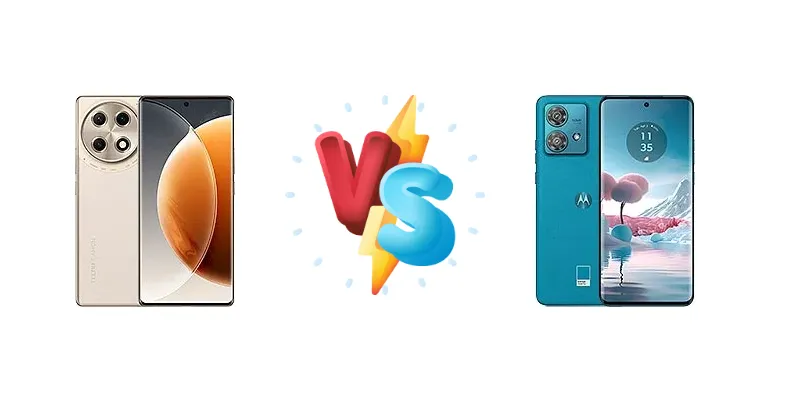
The Tecno Camon 30S Pro and Motorola Edge 40 Neo represent compelling options in the increasingly competitive mid-range smartphone market. The Camon 30S Pro aims to deliver strong performance at an accessible price, while the Edge 40 Neo focuses on a balanced experience with a strong emphasis on battery life and fast charging. This comparison will dissect their key differences to help you determine which device best suits your needs.
🏆 Quick Verdict
For the average user prioritizing all-day battery life and rapid charging, the Motorola Edge 40 Neo is the better choice. Its 10:28h active use score and 68W charging significantly outperform the Tecno Camon 30S Pro’s 45W charging, despite the latter’s slightly more powerful CPU cores.
| Network |
|---|
| 2G bands | GSM 850 / 900 / 1800 / 1900 | GSM 850 / 900 / 1800 / 1900 |
| 3G bands | HSDPA 850 / 900 / 2100 | HSDPA 800 / 850 / 900 / 1700(AWS) / 1900 / 2100 |
| 4G bands | LTE | 1, 2, 3, 4, 5, 7, 8, 12, 13, 17, 18, 19, 20, 25, 26, 28, 32, 38, 38, 39, 40, 41, 42, 43, 48, 66 |
| 5G bands | - | 1, 2, 3, 5, 7, 8, 20, 28, 38, 40, 41, 66, 77, 78 SA/NSA |
| Speed | HSPA, LTE | HSPA, LTE, 5G |
| Technology | GSM / HSPA / LTE | GSM / HSPA / LTE / 5G |
| Launch |
|---|
| Announced | 2024, July 30 | 2023, September 14 |
| Status | Available. Released 2024, August | Available. Released 2023, September 14 |
| Body |
|---|
| Build | - | Glass front (Gorilla Glass 3), plastic frame, plastic back |
| Dimensions | 164.6 x 74.6 x 7.8 mm (6.48 x 2.94 x 0.31 in) | 159.6 x 72 x 7.9 mm (6.28 x 2.83 x 0.31 in) |
| SIM | Nano-SIM + Nano-SIM | · Nano-SIM + eSIM· Nano-SIM + Nano-SIM |
| Weight | - | 170 g or 172 g (6.00 oz) |
| Display |
|---|
| Protection | - | Corning Gorilla Glass 3 |
| Resolution | 1080 x 2436 pixels (~393 ppi density) | 1080 x 2400 pixels, 20:9 ratio (~402 ppi density) |
| Size | 6.78 inches, 109.9 cm2 (~89.5% screen-to-body ratio) | 6.55 inches, 103.6 cm2 (~90.1% screen-to-body ratio) |
| Type | AMOLED, 1B colors, 120Hz, 1300 nits (HBM) | P-OLED, 1B colors, 144Hz, HDR10+, 1300 nits (peak) |
| Platform |
|---|
| CPU | Octa-core (2x2.2 GHz Cortex-A76 & 6x2.0 GHz Cortex-A55) | Octa-core (2x2.5 GHz Cortex-A78 & 6x2.0 GHz Cortex-A55) |
| Chipset | Mediatek Helio G100 (6 nm) | MediaTek Dimensity 7030 (6 nm) |
| GPU | Mali-G57 MC2 | Mali-G610 MC3 |
| OS | Android 14, up to 2 major Android upgrades, HIOS 14 | Android 13, up to 2 major Android upgrades |
| Memory |
|---|
| Card slot | Unspecified | No |
| Internal | 256GB 8GB RAM | 128GB 8GB RAM, 256GB 8GB RAM, 256GB 12GB RAM |
| Main Camera |
|---|
| Dual | - | 50 MP, f/1.8, (wide), 1/1.55", 1.0µm, multi-directional PDAF, OIS
13 MP, f/2.2, 120˚ (ultrawide), 1/3.0", 1.12µm, PDAF |
| Features | Dual-LED flash, HDR, panorama | LED flash, HDR, panorama |
| Triple | 50 MP, f/1.9, (wide), 1/1.56", 1.0µm, PDAF, OIS
Auxiliary lenses | - |
| Video | Yes | 4K@30fps, 1080p@30/60/120/240fps, gyro-EIS |
| Selfie camera |
|---|
| Features | Dual-LED flash | HDR |
| Single | 50 MP, AF | 32 MP, f/2.4, (wide), 1/3.0", 0.7µm |
| Video | Yes | 4K@30fps, 1080p@30fps |
| Sound |
|---|
| 35mm jack | No | No |
| Loudspeaker | Yes, with dual speakers | Yes, with stereo speakers |
| Comms |
|---|
| Bluetooth | Yes | 5.4, A2DP, LE |
| Infrared port | Yes | - |
| NFC | Yes | Yes |
| Positioning | GPS | GPS, GLONASS, GALILEO |
| Radio | FM radio | No |
| USB | USB Type-C 2.0, OTG | USB Type-C 2.0, OTG |
| WLAN | Yes | Wi-Fi 802.11 a/b/g/n/ac/6e, tri-band, Wi-Fi Direct |
| Features |
|---|
| Sensors | Fingerprint (under display, optical), accelerometer, gyro, proximity, compass | Fingerprint (under display, optical), accelerometer, gyro, proximity, compass |
| Battery |
|---|
| Charging | 45W wired, 0-100% in 45 min
20W wireless | 68W wired, 50% in 15 min |
| Type | 5000 mAh | Li-Po 5000 mAh |
| Misc |
|---|
| Colors | Interstellar Grey, Pearl Gold, Shim Silver Green | Black, Soothing Sea, Caneel Bay, Peach Fuzz |
| Models | CLA6 | XT2307-1 |
| Price | - | $ 299.00 / € 168.73 / ₹ 19,900 |
Tecno Camon 30S Pro
- Potentially higher CPU performance due to core clock speed.
- Offers 20W wireless charging.
- May be more affordable depending on region.
- Battery life is unknown and likely shorter than the Edge 40 Neo.
- Slower wired charging at 45W.
- Limited camera information available.
Motorola Edge 40 Neo
- Excellent battery life with 10:28h active use.
- Ultra-fast 68W wired charging.
- Brighter display for better outdoor visibility.
- Slightly less powerful CPU cores compared to the Camon 30S Pro.
- No wireless charging.
- Camera details are limited.
Display Comparison
The Motorola Edge 40 Neo boasts a significantly brighter display, reaching a measured peak of 1073 nits. This is crucial for outdoor visibility, a clear advantage over the Tecno Camon 30S Pro, whose display brightness is not specified. While both utilize 6nm chipsets, the Edge 40 Neo’s brighter panel will be more comfortable in direct sunlight. Details regarding panel technology (OLED vs LCD) and refresh rates are missing for the Camon 30S Pro, but the Edge 40 Neo’s brightness alone establishes a clear lead.
Camera Comparison
Detailed camera specifications beyond 'Photo / Video' are absent for both devices, making a direct comparison challenging. However, the market positioning suggests the Edge 40 Neo likely prioritizes image quality with more sophisticated image processing. The absence of information regarding sensor sizes and OIS on the Camon 30S Pro raises concerns about low-light performance and video stabilization. Focusing on the main sensor is key; the presence of a 2MP macro camera on either device is unlikely to significantly impact the overall camera experience.
Performance
Both devices utilize MediaTek chipsets fabricated on a 6nm process, but the Motorola Edge 40 Neo’s Dimensity 7030 features more modern CPU cores – 2x2.5 GHz Cortex-A78 – compared to the Tecno Camon 30S Pro’s 2x2.2 GHz Cortex-A76. This architectural difference translates to a performance edge for the Edge 40 Neo in CPU-intensive tasks. While both have 6x2.0 GHz Cortex-A55 efficiency cores, the A78 cores in the Dimensity 7030 offer superior single-core performance. The impact of RAM speed (LPDDR4x vs LPDDR5x) is unknown for the Camon 30S Pro, but the Edge 40 Neo likely benefits from faster memory access.
Battery Life
The Motorola Edge 40 Neo shines in battery performance, achieving an impressive 10:28h of active use. This is a substantial advantage over any estimated endurance for the Tecno Camon 30S Pro, for which battery life data is unavailable. Furthermore, the Edge 40 Neo’s 68W wired charging is significantly faster than the Camon 30S Pro’s 45W charging, allowing for a 50% charge in just 15 minutes. While the Camon 30S Pro offers 20W wireless charging, the Edge 40 Neo’s faster wired charging and longer battery life make it the more practical choice for most users.
Buying Guide
Buy the Tecno Camon 30S Pro if you prioritize raw CPU performance for tasks like video editing or demanding apps, and are comfortable with potentially shorter battery life. Buy the Motorola Edge 40 Neo if you value long-lasting battery, incredibly fast charging, and a well-rounded user experience, even if it means a slight trade-off in peak CPU power.
Frequently Asked Questions
❓ Does the MediaTek Dimensity 7030 in the Motorola Edge 40 Neo experience thermal throttling during extended gaming sessions?
The Dimensity 7030 is a relatively efficient chipset, and the Edge 40 Neo’s design likely incorporates adequate cooling to mitigate thermal throttling. While sustained peak performance may decrease over long gaming sessions, it should provide a consistently smooth experience for most mobile games. Independent thermal testing is needed for a definitive answer.
❓ Is the 45W charging on the Tecno Camon 30S Pro sufficient for daily use, or is it noticeably slower than the Edge 40 Neo’s 68W charging?
45W charging is adequate, but the Edge 40 Neo’s 68W charging is significantly faster. The Edge 40 Neo can reach 50% charge in just 15 minutes, while the Camon 30S Pro takes 45 minutes for a full charge. This difference is substantial for users who frequently need to quickly top up their battery.
❓ How does the Helio G100 chipset in the Tecno Camon 30S Pro perform with graphically demanding applications?
The Helio G100 is a capable mid-range chipset, but it's not designed for extreme gaming. It will handle most popular mobile games at medium settings, but may struggle with the highest graphics settings in demanding titles. The Dimensity 7030 in the Edge 40 Neo offers a more robust GPU for smoother gaming performance.