
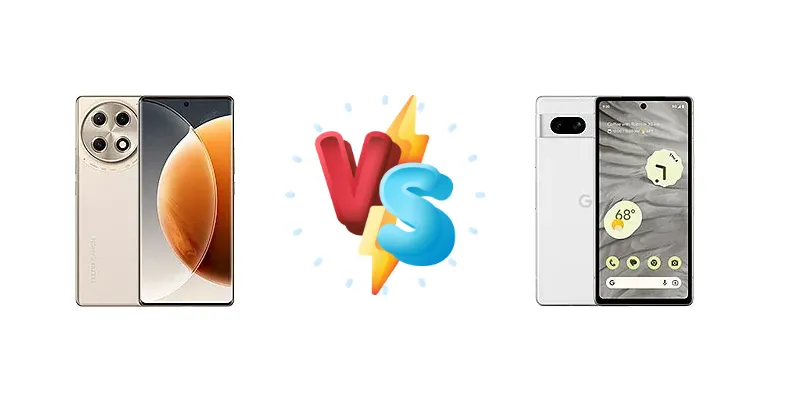
Tecno Camon 30S Pro vs Google Pixel 7a: Which Mid-Range Phone Reigns Supreme?
| Phones Images | |||||
|---|---|---|---|---|---|
|
🏆 Quick Verdict
For the average user prioritizing a seamless software experience and consistently excellent camera performance, the Google Pixel 7a is the better choice. However, the Tecno Camon 30S Pro offers significantly faster charging and could appeal to those who prioritize speed and value over software polish.
| PHONES | ||
|---|---|---|
| Phone Names | Tecno Camon 30S Pro | Google Pixel 7a |
| Network | ||
|---|---|---|
| 2G bands | GSM 850 / 900 / 1800 / 1900 | GSM 850 / 900 / 1800 / 1900 |
| 3G bands | HSDPA 850 / 900 / 2100 | HSDPA 800 / 850 / 900 / 1700(AWS) / 1900 / 2100 |
| 4G bands | LTE | 1, 2, 3, 4, 5, 7, 8, 12, 13, 14, 17, 20, 25, 26, 28, 29, 30, 38, 40, 41, 48, 66, 71 - GWKK3, G0DZQ |
| 5G bands | - | 1, 2, 3, 5, 7, 8, 12, 14, 20, 25, 28, 30, 38, 41, 48, 66, 71, 77, 78 SA/NSA/Sub6 - GWKK3 |
| Speed | HSPA, LTE | HSPA, LTE, 5G |
| Technology | GSM / HSPA / LTE | GSM / HSPA / LTE / 5G |
| - | 1, 2, 3, 5, 7, 8, 12, 20, 25, 28, 38, 40, 41, 66, 75, 76, 77, 78, 79 SA/NSA/Sub6 - GHL1X, G82U8 | |
| Launch | ||
|---|---|---|
| Announced | 2024, July 30 | 2023, May 10 |
| Status | Available. Released 2024, August | Available. Released 2023, May 10 |
| Body | ||
|---|---|---|
| Build | - | Glass front (Gorilla Glass 3), aluminum frame, plastic back |
| Dimensions | 164.6 x 74.6 x 7.8 mm (6.48 x 2.94 x 0.31 in) | 152 x 72.9 x 9 mm (5.98 x 2.87 x 0.35 in) |
| SIM | Nano-SIM + Nano-SIM | Nano-SIM + eSIM |
| Weight | - | 193.5 g (6.84 oz) |
| - | IP67 dust/water resistant (up to 1m for 30 min) | |
| Display | ||
|---|---|---|
| Protection | - | Corning Gorilla Glass 3 |
| Resolution | 1080 x 2436 pixels (~393 ppi density) | 1080 x 2400 pixels, 20:9 ratio (~429 ppi density) |
| Size | 6.78 inches, 109.9 cm2 (~89.5% screen-to-body ratio) | 6.1 inches, 90.7 cm2 (~81.8% screen-to-body ratio) |
| Type | AMOLED, 1B colors, 120Hz, 1300 nits (HBM) | OLED, HDR, 90Hz |
| - | Always-on display | |
| Platform | ||
|---|---|---|
| CPU | Octa-core (2x2.2 GHz Cortex-A76 & 6x2.0 GHz Cortex-A55) | Octa-core (2x2.85 GHz Cortex-X1 & 2x2.35 GHz Cortex-A78 & 4x1.80 GHz Cortex-A55) |
| Chipset | Mediatek Helio G100 (6 nm) | Google Tensor G2 (5 nm) |
| GPU | Mali-G57 MC2 | Mali-G710 MP7 |
| OS | Android 14, up to 2 major Android upgrades, HIOS 14 | Android 13, upgradable to Android 15, up to 5 major Android upgrades |
| Memory | ||
|---|---|---|
| Card slot | Unspecified | No |
| Internal | 256GB 8GB RAM | 128GB 8GB RAM |
| - | UFS 3.1 | |
| Main Camera | ||
|---|---|---|
| Dual | - | 64 MP, f/1.9, 26mm (wide), 1/1.73", 0.8µm, dual pixel PDAF, OIS 13 MP, f/2.2, 120˚ (ultrawide), 1.12µm |
| Features | Dual-LED flash, HDR, panorama | Dual-LED flash, Pixel Shift, Auto-HDR, panorama |
| Triple | 50 MP, f/1.9, (wide), 1/1.56", 1.0µm, PDAF, OIS Auxiliary lenses | - |
| Video | Yes | 4K@30/60fps, 1080p@30/60/120/240fps, OIS |
| Selfie camera | ||
|---|---|---|
| Features | Dual-LED flash | HDR, panorama |
| Single | 50 MP, AF | 13 MP, f/2.2, 20mm (ultrawide), 1.12µm |
| Video | Yes | 4K@30fps, 1080p@30fps |
| Sound | ||
|---|---|---|
| 3.5mm jack | - | No |
| 35mm jack | No | No |
| Loudspeaker | Yes, with dual speakers | Yes, with stereo speakers |
| Comms | ||
|---|---|---|
| Bluetooth | Yes | 5.3, A2DP, LE |
| Infrared port | Yes | - |
| NFC | Yes | Yes |
| Positioning | GPS | GPS, GLONASS, GALILEO, BDS, QZSS, NavIC |
| Radio | FM radio | No |
| USB | USB Type-C 2.0, OTG | USB Type-C 3.2 |
| WLAN | Yes | Wi-Fi 802.11 a/b/g/n/ac/6e, tri-band |
| Features | ||
|---|---|---|
| Sensors | Fingerprint (under display, optical), accelerometer, gyro, proximity, compass | Fingerprint (under display, optical), accelerometer, gyro, proximity, compass, barometer |
| Battery | ||
|---|---|---|
| Charging | 45W wired, 0-100% in 45 min 20W wireless | 18W wired, PD3.0 7.5W wireless |
| Type | 5000 mAh | Li-Po 4385 mAh |
| Misc | ||
|---|---|---|
| Colors | Interstellar Grey, Pearl Gold, Shim Silver Green | Charcoal, Snow, Sea, Coral |
| Models | CLA6 | GWKK3, GHL1X, G0DZQ, G82U8 |
| Price | - | € 179.90 / $ 150.00 / £ 170.00 / ₹ 25,980 |
Tecno Camon 30S Pro
- 45W Wired & 20W Wireless Charging
- Potentially Lower Price
- Fast Charging Convenience
- Less Refined Software Experience
- Likely Inferior Camera Image Processing
Google Pixel 7a
- Superior Software Experience (Clean Android)
- Excellent Camera Image Processing
- Strong CPU Performance (Tensor G2)
- Slow 18W Wired Charging
- No Wireless Charging
Display Comparison
The Pixel 7a boasts a measured peak brightness of 1070 nits, suggesting a vibrant and easily viewable display in outdoor conditions. While the Tecno Camon 30S Pro’s display specifications are not provided, it’s likely to be a standard AMOLED panel. The Pixel 7a’s brightness advantage is significant, especially for users who frequently consume content outdoors. The absence of LTPO technology in either phone suggests neither offers adaptive refresh rates for power saving, a feature increasingly common in this price bracket.
Camera Comparison
The Pixel 7a is renowned for its computational photography prowess, leveraging Google’s image processing algorithms. While specific sensor details aren’t provided, the Pixel’s strength lies in its software optimization. The Tecno Camon 30S Pro’s camera specifications are not detailed enough to make a direct comparison, but the brand often focuses on high megapixel counts. However, megapixel count isn’t everything; the Pixel 7a’s image processing and dynamic range capabilities are likely to surpass the Tecno’s, especially in challenging lighting conditions. We can assume the Pixel 7a will deliver more consistent and refined images.
Performance
The core difference lies in the chipsets. The Google Pixel 7a’s Tensor G2, fabricated on a 5nm process, features a tri-cluster configuration with 2x2.85 GHz Cortex-X1 cores for peak performance, 2x2.35 GHz Cortex-A78 cores for sustained tasks, and 4x1.80 GHz Cortex-A55 cores for efficiency. This contrasts with the Tecno Camon 30S Pro’s Mediatek Helio G100 (6nm), utilizing a dual-cluster setup with 2x2.2 GHz Cortex-A76 and 6x2.0 GHz Cortex-A55 cores. The Tensor G2’s more advanced architecture and smaller fabrication node should translate to superior CPU and GPU performance, particularly in demanding applications and games. The Pixel 7a will likely exhibit better sustained performance due to superior thermal management capabilities inherent in the 5nm process.
Battery Life
The Pixel 7a has an endurance rating of 76 hours, indicating solid battery life. However, its 18W wired charging is comparatively slow. The Tecno Camon 30S Pro significantly outpaces the Pixel 7a with 45W wired charging, promising a 0-100% charge in just 45 minutes. It also offers 20W wireless charging, a feature absent on the Pixel 7a. While the Pixel 7a’s battery endurance is respectable, the Tecno’s charging speed provides a substantial convenience advantage for users who frequently need to top up their devices.
Buying Guide
Buy the Tecno Camon 30S Pro if you need blazing-fast 45W wired and 20W wireless charging, and are comfortable with a less refined software experience. You'll benefit from quicker top-ups and potentially a lower upfront cost. Buy the Google Pixel 7a if you prefer a clean, optimized Android experience, exceptional camera image processing, and guaranteed software updates, even if it means slower charging and a potentially higher price.