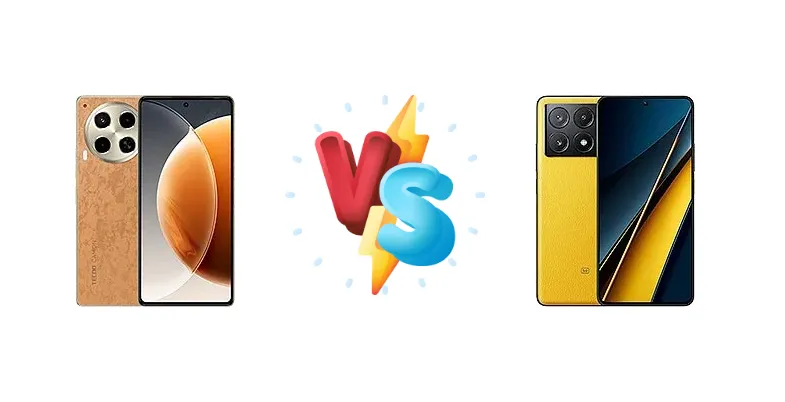
The Tecno Camon 30 and Xiaomi Poco X6 Pro represent compelling options in the increasingly competitive mid-range smartphone market. The Camon 30 focuses on delivering a balanced experience with a focus on efficiency, while the Poco X6 Pro aggressively targets performance with a flagship-adjacent chipset. This comparison dissects their key differences to help you determine which device best suits your priorities.
🏆 Quick Verdict
For most users, the Xiaomi Poco X6 Pro emerges as the stronger choice. Its Dimensity 8300 Ultra chipset provides significantly superior processing power, making it ideal for gaming and demanding applications. While the Tecno Camon 30 offers respectable efficiency, the X6 Pro’s performance advantage justifies the slight price premium.
| Network |
|---|
| 2G bands | GSM 850 / 900 / 1800 / 1900 | GSM 850 / 900 / 1800 / 1900 |
| 3G bands | HSDPA 850 / 900 / 1700(AWS) / 1900 / 2100 | HSDPA 850 / 900 / 1700(AWS) / 1900 / 2100 |
| 4G bands | LTE | 1, 2, 3, 4, 5, 7, 8, 18, 19, 20, 28, 38, 40, 41, 48, 66 |
| 5G bands | - | 1, 2, 3, 5, 7, 8, 20, 28, 38, 40, 41, 48, 77, 78 SA/NSA/Sub6 |
| Speed | HSPA, LTE | HSPA, LTE, 5G |
| Technology | GSM / HSPA / LTE | GSM / HSPA / LTE / 5G |
| Launch |
|---|
| Announced | 2024, February 27 | 2024, January 11 |
| Status | Available. Released 2024, April 02 | Available. Released 2024, January 12 |
| Body |
|---|
| Build | Glass front, glass back or silicone polymer back (eco leather) | Glass front (Gorilla Glass 5), plastic frame, plastic back or silicone polymer back (eco leather) |
| Dimensions | 165.3 x 75.3 x 7.7 mm (6.51 x 2.96 x 0.30 in) | 160.5 x 74.3 x 8.3 mm (6.32 x 2.93 x 0.33 in) |
| SIM | Nano-SIM + Nano-SIM | Nano-SIM + Nano-SIM |
| Weight | - | 186 g or 190 g (6.56 oz) |
| Display |
|---|
| Protection | - | Corning Gorilla Glass 5 |
| Resolution | 1080 x 2436 pixels (~393 ppi density) | 1220 x 2712 pixels, 20:9 ratio (~446 ppi density) |
| Size | 6.78 inches, 109.9 cm2 (~88.3% screen-to-body ratio) | 6.67 inches, 107.4 cm2 (~90.1% screen-to-body ratio) |
| Type | AMOLED, 120Hz | AMOLED, 68B colors, 120Hz, 1920Hz PWM, HDR10+, Dolby Vision, 500 nits (typ), 1200 nits (HBM), 1800 nits (peak) |
| Platform |
|---|
| CPU | Octa-core (2x2.2 GHz Cortex-A76 & 6x2.0 GHz Cortex-A55) | Octa-core (1x3.35 GHz Cortex-A715 & 3x3.20 GHz Cortex-A715 & 4x2.20 GHz Cortex-A510) |
| Chipset | Mediatek Helio G99 Ultimate | Mediatek Dimensity 8300 Ultra (4 nm) |
| GPU | Mali-G57 MC2 | Mali G615-MC6 |
| OS | Android 14, up to 2 major Android upgrades, HIOS 14 | Android 14, up to 3 major Android upgrades, HyperOS |
| Memory |
|---|
| Card slot | microSDXC (dedicated slot) | No |
| Internal | 256GB 8GB, 256GB 12GB | 256GB 8GB RAM, 256GB 12GB RAM, 512GB 12GB RAM |
| Main Camera |
|---|
| Dual | 50 MP, f/1.9, (wide), 1/1.57", PDAF, OIS
Auxiliary lens | - |
| Features | Dual-LED flash, HDR, panorama | LED flash, HDR, panorama |
| Triple | - | 64 MP, f/1.7, 25mm (wide), 1/2.0", 0.7µm, PDAF, OIS
8 MP, f/2.2, 120˚ (ultrawide), 1/4.0", 1.12µm
2 MP (macro) |
| Video | 1440p@30fps, 1080p@30/60fps | 4K@24/30fps, 1080p@30/60fps, gyro-EIS |
| Selfie camera |
|---|
| Features | Dual-LED dual-tone | HDR, panorama |
| Single | 50 MP, (wide), AF | 16 MP, f/2.4, (wide), 1/3.06", 1.0µm |
| Video | 1440p@30fps, 1080p@30/60fps | 1080p@30/60fps |
| Sound |
|---|
| 35mm jack | Yes | No |
| Loudspeaker | Yes, with dual speakers | Yes, with dual speakers |
| Comms |
|---|
| Bluetooth | 5.3, A2DP, LE | 5.4, A2DP, LE, aptX HD |
| Infrared port | Yes | Yes |
| NFC | Yes | Yes (market/region dependent) |
| Positioning | GPS | GPS, GALILEO, GLONASS, QZSS, BDS (B1I+B1c) |
| Radio | FM radio | No |
| USB | USB Type-C 2.0, OTG | USB Type-C 2.0, OTG |
| WLAN | Wi-Fi 802.11 a/b/g/n/ac, dual-band | Wi-Fi 802.11 a/b/g/n/ac/6, dual-band, Wi-Fi Direct |
| Features |
|---|
| Sensors | Fingerprint (under display, optical), accelerometer, gyro, proximity, compass | Fingerprint (under display, optical), accelerometer, gyro, compass |
| Battery |
|---|
| Charging | 70W wired, 0-100% in 45 min | 67W wired, QC2.0, PD3.0, 100% in 45 min |
| Type | 5000 mAh | 5000 mAh |
| Misc |
|---|
| Colors | Iceland Basaltic Dark, Uyuni Salt White, Sahara Sand Brown | Black, Yellow, Gray |
| Models | CL6, CL6k | 2311DRK48G, 2311DRK48I |
| Price | - | € 195.30 / $ 209.79 / £ 274.99 / ₹ 21,999 |
| SAR EU | - | 0.99 W/kg (head) 1.00 W/kg (body) |
Tecno Camon 30
- Efficient Mediatek Helio G99 Ultimate chipset
- Fast 70W wired charging
- Potentially longer battery life due to efficient chipset
- Significantly less powerful CPU and GPU
- Likely less capable camera system
- May struggle with demanding games and applications
Xiaomi Poco X6 Pro
- Powerful Mediatek Dimensity 8300 Ultra chipset
- Bright 1148 nit display
- Excellent battery life (11:46h active use)
- Slightly slower charging speed (67W vs 70W)
- Potentially higher price
- May run warmer under sustained load
Display Comparison
The Poco X6 Pro boasts a significantly brighter display, reaching a measured peak of 1148 nits. This translates to superior visibility outdoors under direct sunlight compared to the Tecno Camon 30, whose brightness is not specified. While both likely utilize AMOLED panels (based on market segment), the X6 Pro’s higher brightness and potential for a higher refresh rate (not specified for either) contribute to a more immersive viewing experience. The absence of LTPO technology in either device suggests both will rely on adaptive refresh rate switching rather than variable refresh rates for power saving.
Camera Comparison
While both phones feature cameras, the context data is limited. We can infer that the Poco X6 Pro, positioned as a performance-focused device, likely incorporates a more advanced camera system. Sensor size and lens aperture are critical factors not provided, but the X6 Pro’s higher price point suggests a larger sensor and potentially optical image stabilization (OIS). The Tecno Camon 30 likely focuses on software-based image processing to enhance photo quality. Without specific details, it’s difficult to definitively assess camera performance, but the X6 Pro’s chipset offers more processing power for image processing tasks.
Performance
The core difference lies in the chipsets. The Poco X6 Pro’s Mediatek Dimensity 8300 Ultra (4nm) is a substantial upgrade over the Tecno Camon 30’s Helio G99 Ultimate. The Dimensity 8300 Ultra features a more modern CPU architecture – Cortex-A715 cores versus the Camon 30’s Cortex-A76 – and a more efficient 4nm manufacturing process. This results in significantly faster processing speeds (3.35 GHz peak vs 2.2 GHz) and improved thermal management. The X6 Pro’s CPU configuration (1x3.35 GHz Cortex-A715 & 3x3.20 GHz Cortex-A715 & 4x2.20 GHz Cortex-A510) also indicates a focus on sustained performance, unlike the Camon 30’s 2x2.2 GHz Cortex-A76 & 6x2.0 GHz Cortex-A55 configuration which is more geared towards efficiency. The X6 Pro will handle demanding games and applications with ease, while the Camon 30 may exhibit some slowdowns under heavy load.
Battery Life
The Poco X6 Pro demonstrates superior battery performance with an active use score of 11:46h, indicating excellent efficiency despite its powerful chipset. Both phones offer 45-minute charging times to 100% with 70W (Tecno) and 67W (Poco) wired charging, supporting QC2.0 and PD3.0 standards on the Poco. The X6 Pro’s longer battery life suggests better optimization and power management, offsetting any potential battery capacity differences (not specified for either device). The similar charging speeds mean neither phone will leave you waiting long to top up.
Buying Guide
Buy the Tecno Camon 30 if you prioritize long-term battery life and a smooth, responsive experience for everyday tasks like social media, browsing, and light gaming. It’s a solid choice for users who don’t need the absolute fastest performance. Buy the Xiaomi Poco X6 Pro if you’re a mobile gamer, frequently multitask, or simply want a phone that feels consistently snappy and future-proof. The Dimensity 8300 Ultra offers a substantial performance leap.
Frequently Asked Questions
❓ Does the Poco X6 Pro’s Dimensity 8300 Ultra chipset get hot during prolonged gaming sessions?
While the Dimensity 8300 Ultra is a powerful chip, its 4nm process and efficient core configuration help mitigate thermal throttling. However, sustained gaming at maximum settings will inevitably generate heat. The Poco X6 Pro likely incorporates thermal management solutions, but users should expect some degree of temperature increase during extended gameplay.
❓ Is the 70W charging on the Tecno Camon 30 significantly slower than the 67W on the Poco X6 Pro in real-world use?
The difference of 3W in charging wattage is unlikely to be noticeable in everyday use. Both phones achieve a 0-100% charge in 45 minutes, suggesting similar charging circuitry and optimization. The presence of QC2.0 and PD3.0 on the Poco X6 Pro offers broader compatibility with chargers.
❓ How does the Helio G99 Ultimate in the Tecno Camon 30 perform with popular games like PUBG Mobile?
The Helio G99 Ultimate can run PUBG Mobile, but likely at medium graphics settings to maintain a stable frame rate. Expect some occasional stuttering or frame drops during intense firefights. The Poco X6 Pro’s Dimensity 8300 Ultra will provide a significantly smoother and more consistent gaming experience with higher graphics settings.