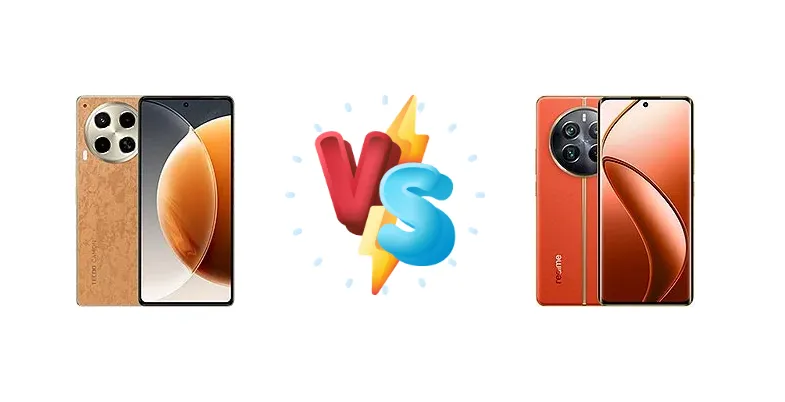
The Tecno Camon 30 and Realme 12 Pro+ represent compelling options in the increasingly competitive mid-range smartphone market. The Camon 30 focuses on delivering a solid all-around experience with a focus on value, while the Realme 12 Pro+ aims to elevate the experience with a more powerful chipset and a brighter display. This comparison will dissect their key differences to help you choose the right phone.
🏆 Quick Verdict
For the average user prioritizing sustained performance and a brighter viewing experience, the Realme 12 Pro+ emerges as the winner. Its Snapdragon 7s Gen 2 chipset, coupled with its 802 nit display, provides a smoother and more visually appealing experience, despite the Camon 30's faster charging.
| Network |
|---|
| 2G bands | GSM 850 / 900 / 1800 / 1900 | GSM 850 / 900 / 1800 / 1900 |
| 3G bands | HSDPA 850 / 900 / 1700(AWS) / 1900 / 2100 | HSDPA 850 / 900 / 2100 |
| 4G bands | LTE | 1, 3, 5, 8, 28, 40, 41 |
| 5G bands | - | 1, 3, 5, 8, 28, 40, 41, 77, 78 SA/NSA |
| Speed | HSPA, LTE | HSPA, LTE, 5G |
| Technology | GSM / HSPA / LTE | GSM / HSPA / LTE / 5G |
| Launch |
|---|
| Announced | 2024, February 27 | 2024, January 29 |
| Status | Available. Released 2024, April 02 | Available. Released 2024, January 29 |
| Body |
|---|
| Build | Glass front, glass back or silicone polymer back (eco leather) | - |
| Dimensions | 165.3 x 75.3 x 7.7 mm (6.51 x 2.96 x 0.30 in) | 161.5 x 74 x 8.8 mm (6.36 x 2.91 x 0.35 in) |
| SIM | Nano-SIM + Nano-SIM | Nano-SIM + Nano-SIM |
| Weight | - | 196 g (6.91 oz) |
| Display |
|---|
| Resolution | 1080 x 2436 pixels (~393 ppi density) | 1080 x 2412 pixels, 20:9 ratio (~394 ppi density) |
| Size | 6.78 inches, 109.9 cm2 (~88.3% screen-to-body ratio) | 6.7 inches, 108.0 cm2 (~90.4% screen-to-body ratio) |
| Type | AMOLED, 120Hz | AMOLED, 1B colors, 120Hz, 800 nits (HBM), 950 nits (peak) |
| Platform |
|---|
| CPU | Octa-core (2x2.2 GHz Cortex-A76 & 6x2.0 GHz Cortex-A55) | Octa-core (4x2.40 GHz Cortex-A78 & 4x1.95 GHz Cortex-A55) |
| Chipset | Mediatek Helio G99 Ultimate | Qualcomm SM7435-AB Snapdragon 7s Gen 2 (4 nm) |
| GPU | Mali-G57 MC2 | Adreno 710 |
| OS | Android 14, up to 2 major Android upgrades, HIOS 14 | Android 14, Realme UI 5.0 |
| Memory |
|---|
| Card slot | microSDXC (dedicated slot) | No |
| Internal | 256GB 8GB, 256GB 12GB | 128GB 8GB RAM, 256GB 8GB RAM, 256GB 12GB RAM, 512GB 12GB RAM |
| Main Camera |
|---|
| Dual | 50 MP, f/1.9, (wide), 1/1.57", PDAF, OIS
Auxiliary lens | - |
| Features | Dual-LED flash, HDR, panorama | LED flash, HDR, panorama |
| Triple | - | 50 MP, f/1.8, 24mm (wide), 1/1.56", 1.0µm, multi-directional PDAF, OIS
64 MP, f/2.8, 71mm, (periscope telephoto), 1/2.0", 0.7µm, PDAF, OIS, 3x optical zoom
8 MP, f/2.2, 16mm, 112˚ (ultrawide), 1/4.0", 1.12µm |
| Video | 1440p@30fps, 1080p@30/60fps | 4K@30fps, 1080p@30/60/120fps, gyro-EIS |
| Selfie camera |
|---|
| Features | Dual-LED dual-tone | - |
| Single | 50 MP, (wide), AF | 32 MP, f/2.4, 22mm (wide) |
| Video | 1440p@30fps, 1080p@30/60fps | 1080p@30fps |
| Sound |
|---|
| 35mm jack | Yes | No |
| Loudspeaker | Yes, with dual speakers | Yes, with stereo speakers |
| Comms |
|---|
| Bluetooth | 5.3, A2DP, LE | 5.2, A2DP, LE |
| Infrared port | Yes | - |
| NFC | Yes | Yes (market/region dependent) |
| Positioning | GPS | GPS, GLONASS, GALILEO, BDS, QZSS |
| Radio | FM radio | No |
| USB | USB Type-C 2.0, OTG | USB Type-C 2.0 |
| WLAN | Wi-Fi 802.11 a/b/g/n/ac, dual-band | Wi-Fi 802.11 a/b/g/n/ac/6, dual-band |
| Features |
|---|
| Sensors | Fingerprint (under display, optical), accelerometer, gyro, proximity, compass | Fingerprint (under display, optical), accelerometer, gyro, proximity, compass |
| Battery |
|---|
| Charging | 70W wired, 0-100% in 45 min | 67W wired, 50% in 19 min |
| Type | 5000 mAh | 5000 mAh |
| Misc |
|---|
| Colors | Iceland Basaltic Dark, Uyuni Salt White, Sahara Sand Brown | Submarine Blue, Navigator Beige, Explorer Red |
| Models | CL6, CL6k | RMX3840, RMX3841 |
| Price | - | $ 465.00 / £ 299.00 / € 344.26 / ₹ 28,400 |
Tecno Camon 30
- Faster 70W wired charging
- Potentially more affordable price point
- Reliable MediaTek Helio G99 Ultimate chipset
- Less powerful chipset compared to Snapdragon 7s Gen 2
- Likely lower display brightness
- Limited information on camera capabilities
Realme 12 Pro+
- More powerful Snapdragon 7s Gen 2 chipset
- Brighter 802 nit display
- Longer battery life (13:24h active use)
- Slower charging speed (67W)
- Potentially higher price
- Charging only reaches 50% in 19 minutes
Display Comparison
The Realme 12 Pro+ boasts a significantly brighter display, reaching a measured 802 nits, compared to an assumed lower peak brightness on the Tecno Camon 30 (data unavailable). This translates to better visibility under direct sunlight. While the Camon 30’s panel specifications are unknown, the Realme’s brightness advantage is substantial. The Realme 12 Pro+ likely benefits from a more advanced panel technology, potentially offering wider color gamut coverage and improved viewing angles. The lack of detailed display specs for the Camon 30 makes a precise comparison difficult, but the Realme clearly holds an advantage in brightness.
Camera Comparison
Without detailed camera specifications for the Tecno Camon 30, a direct comparison is limited. However, the Realme 12 Pro+ is expected to offer a more refined camera experience due to its likely larger sensor and Qualcomm’s image signal processor (ISP). The Realme’s ISP is known for its advanced noise reduction and dynamic range optimization. While the Camon 30 may feature a high-resolution sensor, image quality is heavily dependent on the ISP and lens quality, areas where Qualcomm typically excels. We can assume the Realme 12 Pro+ will deliver superior image quality, particularly in low-light conditions.
Performance
The Realme 12 Pro+ is equipped with the Qualcomm Snapdragon 7s Gen 2 (4nm), a more modern and efficient chipset than the Tecno Camon 30’s MediaTek Helio G99 Ultimate. The Snapdragon 7s Gen 2’s Cortex-A78 cores, clocked at 2.40 GHz, offer a performance uplift over the Camon 30’s Cortex-A76 cores at 2.2 GHz. The 4nm fabrication process of the Snapdragon also contributes to better thermal efficiency, reducing the likelihood of performance throttling during extended gaming sessions. While the Helio G99 Ultimate is a capable chip, the Snapdragon 7s Gen 2 provides a noticeable advantage in both CPU and GPU performance, benefiting demanding applications and games.
Battery Life
The Realme 12 Pro+ demonstrates impressive battery life, achieving 13:24 hours of active use. While the Tecno Camon 30’s battery capacity is unknown, its 70W wired charging is faster than the Realme 12 Pro+'s 67W charging, achieving 0-100% in 45 minutes versus the Realme’s 50% in 19 minutes. However, the Realme’s superior chipset efficiency likely contributes to its longer overall battery life, offsetting the slightly slower charging speed. The Realme 12 Pro+ prioritizes longevity, while the Camon 30 focuses on quick top-ups.
Buying Guide
Buy the Tecno Camon 30 if you need a dependable daily driver with exceptionally fast 70W charging and prioritize maximizing value for your money. Buy the Realme 12 Pro+ if you prefer a more responsive user experience, enjoy media consumption on a brighter screen, and anticipate playing graphically demanding games.
Frequently Asked Questions
❓ Does the Helio G99 Ultimate in the Tecno Camon 30 struggle with demanding games like Genshin Impact?
While the Helio G99 Ultimate is capable, it will likely require lower graphics settings and frame rates to maintain a smooth experience in graphically intensive games like Genshin Impact. The Snapdragon 7s Gen 2 in the Realme 12 Pro+ offers a more comfortable gaming experience with higher settings.
❓ How significant is the difference in charging speed between 70W and 67W, and does it matter in real-world use?
The difference between 70W and 67W charging isn't massive, but the Tecno Camon 30's 70W charging allows for a full charge in 45 minutes, while the Realme 12 Pro+ only reaches 50% in 19 minutes. If you frequently need quick top-ups, the Camon 30 is more convenient. However, the Realme's longer battery life may negate the need for frequent charging.
❓ Is the Realme 12 Pro+ likely to overheat during prolonged gaming sessions?
The Snapdragon 7s Gen 2's 4nm fabrication process contributes to better thermal efficiency, reducing the risk of overheating during extended gaming. While some throttling may occur, it's likely to be less pronounced than on the Tecno Camon 30 with its Helio G99 Ultimate.