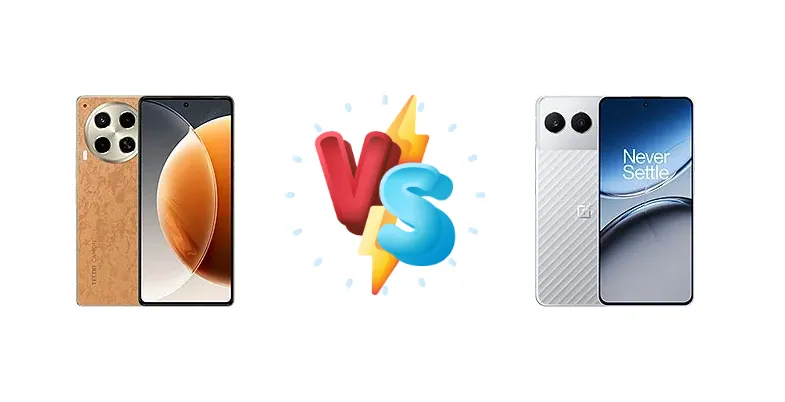
The Tecno Camon 30 and OnePlus Nord 4 represent compelling options in the increasingly competitive mid-range smartphone market. The Camon 30 focuses on delivering a solid feature set at an aggressive price point, while the Nord 4 aims for a more premium experience with a focus on performance and fast charging. This comparison dissects their key differences to help you choose the right device.
🏆 Quick Verdict
For the average user prioritizing sustained performance and rapid charging, the OnePlus Nord 4 emerges as the stronger contender. Its Snapdragon 7+ Gen 3 chipset and 100W charging significantly outperform the Camon 30’s Helio G99 Ultimate, justifying the price difference for power users.
| Network |
|---|
| 2G bands | GSM 850 / 900 / 1800 / 1900 | GSM 850 / 900 / 1800 / 1900 |
| 3G bands | HSDPA 850 / 900 / 1700(AWS) / 1900 / 2100 | HSDPA 800 / 850 / 900 / 1700(AWS) / 1800 / 1900 / 2100 - International |
| 4G bands | LTE | 1, 2, 3, 4, 5, 7, 8, 12, 17, 18, 19, 20, 26, 28, 38, 39, 40, 41, 66 - International |
| 5G bands | - | 1, 2, 3, 5, 7, 8, 12, 20, 28, 38, 40, 41, 66, 77, 78 SA/NSA - International |
| Speed | HSPA, LTE | HSPA, LTE, 5G |
| Technology | GSM / HSPA / LTE | GSM / HSPA / LTE / 5G |
| Launch |
|---|
| Announced | 2024, February 27 | 2024, July 16 |
| Status | Available. Released 2024, April 02 | Available. Released 2024, August 08 |
| Body |
|---|
| Build | Glass front, glass back or silicone polymer back (eco leather) | Glass front, aluminum back, aluminum frame |
| Dimensions | 165.3 x 75.3 x 7.7 mm (6.51 x 2.96 x 0.30 in) | 162.6 x 75 x 8 mm (6.40 x 2.95 x 0.31 in) |
| SIM | Nano-SIM + Nano-SIM | Nano-SIM + Nano-SIM |
| Weight | - | 199.5 g (7.05 oz) |
| Display |
|---|
| Resolution | 1080 x 2436 pixels (~393 ppi density) | 1240 x 2772 pixels, 20:9 ratio (~450 ppi density) |
| Size | 6.78 inches, 109.9 cm2 (~88.3% screen-to-body ratio) | 6.74 inches, 109.7 cm2 (~90.0% screen-to-body ratio) |
| Type | AMOLED, 120Hz | Fluid AMOLED, 1B colors, 120Hz, HDR10+, 2150 nits (peak) |
| Platform |
|---|
| CPU | Octa-core (2x2.2 GHz Cortex-A76 & 6x2.0 GHz Cortex-A55) | Octa-core (1x2.8 GHz Cortex-X4 & 4x2.6 GHz Cortex-A720 & 3x1.9 GHz Cortex-A520) |
| Chipset | Mediatek Helio G99 Ultimate | Qualcomm SM7675 Snapdragon 7+ Gen 3 (4 nm) |
| GPU | Mali-G57 MC2 | Adreno 732 |
| OS | Android 14, up to 2 major Android upgrades, HIOS 14 | Android 14, up to 4 major Android upgrades, OxygenOS 15 |
| Memory |
|---|
| Card slot | microSDXC (dedicated slot) | No |
| Internal | 256GB 8GB, 256GB 12GB | 128GB 8GB RAM, 256GB 8GB RAM, 256GB 12GB RAM, 512GB 16GB RAM |
| Main Camera |
|---|
| Dual | 50 MP, f/1.9, (wide), 1/1.57", PDAF, OIS
Auxiliary lens | 50 MP, f/1.8, 25mm (wide), 1/1.95", 0.8µm, PDAF, OIS
8 MP, f/2.2, 112˚ (ultrawide), 1/4.0", 1.12µm |
| Features | Dual-LED flash, HDR, panorama | Dual-LED flash, HDR, panorama |
| Video | 1440p@30fps, 1080p@30/60fps | 4K@30/60fps, 1080p@30/60/120fps, gyro-EIS |
| Selfie camera |
|---|
| Features | Dual-LED dual-tone | Panorama |
| Single | 50 MP, (wide), AF | 16 MP, f/2.4, 24mm (wide), 1.0µm |
| Video | 1440p@30fps, 1080p@30/60fps | 1080p@30fps |
| Sound |
|---|
| 35mm jack | Yes | No |
| Loudspeaker | Yes, with dual speakers | Yes, with stereo speakers |
| Comms |
|---|
| Bluetooth | 5.3, A2DP, LE | 5.4, A2DP, LE, aptX HD, LHDC |
| Infrared port | Yes | Yes |
| NFC | Yes | Yes |
| Positioning | GPS | GPS, GALILEO, GLONASS, BDS, QZSS |
| Radio | FM radio | No |
| USB | USB Type-C 2.0, OTG | USB Type-C 2.0 |
| WLAN | Wi-Fi 802.11 a/b/g/n/ac, dual-band | Wi-Fi 802.11 a/b/g/n/ac/6, dual-band, Wi-Fi Direct |
| Features |
|---|
| Sensors | Fingerprint (under display, optical), accelerometer, gyro, proximity, compass | Fingerprint (under display, optical), accelerometer, gyro, proximity, compass |
| Battery |
|---|
| Charging | 70W wired, 0-100% in 45 min | 100W wired, PPS, 100% in 28 min |
| Type | 5000 mAh | 5500 mAh |
| Misc |
|---|
| Colors | Iceland Basaltic Dark, Uyuni Salt White, Sahara Sand Brown | Obsidian Midnight, Mercurial Silver, Oasis Green |
| Models | CL6, CL6k | CPH2663, CPH2661 |
| Price | - | € 410.27 / £ 423.17 |
| SAR | - | 1.18 W/kg (head) 1.06 W/kg (body) |
Tecno Camon 30
- More affordable price point
- Decent performance for everyday tasks
- 70W fast charging is still respectable
- Less powerful chipset compared to the Snapdragon 7+ Gen 3
- Likely lower sustained performance due to thermal limitations
- Display brightness likely lower than the Nord 4
OnePlus Nord 4
- Significantly faster Snapdragon 7+ Gen 3 chipset
- 100W SuperVOOC charging for incredibly fast top-ups
- Brighter display for better outdoor visibility
- Higher price compared to the Tecno Camon 30
- May not represent a massive leap in camera quality over competitors
- Software experience can be polarizing for some users
Display Comparison
The OnePlus Nord 4 boasts a significantly brighter display, reaching a measured peak of 1163 nits. This translates to superior visibility outdoors under direct sunlight compared to the Tecno Camon 30, whose brightness is not specified. While the Camon 30’s panel technology isn’t detailed, the Nord 4’s high brightness suggests a more advanced LCD or AMOLED panel. The Nord 4’s brightness advantage is crucial for users who frequently consume content outdoors or in brightly lit environments.
Camera Comparison
Without detailed camera specifications for the Tecno Camon 30, a direct comparison is limited. However, the OnePlus Nord 4 likely benefits from Qualcomm’s image signal processor (ISP) integrated within the Snapdragon 7+ Gen 3, offering improved image processing capabilities. The focus should be on the main sensor quality and aperture. The Nord 4’s ISP will likely deliver better dynamic range and noise reduction, particularly in low-light conditions. Ignoring the typical 2MP macro lenses found on both devices, the primary sensor and its associated image processing are key differentiators.
Performance
The core difference lies in the chipsets. The OnePlus Nord 4’s Qualcomm SM7675 Snapdragon 7+ Gen 3 (4nm) is a substantial upgrade over the Tecno Camon 30’s MediaTek Helio G99 Ultimate. The Snapdragon 7+ Gen 3 features a Cortex-X4 prime core clocked at 2.8 GHz, alongside Cortex-A720 and A520 cores, built on a more efficient 4nm process. This architecture delivers significantly improved CPU and GPU performance, and better thermal management, reducing throttling during extended gaming sessions. The Camon 30’s Helio G99 Ultimate, while capable, relies on older Cortex-A76 and A55 cores and a less efficient manufacturing process. This will result in lower sustained performance and potentially more heat.
Battery Life
The OnePlus Nord 4’s 100W wired charging with PPS support is a game-changer, achieving a full charge in just 28 minutes. This is considerably faster than the Tecno Camon 30’s 70W charging, which takes 45 minutes to reach 100%. While the Nord 4’s battery capacity isn’t specified, its active use score of 14:41h demonstrates excellent battery life. The faster charging speed of the Nord 4 is a significant convenience factor for users who need to quickly top up their battery throughout the day.
Buying Guide
Buy the Tecno Camon 30 if you need a reliable daily driver with decent performance for everyday tasks and prioritize affordability above all else. It’s ideal for users who don’t heavily game or require the fastest possible charging. Buy the OnePlus Nord 4 if you prefer a smoother, more responsive experience, especially for gaming and demanding applications, and value the convenience of incredibly fast 100W charging. This phone is geared towards users who want a near-flagship experience without the flagship price.
Frequently Asked Questions
❓ Does the Helio G99 Ultimate in the Tecno Camon 30 struggle with demanding games like Genshin Impact?
Yes, the Helio G99 Ultimate will likely struggle to maintain high frame rates in graphically intensive games like Genshin Impact, even on medium settings. The chipset’s limitations and less efficient thermal design will lead to noticeable frame drops and potential overheating during prolonged gaming sessions. The OnePlus Nord 4’s Snapdragon 7+ Gen 3 is far better equipped to handle such titles.
❓ How does the 100W charging on the OnePlus Nord 4 compare to other fast charging standards?
OnePlus’s 100W SuperVOOC charging is among the fastest commercially available charging technologies. It’s significantly quicker than typical 65W or 67W charging solutions. The inclusion of PPS (Power Delivery Protocol) ensures compatibility with a wider range of chargers and optimized charging speeds. The Camon 30’s 70W charging is still fast, but it takes considerably longer to fully charge the device.
❓ Is the difference in chipset performance between the Snapdragon 7+ Gen 3 and Helio G99 Ultimate noticeable in everyday tasks?
While both chipsets can handle everyday tasks like browsing, social media, and video playback, the Snapdragon 7+ Gen 3 offers a noticeably smoother and more responsive experience. App launch times are faster, multitasking is more fluid, and the overall user interface feels more polished. The difference is most apparent when switching between apps or performing demanding tasks.