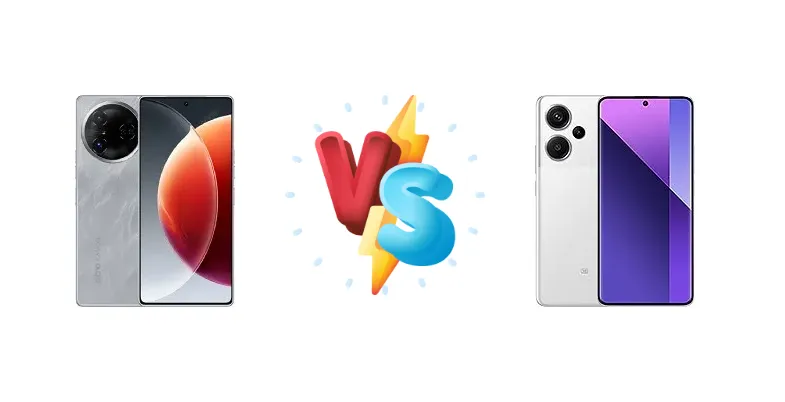
The Tecno Camon 30 Pro and Xiaomi Redmi Note 13 Pro+ represent compelling options in the increasingly competitive mid-range smartphone market. While both devices boast impressive specs on paper, they diverge significantly in their approach to performance and battery life, making the choice less about which is 'better' and more about which aligns with your priorities.
🏆 Quick Verdict
For users prioritizing sustained performance and all-day battery life, the Tecno Camon 30 Pro emerges as the stronger contender. Its Dimensity 8200 Ultimate chipset and 14:29-hour active use score provide a noticeable advantage, despite the Redmi Note 13 Pro+'s faster 120W charging.
| Network |
|---|
| 2G bands | GSM 850 / 900 / 1800 / 1900 | GSM 850 / 900 / 1800 / 1900 |
| 3G bands | HSDPA 850 / 900 / 1700(AWS) / 1900 / 2100 | HSDPA 800 / 850 / 900 / 1700(AWS) / 1900 / 2100 - International |
| 4G bands | LTE | 1, 2, 3, 4, 5, 7, 8, 12, 13, 17, 18, 19, 20, 26, 28, 32, 38, 40, 41, 66 - International |
| 5G bands | SA/NSA | 1, 3, 5, 7, 8, 20, 28, 38, 40, 41, 66, 77, 78 SA/NSA- International |
| Speed | HSPA, LTE, 5G | HSPA, LTE, 5G |
| Technology | GSM / HSPA / LTE / 5G | GSM / CDMA / HSPA / EVDO / LTE / 5G |
| Launch |
|---|
| Announced | 2024, February 27 | 2023, September 21 |
| Status | Available. Released 2024, April 02 | Available. Released 2023, September 21 |
| Body |
|---|
| Build | Glass front, glass back or silicone polymer back (eco leather) | Glass front (Gorilla Glass Victus), glass back or silicone polymer back (eco leather) |
| Dimensions | 164 x 74.5 x 7.7 mm (6.46 x 2.93 x 0.30 in) | 161.4 x 74.2 x 8.9 mm (6.35 x 2.92 x 0.35 in) |
| SIM | Nano-SIM + Nano-SIM | · Nano-SIM + eSIM· Nano-SIM + Nano-SIM |
| Weight | 188.6 g (6.67 oz) | 199 g or 204.5 g (7.02 oz) |
| Display |
|---|
| Protection | - | Corning Gorilla Glass Victus |
| Resolution | 1080 x 2436 pixels (~393 ppi density) | 1220 x 2712 pixels, 20:9 ratio (~446 ppi density) |
| Size | 6.78 inches, 109.9 cm2 (~89.9% screen-to-body ratio) | 6.67 inches, 107.4 cm2 (~89.7% screen-to-body ratio) |
| Type | AMOLED, 144Hz | AMOLED, 68B colors, 120Hz, 1920Hz PWM, Dolby Vision, HDR10+, 1800 nits (peak) |
| Platform |
|---|
| CPU | Octa-core (1x3.1 GHz Cortex-A78 & 3x3.0 GHz Cortex-A78 & 4x2.0 GHz Cortex-A55) | Octa-core (2x2.8 GHz Cortex-A715 & 6x2.0 GHz Cortex-A510) |
| Chipset | Mediatek Dimensity 8200 Ultimate (4 nm) | Mediatek Dimensity 7200 Ultra (4 nm) |
| GPU | Mali-G610 MC6 | Mali-G610 MC4 |
| OS | Android 14, up to 2 major Android upgrades, HIOS 14 | Android 13, up to 3 major Android upgrades, HyperOS |
| Memory |
|---|
| Card slot | No | No |
| Internal | 256GB 12GB RAM, 512GB 12GB RAM | 256GB 8GB RAM, 256GB 12GB RAM, 512GB 8GB RAM, 512GB 12GB RAM, 512GB 16GB RAM |
| Main Camera |
|---|
| Features | Dual-LED flash, HDR, panorama | Dual-LED dual-tone flash, HDR, panorama |
| Triple | 50 MP, f/1.9, 23mm (wide), 1/1.56", 1.0µm, PDAF, OIS
50 MP, f/2.2, 14mm, 114˚ (ultrawide), 1/2.76", 0.64µm, PDAF
Auxiliary lens | 200 MP, f/1.7, 23mm (wide), 1/1.4", 0.56µm, multi-directional PDAF, OIS
8 MP, f/2.2, 16mm, 120˚ (ultrawide), 1/4.0", 1.12µm
2 MP (macro) |
| Video | 4K@30/60fps (HDR), 1080p@30fps | 4K@24/30fps, 1080p@30/60/120fps, gyro-EIS |
| Selfie camera |
|---|
| Features | - | HDR, panorama |
| Single | 50 MP, f/2.5, 24mm (wide), 1/2.8", 0.64µm, PDAF | 16 MP, f/2.4, (wide) |
| Video | Yes | 1080p@30/60fps |
| Sound |
|---|
| 35mm jack | No | No |
| Loudspeaker | Yes, with dual speakers | Yes, with stereo speakers |
| Comms |
|---|
| Bluetooth | 5.3, A2DP, LE | 5.3, A2DP, LE |
| Infrared port | Yes | Yes |
| NFC | Yes | Yes (market/region dependent) |
| Positioning | GPS | GPS, GLONASS, BDS, GALILEO, QZSS |
| Radio | FM radio | No |
| USB | USB Type-C 2.0, OTG | USB Type-C 2.0, OTG |
| WLAN | Wi-Fi 802.11 a/b/g/n/ac, dual-band | Wi-Fi 802.11 a/b/g/n/ac/6, dual-band, Wi-Fi Direct |
| Features |
|---|
| Sensors | Fingerprint (under display, optical), accelerometer, gyro, compass | Fingerprint (under display, optical), accelerometer, gyro, proximity, compass |
| Battery |
|---|
| Charging | 70W wired, 0-100% in 47 min | 120W wired, PD3.0, 100% in 19 min |
| Type | 5000 mAh | Li-Po 5000 mAh |
| Misc |
|---|
| Colors | Iceland Basaltic Dark, Alps Snowy Silver | Midnight Black (Fushion Black), Moonlight White (Fushion White), Aurora Purple, Fushion Purple, Camo Green |
| Models | CL8 | 23090RA98C, 23090RA98G, 23090RA98I |
| Price | - | $ 299.98 / £ 299.00 / € 208.98 / ₹ 24,999 |
| SAR | - | 1.09 W/kg (head) 0.85 W/kg (body) |
| SAR EU | - | 0.98 W/kg (head) 1.00 W/kg (body) |
Tecno Camon 30 Pro
- Superior battery life (14:29h active use)
- More powerful chipset (Dimensity 8200 Ultimate)
- Potentially better image processing
- Slower charging speed (70W)
- Lower peak display brightness
Xiaomi Redmi Note 13 Pro+
- Incredibly fast 120W charging (19 minutes)
- Brighter display (1283 nits)
- Likely more competitive camera hardware (based on market trends)
- Significantly shorter battery life (10:38h active use)
- Less powerful chipset (Dimensity 7200 Ultra)
Display Comparison
The Xiaomi Redmi Note 13 Pro+ boasts a brighter display, reaching a measured 1283 nits compared to the Tecno Camon 30 Pro’s 998 nits. This difference will be most noticeable outdoors under direct sunlight. However, brightness isn’t everything; panel technology and refresh rate (not specified in the data) play a crucial role. While both are likely AMOLED, the Redmi’s higher peak brightness may come at the cost of efficiency. The lack of LTPO support on either device means they will likely default to lower refresh rates to conserve battery.
Camera Comparison
Without detailed camera specs, a direct comparison is limited. However, the chipset’s ISP capabilities are relevant. The Dimensity 8200 Ultimate generally offers more advanced image processing features. While the Redmi Note 13 Pro+ may have a higher megapixel count (market expectation), the Tecno’s chipset could deliver better dynamic range and low-light performance. The absence of information on sensor size and OIS makes a definitive judgment impossible, but the chipset advantage leans towards the Tecno.
Performance
The core difference lies in the chipsets. The Tecno Camon 30 Pro utilizes the Mediatek Dimensity 8200 Ultimate (4nm), featuring a powerful Cortex-A78 prime core clocked at 3.1 GHz. This contrasts with the Redmi Note 13 Pro+'s Dimensity 7200 Ultra (4nm), which employs Cortex-A715 cores at 2.8 GHz. While both are 4nm chips, the Dimensity 8200 Ultimate’s architecture and higher clock speeds translate to superior CPU performance, particularly in multi-threaded tasks. The Redmi’s chipset is still capable, but the Tecno will likely exhibit less throttling during extended gaming sessions. The impact of RAM speed (LPDDR5x is likely on both) is secondary to the chipset differences.
Battery Life
The Tecno Camon 30 Pro’s 14:29-hour active use score significantly outperforms the Redmi Note 13 Pro+'s 10:38 hours. This indicates a more efficient combination of battery capacity and power management. While the Redmi Note 13 Pro+ compensates with blazing-fast 120W charging (0-100% in 19 minutes), the Tecno’s 70W charging (47 minutes) is still respectable. The trade-off is clear: the Redmi prioritizes rapid replenishment, while the Tecno focuses on maximizing runtime between charges.
Buying Guide
Buy the Tecno Camon 30 Pro if you need a phone that can comfortably handle demanding tasks throughout the day and offers consistently smooth performance. Buy the Xiaomi Redmi Note 13 Pro+ if you prioritize incredibly fast charging speeds and a brighter display, even if it means sacrificing some battery endurance and sustained performance under heavy load.
Frequently Asked Questions
❓ Will the Redmi Note 13 Pro+'s 120W charging significantly degrade the battery health over time?
While 120W charging is incredibly fast, modern charging algorithms and battery management systems mitigate the risk of rapid degradation. However, consistently using extremely fast charging *can* generate more heat, which is a known factor in battery aging. The Tecno Camon 30 Pro’s 70W charging offers a more conservative approach, potentially extending long-term battery health.
❓ How will the Dimensity 8200 Ultimate in the Tecno Camon 30 Pro handle graphically intensive games like Genshin Impact?
The Dimensity 8200 Ultimate is well-equipped to handle Genshin Impact and similar titles. Its powerful GPU and efficient 4nm process should allow for stable frame rates at high settings. The Tecno Camon 30 Pro is likely to experience less thermal throttling during extended gaming sessions compared to the Redmi Note 13 Pro+, leading to more consistent performance.
❓ Does the Redmi Note 13 Pro+ support video recording at 8K resolution?
While not explicitly stated in the provided data, the Redmi Note 13 Pro+ is likely to support 4K video recording at 60fps, and potentially 8K at 30fps, given its market positioning and chipset capabilities. However, the quality of 8K recording will depend heavily on the sensor and image processing algorithms.