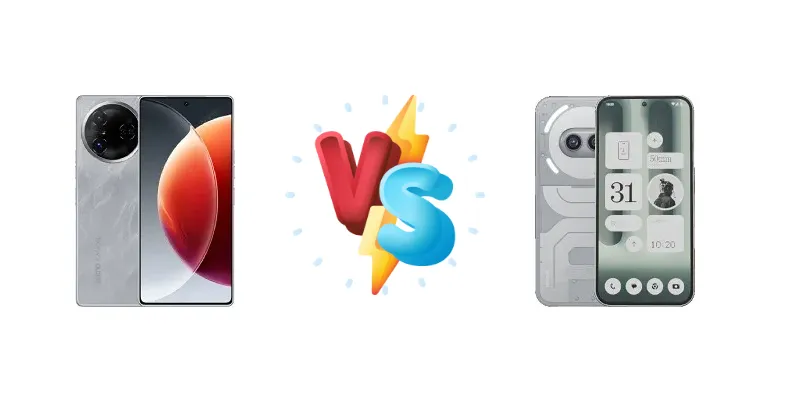
The Tecno Camon 30 Pro and Nothing Phone (2a) Plus represent compelling options in the increasingly competitive mid-range smartphone market. The Camon 30 Pro focuses on raw performance and rapid charging, while the Nothing Phone (2a) Plus prioritizes a refined user experience and extended battery life. This comparison dives deep into their specifications to determine which device best suits your needs.
🏆 Quick Verdict
For the average user prioritizing a balance of performance and fast charging, the Tecno Camon 30 Pro is the better choice. Its Dimensity 8200 Ultimate chipset delivers more processing power, and its 70W charging significantly reduces downtime. However, the Nothing Phone (2a) Plus offers superior battery endurance.
| Network |
|---|
| 2G bands | GSM 850 / 900 / 1800 / 1900 | GSM 850 / 900 / 1800 / 1900 |
| 3G bands | HSDPA 850 / 900 / 1700(AWS) / 1900 / 2100 | HSDPA 800 / 850 / 900 / 1700(AWS) / 1900 / 2100 |
| 4G bands | LTE | 1, 3, 4, 5, 7, 8, 18, 19, 20, 26, 28, 38, 39, 40, 41, 42, 66 |
| 5G bands | SA/NSA | 1, 3, 5, 7, 8, 20, 28, 38, 40, 41, 66, 77, 78 SA/NSA |
| Speed | HSPA, LTE, 5G | HSPA, LTE, 5G |
| Technology | GSM / HSPA / LTE / 5G | GSM / HSPA / LTE / 5G |
| Launch |
|---|
| Announced | 2024, February 27 | 2024, July 31 |
| Status | Available. Released 2024, April 02 | Available. Released 2024, August 03 |
| Body |
|---|
| Build | Glass front, glass back or silicone polymer back (eco leather) | Glass front (Gorilla Glass 5), plastic frame, plastic back |
| Dimensions | 164 x 74.5 x 7.7 mm (6.46 x 2.93 x 0.30 in) | 161.7 x 76.3 x 8.5 mm (6.37 x 3.00 x 0.33 in) |
| SIM | Nano-SIM + Nano-SIM | Nano-SIM + Nano-SIM |
| Weight | 188.6 g (6.67 oz) | 190 g (6.70 oz) |
| Display |
|---|
| Protection | - | Corning Gorilla Glass 5 |
| Resolution | 1080 x 2436 pixels (~393 ppi density) | 1080 x 2412 pixels, 20:9 ratio (~395 ppi density) |
| Size | 6.78 inches, 109.9 cm2 (~89.9% screen-to-body ratio) | 6.7 inches, 107.5 cm2 (~87.1% screen-to-body ratio) |
| Type | AMOLED, 144Hz | AMOLED, 1B colors, 120Hz, 2160Hz PWM, HDR10+, 700 nits (typ), 1100 nits (HBM), 1300 nits (peak) |
| Platform |
|---|
| CPU | Octa-core (1x3.1 GHz Cortex-A78 & 3x3.0 GHz Cortex-A78 & 4x2.0 GHz Cortex-A55) | Octa-core (2x3.0 GHz Cortex-A715 & 6x 2.0 GHz Cortex-A510) |
| Chipset | Mediatek Dimensity 8200 Ultimate (4 nm) | Mediatek Dimensity 7350 Pro (4 nm) |
| GPU | Mali-G610 MC6 | Mali-G610 MC4 |
| OS | Android 14, up to 2 major Android upgrades, HIOS 14 | Android 14, up to 3 major Android upgrades, Nothing OS 3.0 |
| Memory |
|---|
| Card slot | No | No |
| Internal | 256GB 12GB RAM, 512GB 12GB RAM | 256GB 8GB RAM, 256GB 12GB RAM |
| Main Camera |
|---|
| Dual | - | 50 MP, f/1.9, 24mm (wide), 1/1.57", 1.0µm, PDAF, OIS
50 MP, f/2.2, 114˚ (ultrawide), 1/2.76", 0.64µm |
| Features | Dual-LED flash, HDR, panorama | LED flash, panorama, HDR |
| Triple | 50 MP, f/1.9, 23mm (wide), 1/1.56", 1.0µm, PDAF, OIS
50 MP, f/2.2, 14mm, 114˚ (ultrawide), 1/2.76", 0.64µm, PDAF
Auxiliary lens | - |
| Video | 4K@30/60fps (HDR), 1080p@30fps | 4K@30fps, 1080p@60/120fps, gyro-EIS |
| Selfie camera |
|---|
| Features | - | HDR |
| Single | 50 MP, f/2.5, 24mm (wide), 1/2.8", 0.64µm, PDAF | 50 MP, f/2.2, (wide), 1/2.76" |
| Video | Yes | 4K@30fps |
| Sound |
|---|
| 35mm jack | No | No |
| Loudspeaker | Yes, with dual speakers | Yes, with stereo speakers |
| Comms |
|---|
| Bluetooth | 5.3, A2DP, LE | 5.3, A2DP, LE |
| Infrared port | Yes | - |
| NFC | Yes | Yes, 360˚ |
| Positioning | GPS | GPS, GALILEO, GLONASS, BDS, QZSS |
| Radio | FM radio | No |
| USB | USB Type-C 2.0, OTG | USB Type-C 2.0, OTG |
| WLAN | Wi-Fi 802.11 a/b/g/n/ac, dual-band | Wi-Fi 802.11 a/b/g/n/ac/6, dual-band, Wi-Fi Direct |
| Features |
|---|
| Sensors | Fingerprint (under display, optical), accelerometer, gyro, compass | Fingerprint (under display, optical), accelerometer, gyro, proximity, compass |
| Battery |
|---|
| Charging | 70W wired, 0-100% in 47 min | 50W wired, 50% in 21 min, 100% in 56 min |
| Type | 5000 mAh | 5000 mAh |
| Misc |
|---|
| Colors | Iceland Basaltic Dark, Alps Snowy Silver | Black, Grey |
| Models | CL8 | A142P |
| Price | - | € 269.90 / ₹ 22,599 |
Tecno Camon 30 Pro
- Faster charging (70W)
- More powerful processor (Dimensity 8200 Ultimate)
- Potentially better camera ISP
- Shorter battery life
- Slightly dimmer display
Nothing Phone (2a) Plus
- Longer battery life
- Brighter display
- Clean software experience (typical of Nothing)
- Slower charging (50W)
- Less powerful processor (Dimensity 7350 Pro)
Display Comparison
The Nothing Phone (2a) Plus boasts a brighter display, reaching 1097 nits compared to the Tecno Camon 30 Pro’s 998 nits. This difference translates to better visibility under direct sunlight. While both utilize 4nm chipsets, the display brightness impacts power draw. Neither specification details refresh rate or panel technology (OLED/LCD), but given the market segment, OLED is highly probable for both. The Nothing Phone (2a) Plus’s higher peak brightness is a clear advantage for outdoor users.
Camera Comparison
Without detailed camera specifications beyond the chipsets, a direct comparison is limited. However, the Dimensity 8200 Ultimate generally supports more advanced image signal processors (ISPs) capable of handling higher-resolution sensors and more complex image processing. The market positioning of the Camon 30 Pro suggests a focus on camera capabilities, potentially including a larger main sensor and more sophisticated features. The Nothing Phone (2a) Plus likely prioritizes computational photography and a balanced camera experience. Without sensor size or aperture data, it’s difficult to definitively declare a winner.
Performance
The Tecno Camon 30 Pro is equipped with the Mediatek Dimensity 8200 Ultimate, a 4nm chipset featuring a powerful CPU configuration: 1x3.1 GHz Cortex-A78, 3x3.0 GHz Cortex-A78, and 4x2.0 GHz Cortex-A55. The Nothing Phone (2a) Plus utilizes the Dimensity 7350 Pro (also 4nm) with a CPU of 2x3.0 GHz Cortex-A715 & 6x 2.0 GHz Cortex-A510. The Camon 30 Pro’s CPU architecture, with its higher-clocked and more numerous Cortex-A78 cores, suggests superior multi-core performance. While both are 4nm, the Dimensity 8200 Ultimate is a generation ahead and generally offers a more robust GPU, benefiting gaming and graphics-intensive applications. The Nothing Phone (2a) Plus’s Cortex-A715 cores are newer, but the core count and clock speeds don’t match the Camon 30 Pro.
Battery Life
The Nothing Phone (2a) Plus demonstrates a clear advantage in battery life, achieving an active use score of 16:34h compared to the Tecno Camon 30 Pro’s 14:29h. This nearly 2-hour difference is significant for users who prioritize all-day endurance. However, the Tecno Camon 30 Pro compensates with significantly faster charging: 70W wired, reaching 100% in just 47 minutes, versus the Nothing Phone (2a) Plus’s 50W charging, taking 56 minutes for a full charge. The 50% charge time of 21 minutes on the Nothing Phone (2a) Plus is respectable, but the Camon 30 Pro’s overall charging speed is substantially quicker.
Buying Guide
Buy the Tecno Camon 30 Pro if you need a phone for demanding tasks like gaming or video editing and value the convenience of extremely fast charging. Buy the Nothing Phone (2a) Plus if you prioritize all-day battery life, a clean software experience, and a slightly brighter display for outdoor visibility.
Frequently Asked Questions
❓ Does the Dimensity 8200 Ultimate in the Tecno Camon 30 Pro get hot during extended gaming sessions?
The Dimensity 8200 Ultimate is a thermally efficient chipset due to its 4nm process. However, sustained gaming will inevitably generate heat. The Camon 30 Pro’s thermal management system will play a crucial role, but it’s likely to experience some throttling after prolonged use, though less so than older or less efficient chipsets.
❓ How does the 50W charging on the Nothing Phone (2a) Plus compare to other phones in its price range?
50W charging is competitive within the mid-range segment, but it's slower than the 65W or 80W charging offered by some competitors. The Nothing Phone (2a) Plus prioritizes battery health and longevity over ultra-fast charging, aiming for a balance between speed and battery lifespan.
❓ Is the difference in active use battery life between the two phones noticeable in everyday use?
Yes, a nearly 2-hour difference in active use score is significant. Users who frequently use their phones for navigation, streaming, or gaming will likely notice the longer battery life of the Nothing Phone (2a) Plus. The Tecno Camon 30 Pro’s faster charging can mitigate this, but requires access to a charger.