
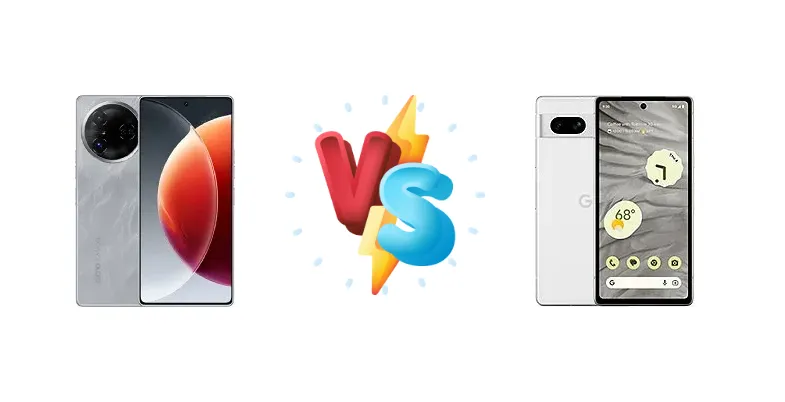
Tecno Camon 30 Pro vs Google Pixel 7a: A Detailed Comparison
| Phones Images | |||||
|---|---|---|---|---|---|
|
🏆 Quick Verdict
For the average user prioritizing raw performance and rapid charging, the Tecno Camon 30 Pro emerges as the winner. Its Dimensity 8200 Ultimate chipset and 70W charging significantly outperform the Pixel 7a’s Tensor G2 and 18W charging. However, the Pixel 7a remains a strong contender for those deeply invested in Google’s ecosystem and prioritizing camera software.
| PHONES | ||
|---|---|---|
| Phone Names | Tecno Camon 30 Pro | Google Pixel 7a |
| Network | ||
|---|---|---|
| 2G bands | GSM 850 / 900 / 1800 / 1900 | GSM 850 / 900 / 1800 / 1900 |
| 3G bands | HSDPA 850 / 900 / 1700(AWS) / 1900 / 2100 | HSDPA 800 / 850 / 900 / 1700(AWS) / 1900 / 2100 |
| 4G bands | LTE | 1, 2, 3, 4, 5, 7, 8, 12, 13, 14, 17, 20, 25, 26, 28, 29, 30, 38, 40, 41, 48, 66, 71 - GWKK3, G0DZQ |
| 5G bands | SA/NSA | 1, 2, 3, 5, 7, 8, 12, 14, 20, 25, 28, 30, 38, 41, 48, 66, 71, 77, 78 SA/NSA/Sub6 - GWKK3 |
| Speed | HSPA, LTE, 5G | HSPA, LTE, 5G |
| Technology | GSM / HSPA / LTE / 5G | GSM / HSPA / LTE / 5G |
| - | 1, 2, 3, 5, 7, 8, 12, 20, 25, 28, 38, 40, 41, 66, 75, 76, 77, 78, 79 SA/NSA/Sub6 - GHL1X, G82U8 | |
| Launch | ||
|---|---|---|
| Announced | 2024, February 27 | 2023, May 10 |
| Status | Available. Released 2024, April 02 | Available. Released 2023, May 10 |
| Body | ||
|---|---|---|
| Build | Glass front, glass back or silicone polymer back (eco leather) | Glass front (Gorilla Glass 3), aluminum frame, plastic back |
| Dimensions | 164 x 74.5 x 7.7 mm (6.46 x 2.93 x 0.30 in) | 152 x 72.9 x 9 mm (5.98 x 2.87 x 0.35 in) |
| SIM | Nano-SIM + Nano-SIM | Nano-SIM + eSIM |
| Weight | 188.6 g (6.67 oz) | 193.5 g (6.84 oz) |
| - | IP67 dust/water resistant (up to 1m for 30 min) | |
| Display | ||
|---|---|---|
| Protection | - | Corning Gorilla Glass 3 |
| Resolution | 1080 x 2436 pixels (~393 ppi density) | 1080 x 2400 pixels, 20:9 ratio (~429 ppi density) |
| Size | 6.78 inches, 109.9 cm2 (~89.9% screen-to-body ratio) | 6.1 inches, 90.7 cm2 (~81.8% screen-to-body ratio) |
| Type | AMOLED, 144Hz | OLED, HDR, 90Hz |
| - | Always-on display | |
| Platform | ||
|---|---|---|
| CPU | Octa-core (1x3.1 GHz Cortex-A78 & 3x3.0 GHz Cortex-A78 & 4x2.0 GHz Cortex-A55) | Octa-core (2x2.85 GHz Cortex-X1 & 2x2.35 GHz Cortex-A78 & 4x1.80 GHz Cortex-A55) |
| Chipset | Mediatek Dimensity 8200 Ultimate (4 nm) | Google Tensor G2 (5 nm) |
| GPU | Mali-G610 MC6 | Mali-G710 MP7 |
| OS | Android 14, up to 2 major Android upgrades, HIOS 14 | Android 13, upgradable to Android 15, up to 5 major Android upgrades |
| Memory | ||
|---|---|---|
| Card slot | No | No |
| Internal | 256GB 12GB RAM, 512GB 12GB RAM | 128GB 8GB RAM |
| - | UFS 3.1 | |
| Main Camera | ||
|---|---|---|
| Dual | - | 64 MP, f/1.9, 26mm (wide), 1/1.73", 0.8µm, dual pixel PDAF, OIS 13 MP, f/2.2, 120˚ (ultrawide), 1.12µm |
| Features | Dual-LED flash, HDR, panorama | Dual-LED flash, Pixel Shift, Auto-HDR, panorama |
| Triple | 50 MP, f/1.9, 23mm (wide), 1/1.56", 1.0µm, PDAF, OIS 50 MP, f/2.2, 14mm, 114˚ (ultrawide), 1/2.76", 0.64µm, PDAF Auxiliary lens | - |
| Video | 4K@30/60fps (HDR), 1080p@30fps | 4K@30/60fps, 1080p@30/60/120/240fps, OIS |
| Selfie camera | ||
|---|---|---|
| Features | - | HDR, panorama |
| Single | 50 MP, f/2.5, 24mm (wide), 1/2.8", 0.64µm, PDAF | 13 MP, f/2.2, 20mm (ultrawide), 1.12µm |
| Video | Yes | 4K@30fps, 1080p@30fps |
| Sound | ||
|---|---|---|
| 3.5mm jack | - | No |
| 35mm jack | No | No |
| Loudspeaker | Yes, with dual speakers | Yes, with stereo speakers |
| Comms | ||
|---|---|---|
| Bluetooth | 5.3, A2DP, LE | 5.3, A2DP, LE |
| Infrared port | Yes | - |
| NFC | Yes | Yes |
| Positioning | GPS | GPS, GLONASS, GALILEO, BDS, QZSS, NavIC |
| Radio | FM radio | No |
| USB | USB Type-C 2.0, OTG | USB Type-C 3.2 |
| WLAN | Wi-Fi 802.11 a/b/g/n/ac, dual-band | Wi-Fi 802.11 a/b/g/n/ac/6e, tri-band |
| Features | ||
|---|---|---|
| Sensors | Fingerprint (under display, optical), accelerometer, gyro, compass | Fingerprint (under display, optical), accelerometer, gyro, proximity, compass, barometer |
| Battery | ||
|---|---|---|
| Charging | 70W wired, 0-100% in 47 min | 18W wired, PD3.0 7.5W wireless |
| Type | 5000 mAh | Li-Po 4385 mAh |
| Misc | ||
|---|---|---|
| Colors | Iceland Basaltic Dark, Alps Snowy Silver | Charcoal, Snow, Sea, Coral |
| Models | CL8 | GWKK3, GHL1X, G0DZQ, G82U8 |
| Price | - | € 179.90 / $ 150.00 / £ 170.00 / ₹ 25,980 |
Tecno Camon 30 Pro
- Significantly faster 70W charging
- More powerful Dimensity 8200 Ultimate chipset
- Excellent battery life (14:29h active use)
- Camera performance is unproven against Pixel 7a
- Software support and updates may be less frequent
Google Pixel 7a
- Exceptional camera image processing
- Seamless Google software experience
- Strong integration with Google services
- Slower 18W charging
- Less powerful Tensor G2 chipset
- Potentially lower peak performance under sustained load
Display Comparison
Both devices feature bright displays, but the Pixel 7a edges out the Camon 30 Pro with a measured peak brightness of 1070 nits compared to the Camon 30 Pro’s 998 nits. This difference, while not massive, will be noticeable in direct sunlight. While both likely utilize OLED panels, the Pixel 7a’s display is known for its color accuracy, a benefit for content creators. Details regarding refresh rate and PWM dimming frequency are missing for the Camon 30 Pro, making it difficult to assess its suitability for users sensitive to flicker.
Camera Comparison
The Pixel 7a’s strength lies in its computational photography, powered by Google’s image processing algorithms. While sensor size and aperture details are missing for the Camon 30 Pro, the Pixel 7a’s reputation for consistently delivering excellent photos, particularly in challenging lighting conditions, is well-established. The Pixel 7a’s video capabilities are also highly regarded. Without specific camera specs for the Camon 30 Pro, it’s difficult to make a direct comparison, but it will likely rely more on hardware than software for image quality. The Pixel 7a’s focus on software optimization gives it a significant advantage.
Performance
The chipset is where these phones diverge significantly. The Tecno Camon 30 Pro boasts the Mediatek Dimensity 8200 Ultimate, a 4nm chip with a powerful CPU configuration (1x3.1 GHz Cortex-A78, 3x3.0 GHz Cortex-A78, 4x2.0 GHz Cortex-A55). This contrasts with the Google Pixel 7a’s Google Tensor G2, fabricated on a 5nm process (2x2.85 GHz Cortex-X1, 2x2.35 GHz Cortex-A78, 4x1.80 GHz Cortex-A55). The 4nm process of the Dimensity 8200 Ultimate generally translates to better power efficiency and potentially less thermal throttling under sustained load. The Cortex-X1 cores in the Tensor G2 are designed for AI tasks, but the Dimensity 8200 Ultimate’s overall CPU and GPU performance likely surpasses the Tensor G2 in most benchmarks.
Battery Life
The Tecno Camon 30 Pro delivers a remarkable 14:29h of active use, showcasing excellent battery endurance. The Pixel 7a’s older endurance rating of 76h is less informative without knowing the test conditions. However, the Camon 30 Pro’s 70W wired charging is a game-changer, achieving a 0-100% charge in just 47 minutes. The Pixel 7a’s 18W charging, while supporting PD3.0, is significantly slower and takes considerably longer to fully charge. The Camon 30 Pro’s faster charging is a clear advantage for users who frequently need to top up their battery.
Buying Guide
Buy the Tecno Camon 30 Pro if you need a phone for demanding tasks like gaming, video editing, or heavy multitasking, and value incredibly fast charging. Buy the Google Pixel 7a if you prioritize a seamless software experience, exceptional image processing, and integration with Google’s AI features, even if it means sacrificing some raw processing power and charging speed.