
Xiaomi 14T Pro vs Tecno Camon 30 Premier: A Deep Dive into Mid-Range Power
| Phones Images | |||||
|---|---|---|---|---|---|
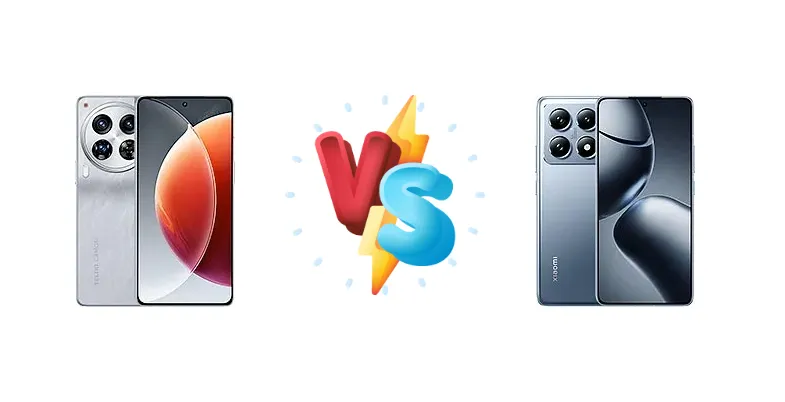
|
🏆 Quick Verdict
For the average user prioritizing speed and future-proofing, the Xiaomi 14T Pro is the clear winner. Its Dimensity 9300+ chipset and 120W charging significantly outperform the Tecno Camon 30 Premier. However, the Camon 30 Premier’s excellent battery life and potentially lower price make it a strong contender for budget-conscious users.
| PHONES | ||
|---|---|---|
| Phone Names | Tecno Camon 30 Premier | Xiaomi 14T Pro |
| Network | ||
|---|---|---|
| 2G bands | GSM 850 / 900 / 1800 / 1900 | GSM 850 / 900 / 1800 / 1900 |
| 3G bands | HSDPA 850 / 900 / 1700(AWS) / 1900 / 2100 | HSDPA 800 / 850 / 900 / 1700(AWS) / 1900 / 2100 |
| 4G bands | LTE | 1, 2, 3, 4, 5, 7, 8, 12, 13, 17, 18, 19, 20, 25, 26, 28, 32, 38, 39, 40, 41, 42, 48, 66 |
| 5G bands | SA/NSA | 1, 2, 3, 5, 7, 8, 12, 20, 25, 26, 28, 38, 40, 41, 48, 66, 75, 77, 78 SA/NSA |
| Speed | HSPA, LTE, 5G | HSPA, LTE, 5G |
| Technology | GSM / HSPA / LTE / 5G | GSM / HSPA / LTE / 5G |
| Launch | ||
|---|---|---|
| Announced | 2024, February 27 | 2024, September 26 |
| Status | Available. Released 2024, May | Available. Released 2024, September 26 |
| Body | ||
|---|---|---|
| Build | Glass front (Gorilla Glass 5), aluminum frame, aluminum back with silicone polymer finish (eco leather) | Glass front (Gorilla Glass 5), aluminum frame, glass back (Panda X) |
| Dimensions | 162.7 x 76.2 x 7.9 mm (6.41 x 3.00 x 0.31 in) | 160.4 x 75.1 x 8.4 mm (6.31 x 2.96 x 0.33 in) |
| SIM | Nano-SIM + Nano-SIM | · Nano-SIM + eSIM· eSIM + eSIM· Nano-SIM + Nano-SIM |
| Weight | 210 g (7.41 oz) | 209 g (7.37 oz) |
| Display | ||
|---|---|---|
| Protection | Corning Gorilla Glass 5 | Corning Gorilla Glass 5 |
| Resolution | 1264 x 2780 pixels (~451 ppi density) | 1220 x 2712 pixels, 20:9 ratio (~446 ppi density) |
| Size | 6.77 inches, 111.4 cm2 (~89.9% screen-to-body ratio) | 6.67 inches, 107.4 cm2 (~89.1% screen-to-body ratio) |
| Type | LTPO AMOLED, 1B colors, 120Hz, HDR, 1400 nits (HBM) | AMOLED, 68B colors, 144Hz, 3840Hz PWM, Dolby Vision, HDR10+, 1600 nits (HBM), 4000 nits (peak) |
| Platform | ||
|---|---|---|
| CPU | Octa-core (1x3.1 GHz Cortex-A78 & 3x3.0 GHz Cortex-A78 & 4x2.0 GHz Cortex-A55) | Octa-core (1x3.4 GHz Cortex-X4 & 3x2.85 GHz Cortex-X4 & 4x2.0 GHz Cortex-A720) |
| Chipset | Mediatek Dimensity 8200 Ultimate (4 nm) | Mediatek Dimensity 9300+ (4 nm) |
| GPU | Mali-G610 MC6 | Immortalis-G720 MC12 |
| OS | Android 14, up to 2 major Android upgrades, HIOS 14 | Android 14, HyperOS |
| Memory | ||
|---|---|---|
| Card slot | No | No |
| Internal | 512GB 12GB RAM | 256GB 12GB RAM, 512GB 12GB RAM, 512GB 16GB RAM, 1TB 12GB RAM |
| Main Camera | ||
|---|---|---|
| Features | Quad-LED flash, HDR, panorama | Leica lens, Ultra HDR, LED flash, HDR, panorama |
| Triple | 50 MP, f/1.9, 23mm (wide), 1/1.56", 1.0µm, PDAF, OIS 50 MP, f/2.2, 70mm (periscope telephoto), 1/2.76", 0.64µm, PDAF, 3x optical zoom 50 MP, f/2.2, 14mm, 114˚ (ultrawide), 1/2.76", 0.64µm, PDAF | 50 MP, f/1.6, 23mm (wide), 1/1.31", 1.2µm, PDAF, OIS 50 MP, f/2.0, 60mm (telephoto), 1/2.88", 0.61µm, PDAF, 2.6x optical zoom 12 MP, f/2.2, 15mm (ultrawide), 1/3.06", 1.12µm |
| Video | 4K@30/60fps (HDR), 1080p@30fps | 8K@24/30fps, 4K@24/30/60fps, 1080p@30/60/120/240/960fps, gyro-EIS, 10-bit Rec. 2020, HDR10+ |
| Selfie camera | ||
|---|---|---|
| Features | - | HDR |
| Single | 50 MP, f/2.5, 24mm (wide), 1/2.8", 0.64µm, PDAF | 32 MP, f/2.0, 25mm (wide), 1/3.44", 0.64µm |
| Video | 4K@30fps, 1080p | 4K@30fps, 1080p@30/60fps, HDR10+ |
| Sound | ||
|---|---|---|
| 35mm jack | No | No |
| Loudspeaker | Yes, with dual speakers | Yes, with stereo speakers |
| Comms | ||
|---|---|---|
| Bluetooth | 5.3, A2DP, LE | 5.4, A2DP, LE, LHDC |
| Infrared port | Yes | Yes |
| NFC | Yes | Yes (market/region dependent) |
| Positioning | GPS | GPS (L1+L5), BDS (B1I+B1C+B2a+B2b), GALILEO (E1+E5a+E5b), QZSS (L1+L5), NavIC (L5), GLONASS |
| Radio | FM radio | No |
| USB | USB Type-C 2.0, OTG | USB Type-C 2.0, OTG |
| WLAN | Wi-Fi 802.11 a/b/g/n/ac, dual-band | Wi-Fi 802.11 a/b/g/n/ac/6e/7, dual-band, Wi-Fi Direct |
| Features | ||
|---|---|---|
| Sensors | Fingerprint (under display, optical), accelerometer, gyro, proximity, compass | Fingerprint (under display, optical), accelerometer, gyro, proximity, compass |
| Battery | ||
|---|---|---|
| Charging | 70W wired, 100% in 45 min | 120W wired, PD3.0, QC4, 100% in 19 min 50W wireless, 100% in 45 min |
| Type | 5000 mAh | Li-Po 5000 mAh |
| Misc | ||
|---|---|---|
| Colors | Alps Snowy Silver, Hawaii Lava Black | Titan Gray, Titan Blue, Titan Black |
| Models | CL9 | 2407FPN8EG |
| Price | ₹ 29,999 | $ 550.00 / £ 498.00 / € 539.99 |
| SAR EU | - | 0.99 W/kg (head) 1.00 W/kg (body) |
Tecno Camon 30 Premier
- Excellent battery life (13:29h active use)
- Potentially lower price point
- Bright display (854 nits)
- Slower charging speed (70W)
- Less powerful processor (Dimensity 8200 Ultimate)
Xiaomi 14T Pro
- Blazing-fast 120W wired charging (19 min full charge)
- More powerful processor (Dimensity 9300+)
- 50W wireless charging support
- Shorter battery life (12:32h active use)
- Potentially higher price
Display Comparison
Both devices utilize 4nm chipsets, but the display experience differs. The Xiaomi 14T Pro reaches a maximum brightness of 1228 nits, noticeably dimmer than the Tecno Camon 30 Premier’s 854 nits. While the Xiaomi’s lower peak brightness might seem counterintuitive, it likely prioritizes efficiency. The absence of LTPO technology in both phones suggests a standard refresh rate, and the impact of panel quality on color accuracy and viewing angles will be crucial in real-world use. The Tecno’s higher brightness will be more beneficial in direct sunlight.
Camera Comparison
Without detailed camera specs, a direct comparison is limited. However, the chipset’s ISP capabilities play a role. The Dimensity 9300+ in the Xiaomi 14T Pro generally offers more advanced image processing features and potentially better low-light performance. The absence of information regarding sensor sizes and OIS makes it difficult to assess image quality definitively, but the 14T Pro’s more powerful processor suggests a more sophisticated camera experience. We can assume both phones will feature multi-camera setups, but the quality of those secondary lenses will be key.
Performance
The Xiaomi 14T Pro’s Mediatek Dimensity 9300+ represents a significant leap in performance over the Tecno Camon 30 Premier’s Dimensity 8200 Ultimate. The 9300+ features a Cortex-X4 prime core clocked at 3.4 GHz, compared to the 8200 Ultimate’s Cortex-A78 core at 3.1 GHz. This architectural difference translates to faster processing speeds and improved responsiveness, particularly in demanding applications. The 14T Pro’s CPU configuration (1x3.4 GHz Cortex-X4 & 3x2.85 GHz Cortex-X4 & 4x2.0 GHz Cortex-A720) also benefits from newer core designs, offering better efficiency and performance per watt. While both use 4nm fabrication, the 9300+’s superior architecture will result in a smoother experience for gamers and power users.
Battery Life
The Tecno Camon 30 Premier delivers a longer active use score of 13:29h compared to the Xiaomi 14T Pro’s 12:32h, indicating superior battery endurance. However, the Xiaomi 14T Pro compensates with significantly faster charging: 120W wired charging, achieving a full charge in just 19 minutes, versus the Tecno’s 70W charging taking 45 minutes. The 14T Pro also adds 50W wireless charging, a feature absent on the Camon 30 Premier. This trade-off between battery life and charging speed caters to different user preferences – those prioritizing longevity versus those valuing convenience.
Buying Guide
Buy the Tecno Camon 30 Premier if you need exceptional battery life and prioritize longevity over raw performance, and are looking for a more affordable option. You’ll benefit from all-day usage and a reliable experience. Buy the Xiaomi 14T Pro if you demand the fastest charging speeds, a more powerful processor for demanding tasks like gaming and video editing, and are willing to pay a premium for cutting-edge technology.