
OnePlus 12R vs Tecno Camon 30 Premier: A Deep Dive into Performance and Value
| Phones Images | |||||
|---|---|---|---|---|---|
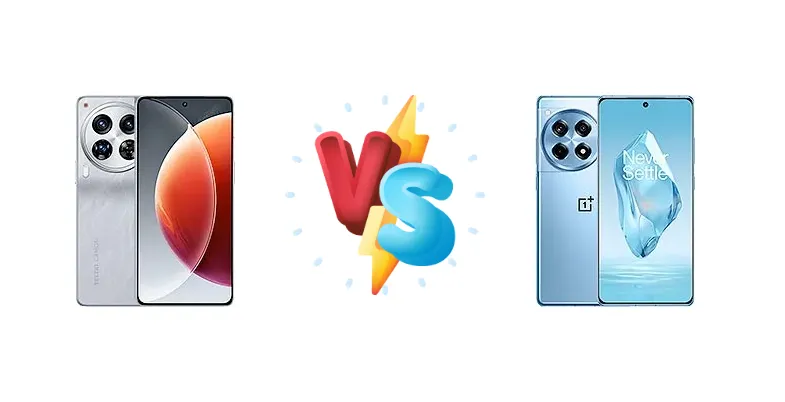
|
🏆 Quick Verdict
For most users, the OnePlus 12R emerges as the stronger contender. Its Snapdragon 8 Gen 2 chipset provides a significant performance advantage, coupled with faster 100W charging and a brighter display. While the Tecno Camon 30 Premier offers respectable battery life, it can't match the raw power and efficiency of its rival.
| PHONES | ||
|---|---|---|
| Phone Names | Tecno Camon 30 Premier | OnePlus 12R |
| Network | ||
|---|---|---|
| 2G bands | GSM 850 / 900 / 1800 / 1900 | GSM 850 / 900 / 1800 / 1900 |
| 3G bands | HSDPA 850 / 900 / 1700(AWS) / 1900 / 2100 | HSDPA 850 / 900 / 1700(AWS) / 1900 / 2100 |
| 4G bands | LTE | 1, 2, 3, 4, 5, 7, 8, 12, 17, 18, 19, 20, 26, 28, 32, 38, 39, 40, 41, 66 |
| 5G bands | SA/NSA | 1, 2, 3, 5, 7, 8, 12, 20, 28, 38, 40, 41, 66, 77, 78 SA/NSA |
| Speed | HSPA, LTE, 5G | HSPA, LTE, 5G |
| Technology | GSM / HSPA / LTE / 5G | GSM / CDMA / HSPA / LTE / 5G |
| Launch | ||
|---|---|---|
| Announced | 2024, February 27 | 2024, January 23 |
| Status | Available. Released 2024, May | Available. Released 2024, February 06 |
| Body | ||
|---|---|---|
| Build | Glass front (Gorilla Glass 5), aluminum frame, aluminum back with silicone polymer finish (eco leather) | Glass front (Gorilla Glass Victus 2), aluminum frame, glass back |
| Dimensions | 162.7 x 76.2 x 7.9 mm (6.41 x 3.00 x 0.31 in) | 163.3 x 75.3 x 8.8 mm (6.43 x 2.96 x 0.35 in) |
| SIM | Nano-SIM + Nano-SIM | · Nano-SIM + Nano-SIM + eSIM (max 2 at a time)· Nano-SIM + Nano-SIM |
| Weight | 210 g (7.41 oz) | 207 g (7.30 oz) |
| Display | ||
|---|---|---|
| Protection | Corning Gorilla Glass 5 | Corning Gorilla Glass Victus 2 |
| Resolution | 1264 x 2780 pixels (~451 ppi density) | 1264 x 2780 pixels (~450 ppi density) |
| Size | 6.77 inches, 111.4 cm2 (~89.9% screen-to-body ratio) | 6.78 inches, 111.7 cm2 (~90.9% screen-to-body ratio) |
| Type | LTPO AMOLED, 1B colors, 120Hz, HDR, 1400 nits (HBM) | LTPO4 AMOLED, 1B colors, 120Hz, HDR10+, Dolby Vision, 1600 nits (HBM), 4500 nits (peak) |
| Platform | ||
|---|---|---|
| CPU | Octa-core (1x3.1 GHz Cortex-A78 & 3x3.0 GHz Cortex-A78 & 4x2.0 GHz Cortex-A55) | Octa-core (1x3.2 GHz Cortex-X3 & 2x2.8 GHz Cortex-A715 & 2x2.8 GHz Cortex-A710 & 3x2.0 GHz Cortex-A510) |
| Chipset | Mediatek Dimensity 8200 Ultimate (4 nm) | Qualcomm SM8550-AB Snapdragon 8 Gen 2 (4 nm) |
| GPU | Mali-G610 MC6 | Adreno 740 |
| OS | Android 14, up to 2 major Android upgrades, HIOS 14 | Android 14, up to 3 major Android upgrades, OxygenOS 15 |
| Memory | ||
|---|---|---|
| Card slot | No | No |
| Internal | 512GB 12GB RAM | 128GB 8GB RAM, 256GB 8GB RAM, 256GB 12GB RAM, 256GB 16GB RAM |
| Main Camera | ||
|---|---|---|
| Features | Quad-LED flash, HDR, panorama | Laser AF, color spectrum sensor, LED flash, HDR, panorama |
| Triple | 50 MP, f/1.9, 23mm (wide), 1/1.56", 1.0µm, PDAF, OIS 50 MP, f/2.2, 70mm (periscope telephoto), 1/2.76", 0.64µm, PDAF, 3x optical zoom 50 MP, f/2.2, 14mm, 114˚ (ultrawide), 1/2.76", 0.64µm, PDAF | 50 MP, f/1.8, 24mm (wide), 1/1.56", 1.0µm, multi-directional PDAF, OIS 8 MP, f/2.2, 16mm, 112˚ (ultrawide), 1/4.0", 1.12µm 2 MP (macro) |
| Video | 4K@30/60fps (HDR), 1080p@30fps | 4K@30/60fps, 1080p@30/60/120/240fps, gyro-EIS, OIS |
| Selfie camera | ||
|---|---|---|
| Features | - | HDR, panorama |
| Single | 50 MP, f/2.5, 24mm (wide), 1/2.8", 0.64µm, PDAF | 16 MP, f/2.4, 26mm (wide), 1/3", 1.0µm |
| Video | 4K@30fps, 1080p | 1080p@30fps, gyro-EIS |
| Sound | ||
|---|---|---|
| 35mm jack | No | No |
| Loudspeaker | Yes, with dual speakers | Yes, with stereo speakers |
| Comms | ||
|---|---|---|
| Bluetooth | 5.3, A2DP, LE | 5.3, A2DP, LE, aptX HD |
| Infrared port | Yes | Yes |
| NFC | Yes | Yes |
| Positioning | GPS | GPS, GALILEO, GLONASS, BDS, QZSS |
| Radio | FM radio | No |
| USB | USB Type-C 2.0, OTG | USB Type-C 2.0 |
| WLAN | Wi-Fi 802.11 a/b/g/n/ac, dual-band | Wi-Fi 802.11 a/b/g/n/ac/6/7, dual-band |
| Features | ||
|---|---|---|
| Sensors | Fingerprint (under display, optical), accelerometer, gyro, proximity, compass | Fingerprint (under display, optical), accelerometer, gyro, proximity, compass |
| Battery | ||
|---|---|---|
| Charging | 70W wired, 100% in 45 min | 100W wired, 100% in 26 min |
| Type | 5000 mAh | Li-Ion 5500 mAh |
| Misc | ||
|---|---|---|
| Colors | Alps Snowy Silver, Hawaii Lava Black | Iron Gray, Cool Blue, Electric Violet, Sunset Dune |
| Models | CL9 | CPH2609, CPH2585, CPH2611 |
| Price | ₹ 29,999 | € 410.84 / $ 399.95 / £ 649.00 |
| SAR | - | 1.19 W/kg (head) 0.82 W/kg (body) |
Tecno Camon 30 Premier
- Longer battery life in active use.
- Potentially more affordable price point.
- 70W fast charging is still respectable.
- Dimensity 8200 Ultimate is outperformed by Snapdragon 8 Gen 2.
- Lower peak display brightness.
- Slower charging compared to OnePlus 12R.
OnePlus 12R
- Significantly faster Snapdragon 8 Gen 2 processor.
- Brighter and potentially more efficient display.
- Ultra-fast 100W charging.
- Slightly shorter battery life in active use.
- Potentially higher price.
- May run warmer under sustained load.
Display Comparison
The OnePlus 12R boasts a significantly brighter display, reaching 1181 nits compared to the Tecno Camon 30 Premier’s 854 nits. This translates to superior visibility outdoors under direct sunlight. While both utilize 4nm chipsets, the brighter display of the OnePlus 12R will draw more power. Neither specification details refresh rate or panel type, but given the OnePlus 12R’s positioning, it’s likely to feature an LTPO panel for adaptive refresh rates and improved efficiency, a feature not confirmed for the Tecno.
Camera Comparison
Without detailed camera specifications, a direct comparison is limited. However, the chipset’s ISP (Image Signal Processor) plays a crucial role. The Snapdragon 8 Gen 2’s ISP is generally considered superior, offering better image processing capabilities, especially in low-light conditions. While the Tecno Camon 30 Premier may feature a high-resolution sensor, the OnePlus 12R’s superior processing power will likely result in more detailed and dynamic images. We can assume both phones will have capable main sensors, but the OnePlus has the edge in overall image quality.
Performance
The core difference lies in the chipsets. The OnePlus 12R’s Snapdragon 8 Gen 2 (SM8550-AB) is a flagship-level processor with a Cortex-X3 prime core clocked at 3.2 GHz, offering a substantial performance leap over the Tecno’s Dimensity 8200 Ultimate. The Dimensity 8200 Ultimate, while powerful, relies on Cortex-A78 cores, which are a generation behind the Cortex-X3 and A715/A710 cores found in the Snapdragon. This architectural difference will be most noticeable in demanding applications like gaming and video editing. The OnePlus 12R also benefits from potentially faster LPDDR5x RAM, further enhancing performance.
Battery Life
The OnePlus 12R offers a slight edge in active use battery life (14:32h) compared to the Tecno Camon 30 Premier (13:29h). However, the real differentiator is charging speed. The OnePlus 12R’s 100W charging can fully charge the battery in just 26 minutes, while the Tecno Camon 30 Premier takes 45 minutes with its 70W charging. This faster charging significantly reduces downtime and provides a more convenient user experience. The slightly larger battery capacity of the OnePlus 12R, combined with the more efficient Snapdragon chipset, contributes to its longer runtime.
Buying Guide
Buy the Tecno Camon 30 Premier if you prioritize extended battery life and are comfortable with slightly less demanding tasks. It’s a solid choice for everyday users who value longevity over peak performance. Buy the OnePlus 12R if you’re a gamer, power user, or simply want a phone that can handle anything you throw at it with ease, and you appreciate significantly faster charging speeds.