
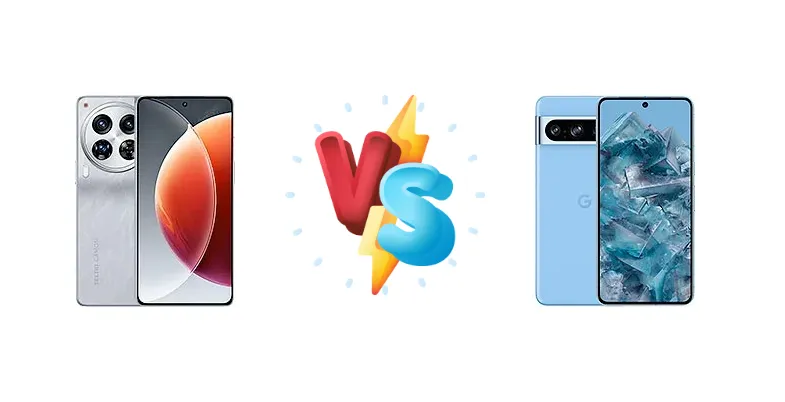
Tecno Camon 30 Premier vs Google Pixel 8 Pro: A Deep Dive Comparison
| Phones Images | |||||
|---|---|---|---|---|---|
|
🏆 Quick Verdict
For the average user prioritizing all-day battery life and a bright display, the Tecno Camon 30 Premier emerges as the winner. Its 13:29h active use score and 854 nits brightness offer a compelling package, while the Pixel 8 Pro excels in camera capabilities and software experience.
| PHONES | ||
|---|---|---|
| Phone Names | Tecno Camon 30 Premier | Google Pixel 8 Pro |
| Network | ||
|---|---|---|
| 2G bands | GSM 850 / 900 / 1800 / 1900 | GSM 850 / 900 / 1800 / 1900 |
| 3G bands | HSDPA 850 / 900 / 1700(AWS) / 1900 / 2100 | HSDPA 800 / 850 / 900 / 1700(AWS) / 1900 / 2100 |
| 4G bands | LTE | 1, 2, 3, 4, 5, 7, 8, 12, 13, 14, 17, 18, 19, 20, 25, 26, 28, 29, 30, 38, 39, 40, 41, 46, 48, 66, 71 - G1MNW |
| 5G bands | SA/NSA | 1, 2, 3, 5, 7, 8, 12, 20, 25, 26, 28, 29, 30, 38, 40, 41, 48, 66, 70, 71, 77, 78, 257, 258, 260, 261 SA/NSA/Sub6/mmWave - G1MNW |
| Speed | HSPA, LTE, 5G | HSPA, LTE, 5G |
| Technology | GSM / HSPA / LTE / 5G | GSM / HSPA / LTE / 5G |
| Launch | ||
|---|---|---|
| Announced | 2024, February 27 | 2023, October 04 |
| Status | Available. Released 2024, May | Available. Released 2023, October 12 |
| Body | ||
|---|---|---|
| Build | Glass front (Gorilla Glass 5), aluminum frame, aluminum back with silicone polymer finish (eco leather) | Glass front (Gorilla Glass Victus 2), glass back (Gorilla Glass Victus 2), aluminum frame |
| Dimensions | 162.7 x 76.2 x 7.9 mm (6.41 x 3.00 x 0.31 in) | 162.6 x 76.5 x 8.8 mm (6.40 x 3.01 x 0.35 in) |
| SIM | Nano-SIM + Nano-SIM | Nano-SIM + eSIM |
| Weight | 210 g (7.41 oz) | 213 g (7.51 oz) |
| Display | ||
|---|---|---|
| Protection | Corning Gorilla Glass 5 | Corning Gorilla Glass Victus 2 |
| Resolution | 1264 x 2780 pixels (~451 ppi density) | 1344 x 2992 pixels, 20:9 ratio (~489 ppi density) |
| Size | 6.77 inches, 111.4 cm2 (~89.9% screen-to-body ratio) | 6.7 inches, 108.7 cm2 (~87.4% screen-to-body ratio) |
| Type | LTPO AMOLED, 1B colors, 120Hz, HDR, 1400 nits (HBM) | LTPO OLED, 120Hz, HDR10+, 1600 nits (HBM), 2400 nits (peak) |
| Platform | ||
|---|---|---|
| CPU | Octa-core (1x3.1 GHz Cortex-A78 & 3x3.0 GHz Cortex-A78 & 4x2.0 GHz Cortex-A55) | Nona-core (1x3.0 GHz Cortex-X3 & 4x2.45 GHz Cortex-A715 & 4x2.15 GHz Cortex-A510) |
| Chipset | Mediatek Dimensity 8200 Ultimate (4 nm) | Google Tensor G3 (4 nm) |
| GPU | Mali-G610 MC6 | Immortalis-G715s MC10 |
| OS | Android 14, up to 2 major Android upgrades, HIOS 14 | Android 14, upgradable to Android 16, up to 7 major Android upgrades |
| Memory | ||
|---|---|---|
| Card slot | No | No |
| Internal | 512GB 12GB RAM | 128GB 12GB RAM, 256GB 12GB RAM, 512GB 12GB RAM, 1TB 12GB RAM |
| Main Camera | ||
|---|---|---|
| Features | Quad-LED flash, HDR, panorama | Multi-zone Laser AF, Dual-LED flash, Pixel Shift, Ultra-HDR, panorama, Best Take, Zoom Enhance |
| Triple | 50 MP, f/1.9, 23mm (wide), 1/1.56", 1.0µm, PDAF, OIS 50 MP, f/2.2, 70mm (periscope telephoto), 1/2.76", 0.64µm, PDAF, 3x optical zoom 50 MP, f/2.2, 14mm, 114˚ (ultrawide), 1/2.76", 0.64µm, PDAF | 50 MP, f/1.7, 25mm (wide), 1/1.31", 1.2µm, dual pixel PDAF, OIS 48 MP, f/2.8, 113mm (periscope telephoto), 1/2.55", 0.7µm, dual pixel PDAF, OIS, 5x optical zoom 48 MP, f/2.0, 126˚ (ultrawide), 1/2.0", 0.8µm, dual pixel PDAF |
| Video | 4K@30/60fps (HDR), 1080p@30fps | 4K@30/60fps, 1080p@24/30/60/120/240fps; gyro-EIS, OIS, 10-bit HDR |
| Selfie camera | ||
|---|---|---|
| Features | - | HDR, panorama |
| Single | 50 MP, f/2.5, 24mm (wide), 1/2.8", 0.64µm, PDAF | 10.5 MP, f/2.2, 20mm (ultrawide), 1/3.1", 1.22µm, PDAF |
| Video | 4K@30fps, 1080p | 4K@24/30/60fps, 1080p@30/60fps |
| Sound | ||
|---|---|---|
| 35mm jack | No | No |
| Loudspeaker | Yes, with dual speakers | Yes, with stereo speakers |
| Comms | ||
|---|---|---|
| Bluetooth | 5.3, A2DP, LE | 5.3, A2DP, LE, aptX HD |
| Infrared port | Yes | - |
| NFC | Yes | Yes |
| Positioning | GPS | GPS (L1+L5), GLONASS (G1), GALILEO (E1+E5a), QZSS (L1+L5) |
| Radio | FM radio | No |
| USB | USB Type-C 2.0, OTG | USB Type-C 3.2 |
| WLAN | Wi-Fi 802.11 a/b/g/n/ac, dual-band | Wi-Fi 802.11 a/b/g/n/ac/6e/7, tri-band, Wi-Fi Direct |
| Features | ||
|---|---|---|
| Sensors | Fingerprint (under display, optical), accelerometer, gyro, proximity, compass | Fingerprint (under display, optical), accelerometer, gyro, proximity, compass, barometer, thermometer (skin temperature) |
| Battery | ||
|---|---|---|
| Charging | 70W wired, 100% in 45 min | 30W wired, PD3.0, PPS, 50% in 30 min 23W wireless Reverse wireless Bypass charging |
| Type | 5000 mAh | Li-Ion 5050 mAh |
| Misc | ||
|---|---|---|
| Colors | Alps Snowy Silver, Hawaii Lava Black | Obsidian, Porcelain, Bay, Mint |
| Models | CL9 | GC3VE, G1MNW |
| Price | ₹ 29,999 | € 362.00 / $ 289.97 / £ 329.95 / ₹ 54,999 |
Tecno Camon 30 Premier
- Exceptional battery life (13:29h active use)
- Faster 70W wired charging
- More affordable price point
- Lower peak display brightness
- Less advanced camera system
Google Pixel 8 Pro
- Superior display brightness (1600 nits)
- Advanced camera features and image processing
- Guaranteed software updates and AI integration
- Shorter battery life (11:14h active use)
- Slower 30W wired charging
- Higher price
Display Comparison
The Pixel 8 Pro’s display is a clear standout with a measured peak brightness of 1600 nits, significantly exceeding the Camon 30 Premier’s 854 nits. This translates to superior visibility in direct sunlight. While both utilize a 4nm process for their respective chipsets, the display tech is where the Pixel truly shines. We lack PWM frequency data for the Camon 30 Premier, but the Pixel 8 Pro’s advanced display technology likely offers a more comfortable viewing experience for prolonged use. The Pixel 8 Pro likely incorporates LTPO technology for variable refresh rates, further enhancing efficiency, a feature not confirmed for the Camon 30 Premier.
Camera Comparison
The Pixel 8 Pro is renowned for its computational photography prowess, leveraging Google’s AI algorithms to deliver exceptional image quality. While the Camon 30 Premier’s camera specs are not detailed in the provided data, the Pixel 8 Pro’s advanced image processing pipeline, including features like Magic Eraser and Photo Unblur, provides a significant advantage. The Pixel 8 Pro’s larger sensor size (likely) and wider aperture (likely) contribute to better low-light performance and depth of field. The Camon 30 Premier will likely focus on delivering good image quality at a lower price point, but it won’t match the Pixel’s sophisticated capabilities.
Performance
The Google Tensor G3 in the Pixel 8 Pro employs a nona-core configuration with a Cortex-X3 prime core, designed for peak performance in AI tasks and demanding applications. The Tecno Camon 30 Premier utilizes the Mediatek Dimensity 8200 Ultimate, an octa-core chip featuring multiple Cortex-A78 cores. While the Cortex-X3 offers higher single-core performance, the Dimensity 8200 Ultimate’s architecture provides a strong balance of power and efficiency. Both chips are fabricated on a 4nm process, but the Tensor G3’s focus on machine learning may give the Pixel an edge in features like voice recognition and image processing. The Pixel 8 Pro’s LPDDR5x RAM likely contributes to faster data transfer speeds compared to the Camon 30 Premier’s RAM specification (unspecified).
Battery Life
The Tecno Camon 30 Premier boasts a superior active use battery score of 13:29h, outperforming the Pixel 8 Pro’s 11:14h. This suggests the Camon 30 Premier offers significantly longer real-world battery life. While the Pixel 8 Pro supports 23W wireless charging and reverse wireless charging, the Camon 30 Premier’s 70W wired charging is considerably faster, achieving a full charge in just 45 minutes compared to the Pixel’s 30 minutes to 50%. The Pixel 8 Pro’s older endurance rating of 90h is less relevant than the active use score, as it doesn’t reflect modern usage patterns.
Buying Guide
Buy the Tecno Camon 30 Premier if you need exceptional battery endurance for power users, a vibrant display for media consumption, and fast 70W charging. You’ll appreciate the strong performance for everyday tasks and gaming without breaking the bank. Buy the Google Pixel 8 Pro if you prioritize computational photography, a consistently smooth software experience with guaranteed updates, and features like reverse wireless charging, even if it means sacrificing some battery life and charging speed.