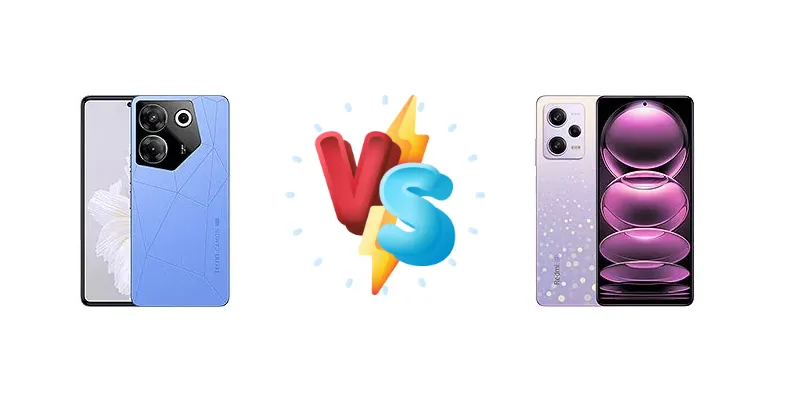
The mid-range smartphone market is fiercely competitive, and two contenders vying for your attention are the Tecno Camon 20 Pro 5G and the Xiaomi Redmi Note 12 Pro. Both offer compelling features at attractive price points, but which one truly comes out on top? Let's dive into a detailed comparison to help you decide.
🏆 Quick Verdict
The Xiaomi Redmi Note 12 Pro edges out the Camon 20 Pro 5G thanks to its significantly faster charging, brighter display, and exceptional battery life. While the Camon 20 Pro 5G boasts a slightly more powerful chipset, the Redmi Note 12 Pro's overall package provides a more polished and practical experience.
| Network |
|---|
| 2G bands | GSM 850 / 900 / 1800 / 1900 | GSM 850 / 900 / 1800 / 1900 |
| 3G bands | HSDPA 850 / 900 / 1700(AWS) / 1900 / 2100 | HSDPA 800 / 850 / 900 / 1900 / 2100 |
| 4G bands | LTE | 1, 2, 3, 4, 5, 7, 8, 12, 13, 17, 18, 19, 20, 26, 28, 32, 38, 40, 41, 66 - International |
| 5G bands | SA/NSA | 1, 3, 5, 7, 8, 20, 28, 38, 40, 41, 66, 77, 78 SA/NSA - International |
| Speed | HSPA, LTE, 5G | HSPA, LTE, 5G |
| Technology | GSM / HSPA / LTE / 5G | GSM / CDMA / HSPA / EVDO / LTE / 5G |
| | - | 1, 3, 5, 8, 28, 38, 41, 77, 78 SA/NSA - China |
| Launch |
|---|
| Announced | 2023, May 09 | 2022, October 27 |
| Status | Available. Released 2023, May 09 | Available. Released 2022, November 01 |
| Body |
|---|
| Build | - | Glass front (Gorilla Glass 5), glass back, plastic frame |
| Dimensions | 162.7 x 75.9 x 7.8 mm (6.41 x 2.99 x 0.31 in) | 163 x 76 x 8 mm (6.42 x 2.99 x 0.31 in) |
| SIM | Nano-SIM + Nano-SIM | Nano-SIM + Nano-SIM |
| Weight | - | 187 g (6.60 oz) |
| | - | IP53, dust and splash resistant |
| Display |
|---|
| Protection | - | Corning Gorilla Glass 5 |
| Resolution | 1080 x 2400 pixels, 20:9 ratio (~395 ppi density) | 1080 x 2400 pixels, 20:9 ratio (~395 ppi density) |
| Size | 6.67 inches, 107.4 cm2 (~87.0% screen-to-body ratio) | 6.67 inches, 107.4 cm2 (~86.7% screen-to-body ratio) |
| Type | AMOLED, 120Hz | AMOLED, 1B colors, 120Hz, Dolby Vision, HDR10+, 500 nits (typ), 900 nits (HBM) |
| | Always-on display | - |
| Platform |
|---|
| CPU | Octa-core (1x3.0 GHz Cortex-A78 & 3x2.6 GHz Cortex-A78 & 4x2.0 GHz Cortex-A55) | Octa-core (2x2.6 GHz Cortex-A78 & 6x2.0 GHz Cortex-A55) |
| Chipset | Mediatek Dimensity 8050 (6 nm) | Mediatek Dimensity 1080 (6 nm) |
| GPU | Mali-G77 MC9 | Mali-G68 MC4 |
| OS | Android 13, HIOS 13 | Android 12, MIUI 13 |
| Memory |
|---|
| Card slot | microSDXC (dedicated slot) | No |
| Internal | 256GB 8GB RAM | 128GB 6GB RAM, 128GB 8GB RAM, 256GB 8GB RAM, 256GB 12GB RAM |
| | - | UFS 2.2 |
| Main Camera |
|---|
| Features | Ring-LED flash, panorama, HDR | Dual-LED dual-tone flash, HDR, panorama |
| Triple | 64 MP, f/1.7, (wide), 1/1.7", 0.8µm, PDAF, OIS
2 MP (macro)
Auxiliary lens | 50 MP, f/1.9, 24mm (wide), 1/1.56", 1.0µm, PDAF, OIS
8 MP, f/2.2, 120˚ (ultrawide), 1/4.0", 1.12µm
2 MP (macro) |
| Video | 4K@30fps, 1080p@30fps, HDR | 4K@30fps, 1080p@30/60/120fps, 720p@960fps |
| Selfie camera |
|---|
| Features | Dual-LED flash | HDR |
| Single | 32 MP, f/2.5, 24mm (wide), 1/2.8", 0.8µm | 16 MP, f/2.5, (wide), 1/3.06", 1.0µm |
| Video | 1080p@30fps | 1080p@30/60fps |
| Sound |
|---|
| 3.5mm jack | Yes | Yes |
| 35mm jack | Yes | Yes |
| Loudspeaker | Yes, with stereo speakers | Yes, with stereo speakers |
| | 24-bit/192kHz audio | 24-bit/192kHz audio |
| Comms |
|---|
| Bluetooth | 5.2, A2DP, LE | 5.2, A2DP, LE |
| Infrared port | - | Yes |
| NFC | Yes | Yes (market/region dependent) |
| Positioning | GPS | GPS (L1), GLONASS (G1), BDS (B1I+B1c), GALILEO (E1), QZSS (L1) |
| Radio | FM radio | No |
| USB | USB Type-C 2.0, OTG | USB Type-C 2.0, OTG |
| WLAN | Wi-Fi 802.11 a/b/g/n/ac, dual-band | Wi-Fi 802.11 a/b/g/n/ac/6, dual-band, Wi-Fi Direct |
| Features |
|---|
| Sensors | Fingerprint (under display, optical), accelerometer, gyro, proximity, compass | Fingerprint (side-mounted), accelerometer, gyro, proximity, compass |
| Battery |
|---|
| Charging | 33W wired | 67W wired, PD3.0, 50% in 15 min, 100% in 46 min |
| Type | 5000 mAh | Li-Po 5000 mAh |
| Misc |
|---|
| Colors | Dark Welkin, Serenity Blue | Frosted Blue (Sky Blue), Onyx Black (Midnight Black), Polar White, Stardust Purple |
| Models | CK8n | 22101316C, 22101316I, 23013RK75C, 22101316G |
| Price | About 270 EUR | € 148.54 / $ 142.17 / £ 149.99 / ₹ 19,999 |
| SAR | - | 1.09 W/kg (head) 1.06 W/kg (body) |
| SAR EU | - | 0.99 W/kg (head) 0.99 W/kg (body) |
| Tests |
|---|
| Battery life | - |
Endurance rating 97h
|
| Camera | - |
Photo / Video |
| Display | - |
Contrast ratio: Infinite (nominal) |
| Loudspeaker | - |
-26.6 LUFS (Good)
|
| Performance | - |
AnTuTu: 490526 (v9)
GeekBench: 2209 (v5.1), 2372 (v6)
GFXBench: 22fps (ES 3.1 onscreen) |
Tecno Camon 20 Pro 5G
- Slightly more powerful chipset
- 5G Connectivity
- Potentially better selfie camera
- Less bright display
- Slower charging
- Shorter battery life
Xiaomi Redmi Note 12 Pro
- Faster 67W charging
- Brighter display
- Exceptional battery life
- Excellent value
- Slightly less powerful chipset compared to Camon 20 Pro 5G
Display Comparison
The Redmi Note 12 Pro takes the display crown with its measured 890 nits peak brightness, offering significantly better visibility in direct sunlight. While the Camon 20 Pro 5G's display is adequate, it lacks the same level of vibrancy and brightness. The Redmi Note 12 Pro's infinite contrast ratio (nominal) further enhances the viewing experience.
Camera Comparison
Both phones offer capable camera systems, but the Redmi Note 12 Pro likely has a slight edge in image quality, particularly in well-lit conditions. Both offer Photo/Video capabilities, but detailed camera comparisons would require more in-depth testing. The Camon series is often known for its selfie camera capabilities, so this is an area to consider.
Performance
The Tecno Camon 20 Pro 5G holds a slight advantage in raw processing power thanks to its Dimensity 8050 chipset. This translates to marginally better performance in demanding games and applications. However, the Dimensity 1080 in the Redmi Note 12 Pro is still more than capable for everyday tasks and most mobile games.
Battery Life
The Redmi Note 12 Pro absolutely dominates in the battery department. Its endurance rating of 97 hours and active use score of 12:08 hours are exceptional. The Camon 20 Pro 5G's battery life is respectable, but falls short of the Redmi Note 12 Pro's longevity.
Buying Guide
The Tecno Camon 20 Pro 5G is ideal for users prioritizing a smooth gaming experience and 5G connectivity. The Xiaomi Redmi Note 12 Pro is a better choice for those who value long battery life, fast charging, and a vibrant display for media consumption.
Frequently Asked Questions
❓ Which phone is better for gaming?
The Tecno Camon 20 Pro 5G has a slightly more powerful chipset, making it marginally better for demanding games. However, the Redmi Note 12 Pro is still capable of handling most mobile games smoothly.
❓ How long does it take to fully charge each phone?
The Xiaomi Redmi Note 12 Pro charges significantly faster with its 67W wired charging, reaching 50% in 15 minutes and 100% in 46 minutes. The Camon 20 Pro 5G has a 33W wired charger, taking longer to fully charge.