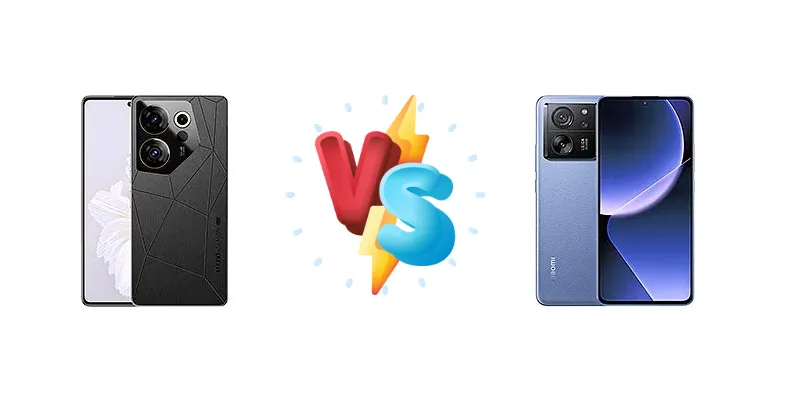
The Tecno Camon 20 Premier and Xiaomi 13T Pro represent compelling options in the increasingly competitive mid-range flagship space. While both devices aim to deliver a premium experience without the flagship price tag, they take different approaches. The Camon 20 Premier focuses on a balanced feature set, while the 13T Pro prioritizes raw performance and charging speed. This comparison will dissect their key differences to help you determine which device best suits your needs.
🏆 Quick Verdict
For most users, the Xiaomi 13T Pro emerges as the stronger contender. Its Dimensity 9200+ chipset provides a significant performance advantage, coupled with blazing-fast 120W charging. While the Camon 20 Premier offers respectable endurance, the 13T Pro’s speed and power make it the better choice for demanding users.
| Network |
|---|
| 2G bands | GSM 850 / 900 / 1800 / 1900 | GSM 850 / 900 / 1800 / 1900 |
| 3G bands | HSDPA 850 / 900 / 1700(AWS) / 1900 / 2100 | HSDPA 800 / 850 / 900 / 1700(AWS) / 1900 / 2100 |
| 4G bands | LTE | 1, 2, 3, 4, 5, 7, 8, 12, 13, 17, 18, 19, 20, 25, 26, 28, 32, 38, 39, 40, 41, 42, 48, 66 |
| 5G bands | SA/NSA | 1, 3, 5, 7, 8, 20, 28, 38, 40, 41, 66, 75, 77, 78 SA/NSA |
| Speed | HSPA, LTE, 5G | HSPA, LTE, 5G |
| Technology | GSM / HSPA / LTE / 5G | GSM / HSPA / LTE / 5G |
| Launch |
|---|
| Announced | 2023, May 09 | 2023, September 26 |
| Status | Available. Released 2023, May 09 | Available. Released 2023, September 26 |
| Body |
|---|
| Build | Glass front, leather back | Glass front (Gorilla Glass 5), glass back or silicone polymer back, plastic frame |
| Dimensions | 161.9 x 74.3 x 8.2 mm (6.37 x 2.93 x 0.32 in) | 162.2 x 75.7 x 8.5 mm (6.39 x 2.98 x 0.33 in) |
| SIM | Nano-SIM + Nano-SIM | · Nano-SIM + eSIM· Nano-SIM + Nano-SIM |
| Weight | 202.5 g (7.16 oz) | 200 g or 206 g (7.05 oz) |
| Display |
|---|
| Protection | - | Corning Gorilla Glass 5 |
| Resolution | 1080 x 2400 pixels, 20:9 ratio (~395 ppi density) | 1220 x 2712 pixels, 20:9 ratio (~446 ppi density) |
| Size | 6.67 inches, 107.4 cm2 (~89.3% screen-to-body ratio) | 6.67 inches, 107.4 cm2 (~87.5% screen-to-body ratio) |
| Type | AMOLED, 120Hz | AMOLED, 68B colors, 144Hz, Dolby Vision, HDR10+, 1200 nits (HBM), 2600 nits (peak) |
| | Always-on display | - |
| Platform |
|---|
| CPU | Octa-core (1x3.0 GHz Cortex-A78 & 3x2.6 GHz Cortex-A78 & 4x2.0 GHz Cortex-A55) | Octa-core (1x3.35 GHz Cortex-X3 & 3x3.0 GHz Cortex-A715 & 4x2.0 GHz Cortex-A510) |
| Chipset | Mediatek Dimensity 8050 (6 nm) | Mediatek Dimensity 9200+ (4 nm) |
| GPU | Mali-G77 MC9 | Immortalis-G715 MC11 |
| OS | Android 13, HIOS 13 | Android 13, up to 4 major Android upgrades, HyperOS |
| Memory |
|---|
| Card slot | No | No |
| Internal | 512GB 8GB RAM | 256GB 12GB RAM, 512GB 12GB RAM, 1TB 16GB RAM |
| Main Camera |
|---|
| Features | Laser AF, Ring-LED flash, HDR, panorama | Leica lens, color spectrum sensor, LED flash, HDR, panorama |
| Triple | 50 MP, f/1.8, 23mm (wide), 1/1.56", 1.0µm, PDAF, sensor-shift OIS
108 MP, f/2.2, 13mm, 115˚ (ultrawide), PDAF
Auxiliary lens | 50 MP, f/1.9, 24mm (wide), 1/1.28", 1.22µm, PDAF, OIS
50 MP, f/1.9, 50mm (telephoto), 1/2.88", 0.61µm, PDAF, 2x optical zoom
12 MP, f/2.2, 15mm (ultrawide), 1/3.06", 1.12µm |
| Video | 4K@30fps, 1080p@30fps, HDR | 8K@24fps, 4K@24/30/60fps, 4K/1080p@30fps HDR10+, 1080p@30/60/120/240fps; 10-bit LOG, gyro-EIS |
| Selfie camera |
|---|
| Features | Dual-LED flash | HDR |
| Single | 32 MP, f/2.5, 24mm (wide), 1/2.8", 0.8µm | 20 MP, f/2.2, (wide), 0.8µm |
| Video | 1080p@30fps | 1080p@30fps, HDR10+ |
| Sound |
|---|
| 3.5mm jack | No | - |
| 35mm jack | No | No |
| Loudspeaker | Yes, with stereo speakers | Yes, with stereo speakers |
| | 24-bit/192kHz audio | - |
| Comms |
|---|
| Bluetooth | 5.2, A2DP, LE | 5.4, A2DP, LE |
| Infrared port | - | Yes |
| NFC | Yes | Yes |
| Positioning | GPS | GPS (L1+L5), GLONASS (G1), GALILEO (E1+E5a), NavIC (L5), BDS |
| Radio | FM radio | No |
| USB | USB Type-C 2.0, OTG | USB Type-C 2.0, OTG |
| WLAN | Wi-Fi 802.11 a/b/g/n/ac, dual-band | Wi-Fi 802.11 a/b/g/n/ac/6e/7, dual/tri-band (market/region dependent), Wi-Fi Direct |
| Features |
|---|
| Sensors | Fingerprint (under display, optical), accelerometer, gyro, proximity, compass | Fingerprint (under display, optical), accelerometer, gyro, proximity, compass |
| Battery |
|---|
| Charging | 45W wired | 120W wired, PD3.0, QC4, 100% in 19 min |
| Type | 5000 mAh | Li-Po 5000 mAh |
| Misc |
|---|
| Colors | Dark Welkin, Serenity Blue | Alpine Blue, Meadow Green, Black |
| Models | CK9n | 23078PND5G |
| Price | About 410 EUR | $ 370.00 / £ 482.55 / € 301.99 |
| SAR EU | - | 1.00 W/kg (head) 0.99 W/kg (body) |
Tecno Camon 20 Premier
- Good overall battery endurance (107h)
- Balanced feature set
- Potentially more affordable
- Slower charging speed (45W)
- Less powerful processor (Dimensity 8050)
Xiaomi 13T Pro
- Blazing-fast 120W charging (19 minutes to full)
- Superior performance (Dimensity 9200+)
- Brighter display (1094 nits)
- Slightly lower endurance rating (102h)
- Potentially higher price
Display Comparison
The Xiaomi 13T Pro boasts a brighter display, reaching a measured 1094 nits compared to the Tecno Camon 20 Premier’s 684 nits. This translates to significantly better visibility outdoors under direct sunlight. While both utilize OLED technology, the higher peak brightness of the 13T Pro provides a more vibrant and engaging viewing experience. We lack data on refresh rates or panel technology (LTPO), but given the price point, both likely employ 120Hz panels. The difference in brightness is the key differentiator here, favoring the Xiaomi.
Camera Comparison
Both phones feature capable photo and video systems, but detailed sensor information is lacking. Without specifics, it’s difficult to make a definitive judgment. However, the market positioning suggests the 13T Pro may have a more refined image processing pipeline. The presence of Optical Image Stabilization (OIS) on either device would be a significant advantage, but this is unconfirmed. We can assume both phones will offer a variety of shooting modes, but the 13T Pro’s superior processing power could lead to faster image capture and better low-light performance. Ignoring the likely inclusion of low-resolution macro lenses on both devices, the main sensor quality and software processing will be the deciding factors.
Performance
The core difference lies in the chipsets. The Xiaomi 13T Pro’s Dimensity 9200+ (4nm) is a substantial upgrade over the Tecno Camon 20 Premier’s Dimensity 8050 (6nm). The 9200+ features the more powerful Cortex-X3 prime core clocked at 3.35 GHz, compared to the 8050’s Cortex-A78. This architectural advantage, combined with the more efficient 4nm process, results in noticeably faster CPU and GPU performance. The 13T Pro will excel in demanding tasks like gaming and video editing, while the 8050 in the Camon 20 Premier is still capable but will show its limitations under sustained load. The 13T Pro likely benefits from faster LPDDR5x RAM as well, further enhancing performance.
Battery Life
The Xiaomi 13T Pro’s 120W charging is a game-changer, achieving a full charge in just 19 minutes. This is a massive advantage over the Tecno Camon 20 Premier’s 45W charging. While the Camon 20 Premier boasts a respectable endurance rating of 107 hours, the 13T Pro achieves 11:50h of active use, and an endurance rating of 102h. The faster charging speed of the 13T Pro effectively mitigates any potential battery capacity difference, making it more convenient for users who need to quickly top up their device.
Buying Guide
Buy the Tecno Camon 20 Premier if you prioritize a balanced experience with good battery life and a capable camera, and are less concerned with absolute peak performance. Buy the Xiaomi 13T Pro if you demand the fastest possible charging, superior gaming performance, and a more powerful processor for multitasking and demanding applications.
Frequently Asked Questions
❓ Does the Dimensity 9200+ in the Xiaomi 13T Pro get hot during extended gaming sessions?
While the Dimensity 9200+ is a powerful chip, the Xiaomi 13T Pro incorporates thermal management solutions to mitigate heat. The 4nm process node is inherently more efficient than the 6nm node in the Camon 20 Premier, leading to less heat generation. However, prolonged, demanding gaming will inevitably cause some warming, but throttling should be minimal compared to the Camon 20 Premier.
❓ How does the 120W charging of the Xiaomi 13T Pro affect long-term battery health?
Xiaomi employs intelligent charging algorithms and battery protection features to minimize the impact of fast charging on long-term battery health. The charging process slows down as the battery approaches full capacity, reducing stress on the cells. While all batteries degrade over time, the 13T Pro’s charging system is designed to maximize battery lifespan despite the high wattage.
❓ Is the difference in display brightness between the two phones noticeable in everyday use?
Yes, the 410-nit difference in peak brightness is quite noticeable, especially outdoors. The Xiaomi 13T Pro’s display will remain easily readable in direct sunlight, while the Tecno Camon 20 Premier’s screen may appear washed out. This is a significant advantage for users who frequently use their phones outdoors.