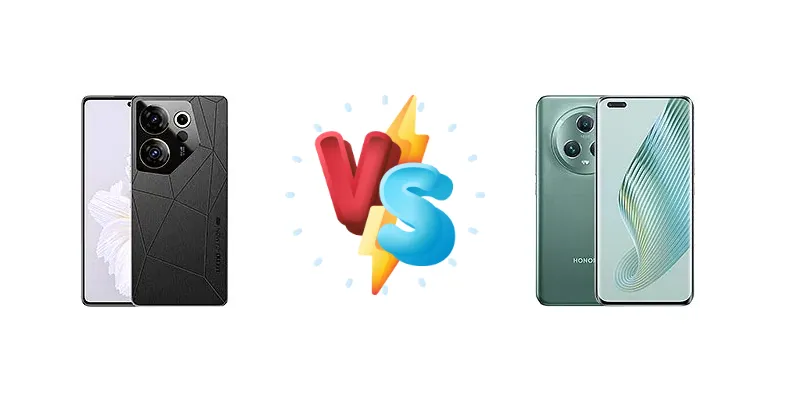
The Tecno Camon 20 Premier and Honor Magic5 Pro represent compelling options in the increasingly competitive flagship smartphone market. While both aim for a premium experience, they diverge in their core philosophies: Tecno focuses on delivering high-end features at a more accessible price point, while Honor aims for uncompromising performance and a refined user experience. This comparison dissects their key differences to help you choose the right device.
🏆 Quick Verdict
For most users, the Honor Magic5 Pro emerges as the superior choice. Its Snapdragon 8 Gen 2 chipset provides a significant performance advantage, coupled with a brighter, higher-quality display and faster charging capabilities. However, the Tecno Camon 20 Premier offers a strong value proposition for budget-conscious buyers.
| Network |
|---|
| 2G bands | GSM 850 / 900 / 1800 / 1900 | GSM 850 / 900 / 1800 / 1900 |
| 3G bands | HSDPA 850 / 900 / 1700(AWS) / 1900 / 2100 | HSDPA 800 / 850 / 900 / 1700(AWS) / 1900 / 2100 |
| 4G bands | LTE | 1, 2, 3, 4, 5, 7, 8, 12, 17, 18, 19, 20, 26, 28, 34, 38, 39, 40, 41 - China |
| 5G bands | SA/NSA | 1, 3, 5, 8, 28, 38, 41, 77, 78, 79 SA/NSA - China |
| Speed | HSPA, LTE, 5G | HSPA, LTE, 5G |
| Technology | GSM / HSPA / LTE / 5G | GSM / CDMA / HSPA / EVDO / LTE / 5G |
| | - | CDMA2000 1xEV-DO |
| Launch |
|---|
| Announced | 2023, May 09 | 2023, February 27 |
| Status | Available. Released 2023, May 09 | Available. Released 2023, March 31 |
| Body |
|---|
| Build | Glass front, leather back | Glass front, glass back or eco leather back |
| Dimensions | 161.9 x 74.3 x 8.2 mm (6.37 x 2.93 x 0.32 in) | 162.9 x 76.7 x 8.8 mm (6.41 x 3.02 x 0.35 in) |
| SIM | Nano-SIM + Nano-SIM | · Nano-SIM + eSIM· Nano-SIM + Nano-SIM + eSIM (max 2 at a time) |
| Weight | 202.5 g (7.16 oz) | 219 g (7.72 oz) |
| | - | IP68 dust/water resistant (up to 1.5m for 30 min) |
| Display |
|---|
| Resolution | 1080 x 2400 pixels, 20:9 ratio (~395 ppi density) | 1312 x 2848 pixels, 19.5:9 ratio (~460 ppi density) |
| Size | 6.67 inches, 107.4 cm2 (~89.3% screen-to-body ratio) | 6.81 inches, 113.7 cm2 (~91.0% screen-to-body ratio) |
| Type | AMOLED, 120Hz | LTPO OLED, 1B colors, 120Hz, HDR10+, 1800 nits (peak) |
| | Always-on display | - |
| Platform |
|---|
| CPU | Octa-core (1x3.0 GHz Cortex-A78 & 3x2.6 GHz Cortex-A78 & 4x2.0 GHz Cortex-A55) | Octa-core (1x3.2 GHz Cortex-X3 & 2x2.8 GHz Cortex-A715 & 2x2.8 GHz Cortex-A710 & 3x2.0 GHz Cortex-A510) |
| Chipset | Mediatek Dimensity 8050 (6 nm) | Qualcomm SM8550-AB Snapdragon 8 Gen 2 (4 nm) |
| GPU | Mali-G77 MC9 | Adreno 740 |
| OS | Android 13, HIOS 13 | Android 13, upgradable to Android 14, MagicOS 8 |
| Memory |
|---|
| Card slot | No | No |
| Internal | 512GB 8GB RAM | 256GB 8GB RAM, 256GB 12GB RAM, 512GB 12GB RAM, 512GB 16GB RAM |
| | - | UFS 4.0 |
| Main Camera |
|---|
| Features | Laser AF, Ring-LED flash, HDR, panorama | Laser AF, color spectrum sensor, LED flash, HDR, panorama |
| Single | - | 12 MP, f/2.4, 100˚ (ultrawide), 1.22µm
TOF 3D, (depth/biometrics sensor) |
| Triple | 50 MP, f/1.8, 23mm (wide), 1/1.56", 1.0µm, PDAF, sensor-shift OIS
108 MP, f/2.2, 13mm, 115˚ (ultrawide), PDAF
Auxiliary lens | 50 MP, f/1.6, 23mm (wide), 1/1.12" 1.4µm, multi-directional PDAF, OIS
50 MP, f/3.0, 90mm (periscope telephoto), PDAF, OIS, 3.5x optical zoom
50 MP, f/2.0, 13mm, 122˚ (ultrawide), 1/2.76", AF
TOF 3D (depth) |
| Video | 4K@30fps, 1080p@30fps, HDR | 4K@30/60fps, 1080p@30/60fps, gyro-EIS, HDR10, 10-bit video |
| Selfie camera |
|---|
| Features | Dual-LED flash | HDR |
| Single | 32 MP, f/2.5, 24mm (wide), 1/2.8", 0.8µm | 12 MP, f/2.4, 100˚ (ultrawide), 1.22µm
TOF 3D, (depth/biometrics sensor) |
| Video | 1080p@30fps | 4K@30fps, 1080p@30/60fps |
| Sound |
|---|
| 3.5mm jack | No | No |
| 35mm jack | No | No |
| Loudspeaker | Yes, with stereo speakers | Yes, with stereo speakers |
| | 24-bit/192kHz audio | 24-bit audio stereo recording |
| Comms |
|---|
| Bluetooth | 5.2, A2DP, LE | 5.2, A2DP, LE, aptX HD |
| Infrared port | - | Yes |
| NFC | Yes | Yes |
| Positioning | GPS | GPS (L1+L5), GLONASS (L1), BDS (B1I+B1c+B2a), GALILEO (E1+E5a) |
| Radio | FM radio | No |
| USB | USB Type-C 2.0, OTG | USB Type-C 3.1, DisplayPort 1.2, OTG |
| WLAN | Wi-Fi 802.11 a/b/g/n/ac, dual-band | Wi-Fi 802.11 a/b/g/n/ac/6, dual-band, Wi-Fi Direct |
| Features |
|---|
| Sensors | Fingerprint (under display, optical), accelerometer, gyro, proximity, compass | Fingerprint (under display, optical), Face ID, accelerometer, gyro, proximity, compass |
| Battery |
|---|
| Charging | 45W wired | 66W wired
50W wireless
Reverse wireless
5W reverse wired |
| Type | 5000 mAh | Market-dependent versions:· Li-Po 5100 mAh (Global)· Si/C Li-Ion 5450 mAh (China only) |
| Misc |
|---|
| Colors | Dark Welkin, Serenity Blue | Black, Meadow Green, Blue, Purple, Orange |
| Models | CK9n | PGT-AN10, PGT-N19 |
| Price | About 410 EUR | £ 799.99 / € 407.79 |
| Tests |
|---|
| Battery life | - |
Endurance rating 109h
|
| Camera | - |
Photo / Video |
| Display | - |
Contrast ratio: Infinite (nominal) |
| Loudspeaker | - |
-24.6 LUFS (Very good)
|
| Performance | - |
GeekBench: 4378 (v5.1), 5096 (v6) |
Tecno Camon 20 Premier
- More affordable price point
- Decent all-around performance
- Potentially unique design elements
- Inferior chipset compared to Snapdragon 8 Gen 2
- Significantly dimmer display
- Slower charging speeds
Honor Magic5 Pro
- Top-tier Snapdragon 8 Gen 2 performance
- Brighter and higher-quality display
- Faster wired and wireless charging
- Higher price tag
- May be overkill for basic users
- Potentially larger and heavier design
Display Comparison
The Honor Magic5 Pro boasts a significantly brighter display, reaching 1227 nits compared to the Tecno Camon 20 Premier’s 684 nits. This translates to superior visibility in direct sunlight. While both are capable of displaying vibrant colors, the Honor’s infinite contrast ratio (nominal) suggests deeper blacks and a more immersive viewing experience. The absence of refresh rate data for the Tecno makes it difficult to assess its smoothness against the likely 120Hz panel on the Honor. The brightness difference alone makes the Honor a better choice for outdoor use.
Camera Comparison
Both phones are advertised as having strong camera systems, but detailed sensor information is lacking for the Tecno. The focus should be on image processing and real-world results, which are currently unavailable. However, the Honor Magic5 Pro’s Snapdragon ISP is known for its advanced computational photography capabilities. The absence of specific details regarding OIS and lens apertures on the Tecno makes it difficult to assess its low-light performance. The Honor’s likely superior image processing and potentially larger sensor size will likely result in better dynamic range and detail.
Performance
The core difference lies in the chipsets. The Honor Magic5 Pro’s Snapdragon 8 Gen 2 (4nm) is a clear step up from the Tecno Camon 20 Premier’s Dimensity 8050 (6nm). The Snapdragon 8 Gen 2 utilizes a more efficient 4nm process, resulting in better thermal management and sustained performance. Its CPU configuration, featuring the Cortex-X3 prime core, offers a noticeable advantage in single-core tasks. While the Dimensity 8050 is no slouch, the Snapdragon 8 Gen 2’s superior GPU will deliver a smoother gaming experience, especially at higher settings. The Honor also benefits from faster RAM, likely LPDDR5x, further enhancing responsiveness.
Battery Life
The Honor Magic5 Pro’s endurance rating of 115h and active use score of 12:06h suggest superior battery life compared to the Tecno Camon 20 Premier’s 107h endurance rating. While the Tecno offers 45W wired charging, the Honor significantly outpaces it with 66W wired, 50W wireless, and even 5W reverse wired charging. This versatility is a major advantage for Honor users. The faster charging speeds of the Honor mean less downtime and more time using the device.
Buying Guide
Buy the Tecno Camon 20 Premier if you prioritize value and a decent all-around experience without breaking the bank. It’s ideal for everyday users who enjoy social media, streaming, and casual gaming. Buy the Honor Magic5 Pro if you demand top-tier performance for demanding tasks like gaming, video editing, and photography, and appreciate a premium build quality and faster charging speeds, including wireless options.
Frequently Asked Questions
❓ Does the Dimensity 8050 in the Tecno Camon 20 Premier struggle with sustained gaming performance?
While the Dimensity 8050 is a capable chipset, its 6nm process and less advanced CPU architecture compared to the Snapdragon 8 Gen 2 mean it's more prone to thermal throttling during extended gaming sessions. Expect some performance dips after prolonged use, especially with graphically demanding titles.
❓ How much faster is the 66W charging on the Honor Magic5 Pro compared to the 45W charging on the Tecno Camon 20 Premier?
The Honor Magic5 Pro’s 66W charging will significantly reduce charging times. Expect a full charge in approximately 35-40 minutes, while the Tecno Camon 20 Premier will likely take closer to 50-60 minutes. The addition of 50W wireless charging on the Honor is a further convenience.
❓ Is the lack of detailed camera specs on the Tecno Camon 20 Premier a cause for concern?
Yes, the absence of information regarding sensor size, OIS, and lens apertures makes it difficult to accurately assess the camera's capabilities. While Tecno often emphasizes megapixel count, these other factors are crucial for image quality, especially in low-light conditions.
❓ Does the Honor Magic5 Pro support high refresh rate gaming?
While not explicitly stated, the Honor Magic5 Pro is expected to support high refresh rate gaming (90Hz or 120Hz) with compatible titles, thanks to its powerful Snapdragon 8 Gen 2 chipset and likely high refresh rate display. This will result in smoother and more responsive gameplay.