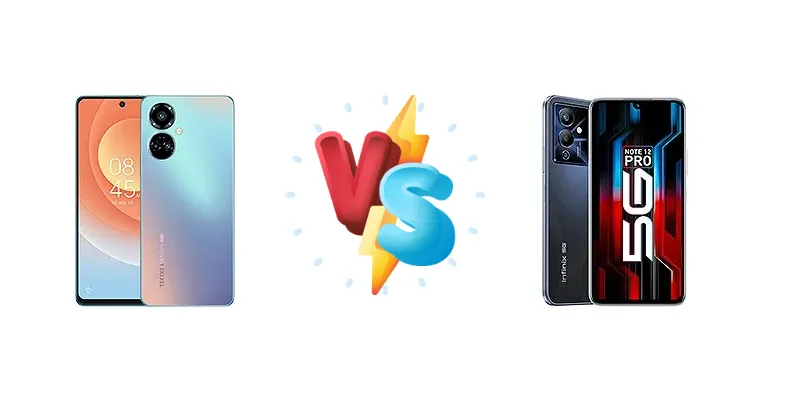
Both the Tecno Camon 19 Pro and the Infinix Note 12 Pro 5G target the competitive mid-range smartphone market, but they approach it with different strengths. The Camon 19 Pro emphasizes endurance and a respectable display, while the Note 12 Pro 5G prioritizes 5G connectivity and a more modern, efficient chipset. This comparison dives deep into the specifics to determine which device delivers the best value.
🏆 Quick Verdict
For the average user, the Infinix Note 12 Pro 5G is the better choice. Its Mediatek Dimensity 810 chipset, built on a 6nm process, offers superior performance and efficiency compared to the Tecno Camon 19 Pro’s Helio G96. While the Camon 19 Pro boasts excellent battery endurance, the Note 12 Pro 5G’s efficiency mitigates the difference.
| Network |
|---|
| 2G bands | GSM 850 / 900 / 1800 / 1900 | GSM 850 / 900 / 1800 / 1900 |
| 3G bands | HSDPA 850 / 900 / 2100 | HSDPA 850 / 900 / 2100 |
| 4G bands | LTE | 1, 3, 5, 7, 8, 20, 28, 38, 40, 41 |
| 5G bands | - | 1, 3, 5, 7, 8, 20, 28, 38, 40, 41, 77, 78 |
| Speed | HSPA, LTE | HSPA, LTE, 5G |
| Technology | GSM / HSPA / LTE | GSM / HSPA / LTE / 5G |
| Launch |
|---|
| Announced | 2022, June 15 | 2022, July 08 |
| Status | Available. Released 2022, July 13 | Available. Released 2022, July 15 |
| Body |
|---|
| Build | Glass front, plastic back, plastic frame | Glass front, plastic frame, plastic back |
| Dimensions | 166.8 x 74.6 x 8.6 mm (6.57 x 2.94 x 0.34 in) | 164.7 x 76.9 x 8 mm (6.48 x 3.03 x 0.31 in) |
| SIM | Nano-SIM + Nano-SIM | Nano-SIM + Nano-SIM |
| Weight | 204 g (7.20 oz) | 188 g (6.63 oz) |
| Display |
|---|
| Protection | - | Corning Gorilla Glass 3 |
| Resolution | 1080 x 2460 pixels (~395 ppi density) | 1080 x 2400 pixels, 20:9 ratio (~393 ppi density) |
| Size | 6.8 inches, 109.8 cm2 (~88.2% screen-to-body ratio) | 6.7 inches, 108.4 cm2 (~85.6% screen-to-body ratio) |
| Type | IPS LCD, 120Hz | AMOLED |
| Platform |
|---|
| CPU | Octa-core (2x2.05 GHz Cortex-A76 & 6x2.0 GHz Cortex-A55) | Octa-core (2x2.4 GHz Cortex-A76 & 6x2.0 GHz Cortex-A55) |
| Chipset | Mediatek MT6781 Helio G96 (12 nm) | Mediatek Dimensity 810 (6 nm) |
| GPU | Mali-G57 MC2 | Mali-G57 MC2 |
| OS | Android 12, HIOS 8.6 | Android 12, XOS 10.6 |
| Memory |
|---|
| Card slot | No | microSDXC (dedicated slot) |
| Internal | 128GB 8GB RAM, 256GB 8GB RAM | 128GB 8GB RAM, 256GB 8GB RAM |
| Main Camera |
|---|
| Features | Laser AF, Quad-LED flash, panorama, HDR | Quad-LED flash, HDR, panorama |
| Single | 32 MP, f/2.4, 26mm (wide), 1/3.4", 0.8µm | 16 MP, f/2.0, (wide) |
| Triple | 64 MP, f/1.6, 26mm (wide), 1/1.7", 0.8µm, PDAF, OIS
50 MP, f/2.0, 50mm (telephoto), 1/2.76", 0.64µm, PDAF, 2x zoom
Auxiliary lens | 108 MP, f/1.8, 24mm (wide), PDAF
2 MP (macro)
Auxiliary lens |
| Video | 1080p@30fps, HDR | 1440p@30fps |
| Selfie camera |
|---|
| Features | HDR | Dual-LED flash |
| Single | 32 MP, f/2.4, 26mm (wide), 1/3.4", 0.8µm | 16 MP, f/2.0, (wide) |
| Video | 1080p@30fps | 1440p@30fps |
| Sound |
|---|
| 3.5mm jack | Yes | Yes |
| 35mm jack | Yes | Yes |
| Loudspeaker | Yes | Yes, with dual speakers |
| Comms |
|---|
| Bluetooth | Yes | 5.0, A2DP, LE |
| NFC | Yes | No |
| Positioning | GPS | GPS |
| Radio | FM radio | Unspecified |
| USB | USB Type-C 2.0, OTG | USB Type-C 2.0, OTG |
| WLAN | Yes | Wi-Fi 802.11 a/b/g/n |
| Features |
|---|
| Sensors | Fingerprint (side-mounted), accelerometer, gyro, proximity | Fingerprint (side-mounted), accelerometer, gyro, proximity, compass |
| Battery |
|---|
| Charging | 33W wired, 100% in 65 min | 33W wired |
| Type | 5000 mAh | 5000 mAh |
| Misc |
|---|
| Colors | Polar Blue, Eco Black, Mondrian | Black, White |
| Models | CI8, CI8n | X671B |
| Price | About 200 EUR | About 140 EUR |
| Tests |
|---|
| Battery life |
Endurance rating 121h
| - |
| Camera |
Photo / Video | - |
| Display |
Contrast ratio: 1597:1 (nominal) | - |
| Loudspeaker |
-28.7 LUFS (Average)
| - |
| Performance |
AnTuTu: 348546 (v9)
GeekBench: 1734 (v5.1)
GFXBench: 11fps (ES 3.1 onscreen) | - |
Tecno Camon 19 Pro
- Exceptional battery endurance (121h)
- Respectable display contrast ratio (1597:1)
- Potentially better camera software processing
- Less efficient Helio G96 chipset
- Larger 12nm fabrication process leads to more heat
- Limited performance for demanding tasks
Infinix Note 12 Pro 5G
- More efficient Dimensity 810 chipset (6nm)
- Faster CPU clock speed (2.4 GHz)
- 5G connectivity
- Better sustained performance
- Potentially shorter battery life compared to Camon 19 Pro
- Display specifications are not detailed
Display Comparison
The Tecno Camon 19 Pro features a display capable of 479 nits of peak brightness and a 1597:1 contrast ratio. While respectable, this is a fairly standard LCD experience. The Infinix Note 12 Pro 5G’s display specifications are not provided, but given its market positioning, it likely features a similar LCD panel. The Camon 19 Pro’s contrast ratio suggests a decent viewing experience, but the lack of information on color accuracy or refresh rate leaves room for improvement. Neither phone is expected to compete with high-end OLED displays.
Camera Comparison
Both devices are listed as having 'Photo / Video' capabilities, offering little specific insight. Without sensor size, aperture, or image processing details, a direct comparison is difficult. However, given the Camon series’ historical focus on camera features, it’s reasonable to assume Tecno invested more in image processing algorithms. The absence of details on OIS or advanced features suggests both phones rely on software enhancements to improve image quality. The usefulness of a 2MP macro camera, often found in this segment, is questionable for most users.
Performance
This is where the Infinix Note 12 Pro 5G pulls ahead significantly. Its Mediatek Dimensity 810 (6nm) chipset boasts a faster CPU clock speed (2.4 GHz vs 2.05 GHz) and, crucially, is fabricated on a smaller 6nm node compared to the Tecno Camon 19 Pro’s Helio G96 (12nm). This process node difference translates directly into improved power efficiency and thermal performance. The Dimensity 810’s architecture allows for sustained performance under load, making it the better choice for gaming and demanding applications. Both CPUs share a similar core configuration (2x Cortex-A76 & 6x Cortex-A55), but the Dimensity 810’s superior fabrication process gives it a clear advantage.
Battery Life
The Tecno Camon 19 Pro boasts an impressive endurance rating of 121 hours, indicating excellent battery life. However, the Infinix Note 12 Pro 5G’s more efficient Dimensity 810 chipset partially offsets the potential difference in battery capacity (which is not specified). Both phones support 33W wired charging, achieving a full charge in approximately 65 minutes. While the Camon 19 Pro may last longer on a single charge, the Note 12 Pro 5G’s efficiency means users may not notice a significant difference in daily usage.
Buying Guide
Buy the Tecno Camon 19 Pro if you absolutely prioritize maximizing battery life above all else and don't heavily rely on demanding applications. Buy the Infinix Note 12 Pro 5G if you want a more responsive experience, 5G connectivity, and a chipset that will handle multitasking and gaming with greater ease, even if it means slightly less overall endurance.
Frequently Asked Questions
❓ Does the Mediatek Dimensity 810 in the Infinix Note 12 Pro 5G tend to overheat during prolonged gaming sessions?
The Dimensity 810’s 6nm fabrication process and efficient architecture are designed to minimize thermal throttling. While some heat generation is inevitable during intensive gaming, the Note 12 Pro 5G is expected to maintain stable performance for longer periods compared to the Tecno Camon 19 Pro’s Helio G96.
❓ Is the 33W charging on both phones fast enough for quick top-ups throughout the day?
33W charging is a respectable charging speed for this price segment. Both phones achieve a full charge in approximately 65 minutes. While not the fastest charging available, it’s sufficient for overnight charging or a quick boost during a short break.
❓ Given the lack of detailed camera specs, should I expect significant differences in photo quality between these two phones?
Without knowing sensor sizes, apertures, or image processing algorithms, it's difficult to predict a substantial difference in photo quality. However, Tecno’s Camon series often prioritizes camera features, suggesting they may have invested more in software enhancements. Real-world testing would be needed to determine which phone produces better images.