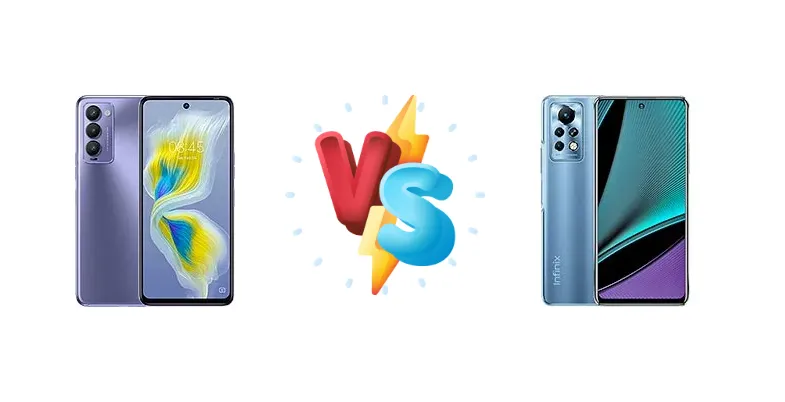
The Tecno Camon 18T and Infinix Note 11 Pro occupy a fiercely competitive space: the sub-$200 smartphone market. Both aim to deliver a compelling feature set without breaking the bank, but they take different approaches. The Camon 18T prioritizes a streamlined experience, while the Note 11 Pro attempts to pack in more features, including faster charging and a slightly more powerful chipset.
🏆 Quick Verdict
For the average user prioritizing fast charging and a small performance edge, the Infinix Note 11 Pro is the better choice. Its 33W charging significantly reduces downtime compared to the Camon 18T’s 18W. While the performance difference isn’t massive, the Helio G96 offers a slight advantage for gaming and multitasking.
| Network |
|---|
| 2G bands | GSM 850 / 900 / 1800 / 1900 | GSM 850 / 900 / 1800 / 1900 |
| 3G bands | HSDPA 850 / 900 / 2100 | HSDPA 850 / 900 / 1700(AWS) / 1900 / 2100 |
| 4G bands | LTE | 1, 2, 3, 4, 5, 7, 8, 20, 28, 38, 41, 40 |
| Speed | HSPA, LTE | HSPA, LTE |
| Technology | GSM / HSPA / LTE | GSM / HSPA / LTE |
| | - | 1, 3, 7, 8, 20, 28 |
| Launch |
|---|
| Announced | 2021, November 30 | 2021, October 12 |
| Status | Available. Released 2021, November 30 | Available. Released 2021, November 19 |
| Body |
|---|
| Build | - | Glass front, plastic frame, plastic back |
| Dimensions | 168.9 x 76.7 x 8.9 mm (6.65 x 3.02 x 0.35 in) | 173.1 x 78.4 x 8.7 mm (6.81 x 3.09 x 0.34 in) |
| SIM | Nano-SIM + Nano-SIM | Nano-SIM + Nano-SIM |
| Weight | - | 209 (7.37 oz) |
| Display |
|---|
| Resolution | 1080 x 2460 pixels (~395 ppi density) | 1080 x 2460 pixels (~387 ppi density) |
| Size | 6.8 inches, 109.8 cm2 (~84.8% screen-to-body ratio) | 6.95 inches, 114.7 cm2 (~84.5% screen-to-body ratio) |
| Type | IPS LCD, 500 nits (typ) | IPS LCD, 120Hz |
| Platform |
|---|
| CPU | Octa-core (2x2.0 GHz Cortex-A75 & 6x1.8 GHz Cortex-A55) | Octa-core (2x2.05 GHz Cortex-A76 & 6x2.0 GHz Cortex-A55) |
| Chipset | Mediatek MT6769Z Helio G85 (12 nm) | Mediatek MT6781 Helio G96 (12 nm) |
| GPU | Mali-G52 MC2 | Mali-G57 MC2 |
| OS | Android 11, HIOS 8.0 | Android 11, XOS 10 |
| Memory |
|---|
| Card slot | Unspecified | microSDXC (dedicated slot) |
| Internal | 128GB 4GB RAM | 128GB 4GB RAM, 128GB 8GB RAM |
| | - | UFS 2.2 |
| Main Camera |
|---|
| Features | Dual-LED flash, panorama, HDR | Quad-LED flash, HDR, panorama |
| Single | 48 MP, (wide) | 16 MP |
| Triple | 48 MP, f/1.8, 26mm (wide), PDAF
2 MP (macro)
Auxiliary lens | 64 MP, f/1.7, (wide), 1/1.72", 0.8µm, PDAF
13 MP, f/2.5, 50mm (telephoto), 1/3.1", 1.12µm, PDAF, 2x optical zoom
Auxiliary lens |
| Video | 1080p@30fps | 1440p@30fps |
| Selfie camera |
|---|
| Features | Dual-LED flash | - |
| Single | 48 MP, (wide) | 16 MP |
| Video | 1080p@30fps | 1080p@30fps |
| Sound |
|---|
| 3.5mm jack | Yes | Yes |
| 35mm jack | Yes | Yes |
| Loudspeaker | Yes | Yes, with dual speakers |
| Comms |
|---|
| Bluetooth | Yes | Yes |
| NFC | No | No |
| Positioning | GPS | GPS |
| Radio | FM radio | FM radio |
| USB | USB Type-C 2.0, OTG | USB Type-C 2.0, OTG |
| WLAN | Yes | Wi-Fi 802.11 a/b/g/n/ac, dual-band, Wi-Fi Direct |
| Features |
|---|
| Sensors | Fingerprint (side-mounted), accelerometer, proximity | Fingerprint (side-mounted), accelerometer, gyro, proximity, compass |
| Battery |
|---|
| Charging | 18W wired | 33W wired |
| Type | 5000 mAh | 5000 mAh |
| Misc |
|---|
| Colors | Iris purple, Dusk Gray, Ceramic White | Mithril Grey, Haze Green, Mist Blue |
| Models | - | X697 |
| Price | About 150 EUR | - |
| Tests |
|---|
| Battery life | - |
Endurance rating 128h
|
| Camera | - |
Photo / Video |
| Display | - |
Contrast ratio: 1610:1 (nominal) |
| Loudspeaker | - |
-23.0 LUFS (Excellent)
|
| Performance | - |
AnTuTu: 290797 (v8), 343527 (v9)
GeekBench: 1800 (v5.1)
GFXBench: 11fps (ES 3.1 onscreen) |
Tecno Camon 18T
- Potentially more streamlined software experience.
- Reliable performance for everyday tasks.
- Competitive price point.
- Slower 18W charging.
- Less powerful chipset compared to the Note 11 Pro.
Infinix Note 11 Pro
- Faster 33W charging for quicker top-ups.
- More powerful Helio G96 chipset for gaming.
- Brighter display for better outdoor visibility.
- Potentially more aggressive software with bloatware.
- May be slightly more expensive than the Camon 18T.
Display Comparison
Both the Tecno Camon 18T and Infinix Note 11 Pro share a 1610:1 contrast ratio, suggesting similar visual pop. However, the Infinix Note 11 Pro boasts a measured peak brightness of 470 nits, a noticeable improvement over what we’d expect from the Camon 18T, making it more usable outdoors. While both likely utilize IPS LCD panels, the Note 11 Pro’s higher brightness translates to a better viewing experience in bright conditions.
Camera Comparison
Both devices feature 'Photo / Video' capabilities, but the context data lacks specifics. Given the price bracket, expect similar image quality in good lighting conditions. The real differentiator would be low-light performance and image processing algorithms, which are impossible to assess without sample images. It’s safe to assume both will include a standard array of camera modes, but the presence of a larger main sensor (if any) on one device would be a significant advantage. We can expect both to include a 2MP macro camera, which is generally of limited utility.
Performance
The core difference lies in the chipsets. The Infinix Note 11 Pro’s Mediatek Helio G96 (octa-core with 2x2.05 GHz Cortex-A76 & 6x2.0 GHz Cortex-A55) represents a step up from the Tecno Camon 18T’s Helio G85 (octa-core with 2x2.0 GHz Cortex-A75 & 6x1.8 GHz Cortex-A55). The G96’s Cortex-A76 cores offer a slight architectural advantage over the G85’s A75 cores, resulting in marginally faster single-core performance. This translates to snappier app launches and smoother multitasking. Both phones likely pair their chipsets with similar RAM configurations, but the G96’s GPU will provide a better gaming experience, though neither is a dedicated gaming powerhouse.
Battery Life
Both phones achieve an endurance rating of 128 hours, indicating comparable battery life under typical usage. However, the Infinix Note 11 Pro’s 33W wired charging is a game-changer. This significantly reduces charging times compared to the Tecno Camon 18T’s 18W charging. While both will last a full day for most users, the Note 11 Pro allows for quicker top-ups, minimizing downtime. A full charge on the Note 11 Pro will be noticeably faster.
Buying Guide
Buy the Tecno Camon 18T if you need a reliable, everyday smartphone with a focus on simplicity and a slightly more conservative design. It’s ideal for users who don’t heavily game or require extremely fast charging. Buy the Infinix Note 11 Pro if you prefer a phone with faster charging capabilities, a marginally more powerful processor for gaming, and a slightly brighter display, even if it means a potentially busier software experience.
Frequently Asked Questions
❓ Does the Helio G96 in the Infinix Note 11 Pro get noticeably hot during extended gaming sessions?
While the Helio G96 is more powerful than the G85, it's still a mid-range chipset. Expect some heat buildup during prolonged gaming, but thermal throttling is unlikely to be severe. The phone's cooling system will likely manage temperatures adequately for typical gaming durations. However, sustained, high-graphics settings may lead to some performance reduction over time.
❓ Is the 33W charging on the Infinix Note 11 Pro compatible with Power Delivery (PD) chargers?
The Infinix Note 11 Pro utilizes its own proprietary 33W charging standard. While it *might* charge with a PD charger, it won't achieve the full 33W speed unless you use the included charger. Using a PD charger will likely result in slower charging speeds, similar to standard USB charging.
❓ How does the software experience differ between the Tecno Camon 18T and the Infinix Note 11 Pro?
Both phones run on Android, but with custom UIs from Tecno and Infinix respectively. Infinix's XOS is known to be more feature-rich, but also potentially more bloated with pre-installed apps. Tecno's HiOS generally offers a cleaner, more streamlined experience, though it may lack some of the advanced features found in XOS. User preference will play a significant role here.