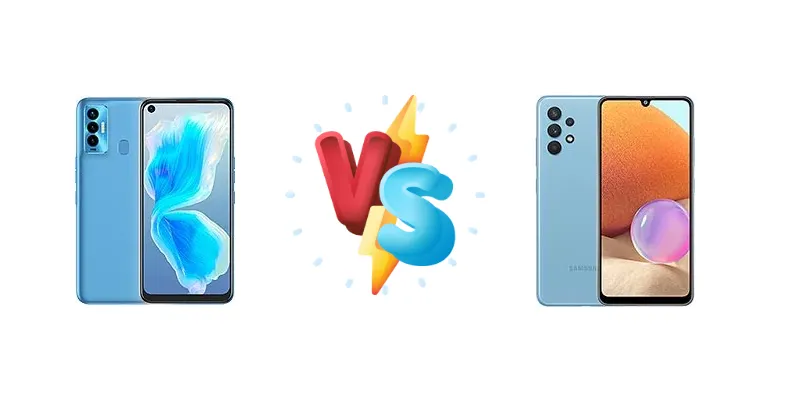
The Tecno Camon 18i and Samsung Galaxy A32 represent compelling options in the crowded budget smartphone market. Both aim to deliver essential features at an accessible price point, but they take slightly different approaches. This comparison dives deep into their specifications to determine which device offers the best value for your money, focusing on performance, display quality, and everyday usability.
🏆 Quick Verdict
For most users, the Tecno Camon 18i emerges as the slightly better choice. While both phones offer identical CPU performance, the Camon 18i’s Helio G85 chipset provides a marginal GPU advantage, and its 18W charging is faster than the A32’s 15W. The A32 counters with a brighter display, but the overall package favors Tecno.
| Network |
|---|
| 2G bands | GSM 850 / 900 / 1800 / 1900 | GSM 850 / 900 / 1800 / 1900 |
| 3G bands | HSDPA 850 / 900 / 2100 | HSDPA 850 / 900 / 1900 / 2100 |
| 4G bands | LTE | 1, 2, 3, 5, 7, 8, 20, 28, 38, 40, 41 |
| Speed | HSPA, LTE | HSPA, LTE |
| Technology | GSM / HSPA / LTE | GSM / HSPA / LTE |
| Launch |
|---|
| Announced | 2021, November 01 | 2021, February 25 |
| Status | Available. Released 2021, November 01 | Available. Released 2021, February 25 |
| Body |
|---|
| Build | - | Glass front (Gorilla Glass 5), plastic frame, plastic back |
| Dimensions | 164.5 x 76.5 x 8.9 mm (6.48 x 3.01 x 0.35 in) | 158.9 x 73.6 x 8.4 mm (6.26 x 2.90 x 0.33 in) |
| SIM | Nano-SIM + Nano-SIM | · Nano-SIM· Nano-SIM + Nano-SIM |
| Weight | - | 184 g (6.49 oz) |
| Display |
|---|
| Protection | - | Corning Gorilla Glass 5 |
| Resolution | 720 x 1640 pixels (~271 ppi density) | 1080 x 2400 pixels, 20:9 ratio (~411 ppi density) |
| Size | 6.6 inches, 103.4 cm2 (~82.2% screen-to-body ratio) | 6.4 inches, 98.9 cm2 (~84.6% screen-to-body ratio) |
| Type | IPS LCD, 90Hz | Super AMOLED, 90Hz, 800 nits (HBM) |
| Platform |
|---|
| CPU | Octa-core (2x2.0 GHz Cortex-A75 & 6x1.8 GHz Cortex-A55) | Octa-core (2x2.0 GHz Cortex-A75 & 6x1.8 GHz Cortex-A55) |
| Chipset | Mediatek MT6769Z Helio G85 (12 nm) | Mediatek MT6769V/CU Helio G80 (12 nm) |
| GPU | Mali-G52 MC2 | Mali-G52 MC2 |
| OS | Android 11, HIOS 7.6 | Android 11, upgradable to Android 13, One UI 5 |
| Memory |
|---|
| Card slot | Unspecified | microSDXC (dedicated slot) |
| Internal | 128GB 4GB RAM | 64GB 4GB RAM, 64GB 6GB RAM, 128GB 4GB RAM, 128GB 6GB RAM, 128GB 8GB RAM |
| | eMMC 5.1 | - |
| Main Camera |
|---|
| Features | Quad-LED flash | LED flash, panorama, HDR |
| Quad | - | 64 MP, f/1.8, 26mm (wide), PDAF
8 MP, f/2.2, 123˚, (ultrawide), 1/4.0", 1.12µm
5 MP (macro)
Auxiliary lens |
| Single | 16 MP, f/2.0 | 20 MP, f/2.2, (wide) |
| Triple | 48 MP, (wide), AF
Auxiliary lens | - |
| Video | 1080p@30fps | 1080p@30fps |
| Selfie camera |
|---|
| Features | Dual-LED flash | - |
| Single | 16 MP, f/2.0 | 20 MP, f/2.2, (wide) |
| Video | 1080p@30fps | 1080p@30fps |
| Sound |
|---|
| 3.5mm jack | Yes | Yes |
| 35mm jack | Yes | Yes |
| Loudspeaker | Yes | Yes |
| Comms |
|---|
| Bluetooth | 5.0, A2DP, LE | 5.0, A2DP, LE |
| NFC | No | Yes (market/region dependent) |
| Positioning | GPS | GPS, GLONASS, BDS, GALILEO |
| Radio | FM radio | FM radio, RDS, recording |
| USB | microUSB 2.0, OTG | USB Type-C 2.0, OTG |
| WLAN | Wi-Fi 802.11 a/b/g/n/ac, dual-band | Wi-Fi 802.11 a/b/g/n/ac, dual-band, Wi-Fi Direct |
| Features |
|---|
| Sensors | Fingerprint (rear-mounted), accelerometer, gyro, proximity, compass | Fingerprint (under display, optical), accelerometer, gyro, compass |
| | - | Virtual proximity sensing |
| Battery |
|---|
| Charging | 18W wired | 15W wired |
| Type | 5000 mAh | Li-Ion 5000 mAh |
| Misc |
|---|
| Colors | Deep Sea, Frost Silver, Tranquil Green | Awesome Black, Awesome White, Awesome Blue, Awesome Violet |
| Models | CG6 | SM-A325F, SM-A325F/DS, SM-A325M, SM-A325N |
| Price | About 150 EUR | € 124.99 / £ 89.38 |
| SAR EU | - | 0.45 W/kg (head) 1.30 W/kg (body) |
| Tests |
|---|
| Battery life | - |
Endurance rating 119h
|
| Camera | - |
Photo / Video |
| Display | - |
Contrast ratio: Infinite (nominal) |
| Loudspeaker | - |
-30.3 LUFS (Below average)
|
| Performance | - |
AnTuTu: 286666 (v8)
GeekBench: 1277 (v5.1)
GFXBench: 8.1fps (ES 3.1 onscreen) |
Tecno Camon 18i
- Faster 18W charging
- Slightly better GPU performance (Helio G85)
- Potentially better value for money
- Less established brand reputation
- Display brightness likely lower than A32
Samsung Galaxy A32
- Brighter display (814 nits)
- Established Samsung brand
- Good battery endurance
- Slower 15W charging
- Slightly less powerful GPU (Helio G80)
Display Comparison
The Samsung Galaxy A32 boasts a significantly brighter display, reaching a measured 814 nits. This is a substantial advantage for outdoor use under direct sunlight, where the Camon 18i’s display brightness is not specified but likely lower. Both phones feature an 'infinite' contrast ratio (nominal), typical of IPS LCD panels. However, the A32’s higher peak brightness is the defining difference, making it more comfortable to view content in bright environments. The lack of high refresh rate on either device is standard for this price bracket.
Camera Comparison
Both devices are listed as having 'Photo / Video' capabilities, but specific details are lacking. Without sensor size or aperture information, a direct comparison is difficult. It’s reasonable to assume both phones rely on multi-camera setups with a primary sensor and supporting lenses (likely including a depth or macro sensor). Given the market segment, image processing will likely prioritize scene optimization over natural color reproduction. The absence of Optical Image Stabilization (OIS) on either device suggests low-light performance will be similar, relying heavily on software algorithms.
Performance
Both the Tecno Camon 18i and Samsung Galaxy A32 are powered by Mediatek Helio G8x series chipsets, utilizing the same octa-core CPU configuration (2x2.0 GHz Cortex-A75 & 6x1.8 GHz Cortex-A55). However, the Camon 18i features the Helio G85, while the A32 uses the Helio G80. The G85 offers a slightly higher clock speed for the GPU, potentially translating to a small performance boost in graphically intensive tasks like gaming. Both devices will handle everyday tasks like browsing, social media, and video streaming without issue, but the G85 provides a marginal edge for gamers. Both utilize a 12nm process, meaning thermal throttling could be a factor during prolonged heavy use.
Battery Life
Both the Tecno Camon 18i and Samsung Galaxy A32 achieve an endurance rating of 119 hours, indicating comparable battery life under typical usage scenarios. However, the Camon 18i supports 18W wired charging, while the A32 is limited to 15W. This means the Camon 18i will recharge faster, reducing downtime. While the battery capacity isn't specified for the Camon 18i, the similar endurance rating suggests it's adequately sized to match the A32’s capacity. The faster charging speed is a practical advantage for users who frequently need to top up their battery.
Buying Guide
Buy the Tecno Camon 18i if you prioritize slightly better gaming performance and faster charging speeds, and are comfortable with a less-renowned brand. Buy the Samsung Galaxy A32 if a brighter display is crucial for outdoor visibility and you prefer the established Samsung ecosystem and brand reputation. Both are excellent choices for basic smartphone tasks.
Frequently Asked Questions
❓ Will the Helio G85 in the Camon 18i handle demanding games like PUBG Mobile?
The Helio G85 is capable of running PUBG Mobile, but you'll likely need to use medium graphics settings for a smooth experience. While not a dedicated gaming chipset, it offers a slight performance advantage over the Helio G80 in the Galaxy A32, making it the marginally better choice for mobile gaming.
❓ Is the 15W charging on the Galaxy A32 noticeably slow in 2024?
Yes, 15W charging is relatively slow compared to the 25W or 33W charging found on many newer budget phones. Expect a full charge to take around 2-3 hours. The Camon 18i’s 18W charging offers a noticeable improvement in recharge speed.
❓ How does the camera perform in low-light conditions on either phone?
Both phones lack Optical Image Stabilization (OIS), so low-light performance will rely heavily on software processing. Expect images to be soft and potentially noisy in very dark environments. Night mode features will attempt to brighten the scene, but image quality will still be limited by the sensor size and aperture.