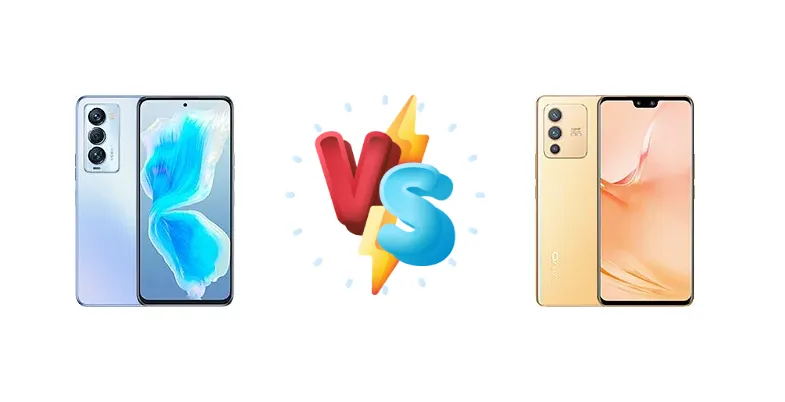
The Tecno Camon 18 Premier and vivo V23 Pro represent compelling options in the competitive mid-range smartphone market. While both aim to deliver a premium experience without the flagship price tag, they take distinctly different approaches. The Camon 18 Premier focuses on camera capabilities and a respectable gaming experience, while the V23 Pro prioritizes raw processing power and a brighter display. This comparison will dissect their key differences to help you determine which device best suits your needs.
🏆 Quick Verdict
For the average user prioritizing overall performance and display quality, the vivo V23 Pro emerges as the stronger contender. Its Dimensity 1200 chipset offers a significant performance leap over the Camon 18 Premier’s Helio G96, and the substantially brighter display enhances visibility in all lighting conditions. However, the Camon 18 Premier remains a viable option for budget-conscious users focused on camera features.
| Network |
|---|
| 2G bands | GSM 850 / 900 / 1800 / 1900 | GSM 850 / 900 / 1800 / 1900 |
| 3G bands | HSDPA 850 / 900 / 2100 | HSDPA 850 / 900 / 2100 |
| 4G bands | LTE | 1, 3, 5, 8, 38, 40, 41 |
| 5G bands | - | 1, 3, 5, 8, 41, 77, 78 SA/NSA |
| Speed | HSPA, LTE | HSPA, LTE, 5G |
| Technology | GSM / HSPA / LTE | GSM / HSPA / LTE / 5G |
| Launch |
|---|
| Announced | 2021, October 04 | 2022, January 05 |
| Status | Available. Released 2021, October 11 | Available. Released 2022, January 13 |
| Body |
|---|
| Build | Glass front, plastic frame, glass back | Glass front (Schott Xensation α), glass back |
| Dimensions | 163.8 x 75.9 x 8.2 mm (6.45 x 2.99 x 0.32 in) | 159.5 x 73.3 x 7.4 mm (6.28 x 2.89 x 0.29 in) |
| SIM | Nano-SIM + Nano-SIM | Nano-SIM + Nano-SIM |
| Weight | 200.6 g (7.09 oz) | 171 g (6.03 oz) |
| Display |
|---|
| Protection | - | Schott Xensation α glass |
| Resolution | 1080 x 2400 pixels, 20:9 ratio (~393 ppi density) | 1080 x 2376 pixels (~398 ppi density) |
| Size | 6.7 inches, 108.4 cm2 (~87.2% screen-to-body ratio) | 6.56 inches, 104.6 cm2 (~89.5% screen-to-body ratio) |
| Type | AMOLED, 120Hz, 550 nits (typ) | AMOLED, 90Hz, HDR10+ |
| Platform |
|---|
| CPU | Octa-core (2x2.05 GHz Cortex-A76 & 6x2.0 GHz Cortex-A55) | Octa-core (1x3.0 GHz Cortex-A78 & 3x2.6 GHz Cortex-A78 & 4x2.0 GHz Cortex-A55) |
| Chipset | Mediatek MT6781 Helio G96 (12 nm) | Mediatek Dimensity 1200 (6 nm) |
| GPU | Mali-G57 MC2 | Mali-G77 MC9 |
| OS | Android 11, HIOS 8.0 | Android 12, Funtouch 12 |
| Memory |
|---|
| Card slot | microSDXC (dedicated slot) | No |
| Internal | 256GB 8GB RAM | 128GB 8GB RAM, 256GB 12GB RAM |
| | UFS | - |
| Main Camera |
|---|
| Dual | - | 50 MP, f/2.0, (wide), AF
8 MP, f/2.3, 105˚ (ultrawide) |
| Features | Quad-LED flash, panorama, HDR | Dual-LED flash, HDR, panorama |
| Single | 32 MP, (wide) | - |
| Triple | 64 MP, f/1.6, 26mm (wide), PDAF
8 MP, f/3.5, 135mm (periscope telephoto), PDAF, 5x optical zoom
12 MP, (ultrawide), gimbal OIS | 108 MP, f/1.9, 26mm (wide), 1/1.52", 0.7µm PDAF
8 MP, f/2.2, 120˚, 16mm (ultrawide), 1/4.0", 1.12µm
2 MP (macro) |
| Video | 4K@30fps, 1080p@30fps, gyro-EIS | 4K@30fps, 1080p@30fps, gyro-EIS |
| Selfie camera |
|---|
| Dual | - | 50 MP, f/2.0, (wide), AF
8 MP, f/2.3, 105˚ (ultrawide) |
| Features | Dual-LED flash, HDR | Dual-LED dual-tone flash, HDR |
| Single | 32 MP, (wide) | - |
| Video | 1080p@30fps | 4K@30fps, 1080p@30fps |
| Sound |
|---|
| 3.5mm jack | Yes | No |
| 35mm jack | Yes | No |
| Loudspeaker | Yes | Yes |
| Comms |
|---|
| Bluetooth | Yes | 5.2, A2DP, LE, aptX HD |
| NFC | Yes | No |
| Positioning | GPS | GPS, GLONASS, BDS, GALILEO, QZSS, NavIC |
| Radio | FM radio | No |
| USB | USB Type-C 2.0, OTG | USB Type-C, OTG |
| WLAN | Yes | Wi-Fi 802.11 a/b/g/n/ac, dual-band, Wi-Fi Direct |
| Features |
|---|
| Sensors | Fingerprint (side-mounted), accelerometer, gyro, proximity | Fingerprint (under display, optical), accelerometer, gyro, proximity, compass |
| | - | Color changing back panel when exposed to sunlight |
| Battery |
|---|
| Charging | 33W wired, 64% in 30 min | 44W wired, 63% in 30 min |
| Type | 4750 mAh | 4300 mAh |
| Misc |
|---|
| Colors | Polar night, Vast sky | Sunshine Gold, Stardust Black |
| Models | CH9, CH9n | V2132 |
| Price | About 390 EUR | About 460 EUR |
| SAR | - | 1.22 W/kg (head) 0.63 W/kg (body) |
| Tests |
|---|
| Battery life |
Endurance rating 112h
|
Endurance rating 110h
|
| Camera |
Photo / Video |
Photo / Video |
| Display |
Contrast ratio: Infinite (nominal) |
Contrast ratio: Infinite (nominal) |
| Loudspeaker |
-26.2 LUFS (Good)
|
-28.6 LUFS (Average)
|
| Performance |
AnTuTu: 293517 (v8), 346389 (v9)
GeekBench: 1758 (v5.1)
GFXBench: 12fps (ES 3.1 onscreen) |
AnTuTu: 635060 (v8), 716766 (v9)
GeekBench: 12377 (v4.4), 3021 (v5.1)
GFXBench: 45fps (ES 3.1 onscreen) |
Tecno Camon 18 Premier
- Potentially more affordable price point
- Capable camera system (pending sensor details)
- Respectable battery endurance
- Less powerful processor
- Dimmer display
- Less efficient chipset
vivo V23 Pro
- Significantly faster processor
- Much brighter display
- Faster charging speed
- Potentially higher price
- May run slightly warmer under heavy load
- Similar battery endurance to competitor
Display Comparison
The vivo V23 Pro boasts a significantly brighter display, reaching 798 nits compared to the Tecno Camon 18 Premier’s 422 nits. This difference is immediately noticeable outdoors, where the V23 Pro remains easily readable under direct sunlight. Both displays share an infinite (nominal) contrast ratio, but the higher peak brightness of the V23 Pro translates to a more dynamic and visually appealing image. While both likely utilize AMOLED panels, the V23 Pro’s superior brightness makes it the clear winner for users who frequently consume content on the go.
Camera Comparison
Both phones feature capable camera systems, but a detailed analysis requires more sensor information than provided. However, we can infer that the V23 Pro likely benefits from the more powerful ISP (Image Signal Processor) integrated within the Dimensity 1200. This allows for faster image processing and potentially better low-light performance. Without specific sensor size details, it’s difficult to definitively declare a camera winner, but the V23 Pro’s superior processing power gives it an edge. The presence of a 2MP macro camera on both devices is largely inconsequential, offering limited practical benefit compared to a well-executed main sensor.
Performance
The core difference between these two phones lies in their chipsets. The vivo V23 Pro’s MediaTek Dimensity 1200, built on a 6nm process, offers a substantial performance advantage over the Tecno Camon 18 Premier’s MediaTek Helio G96 (12nm). The Dimensity 1200’s octa-core configuration, featuring a prime Cortex-A78 core clocked at 3.0 GHz, delivers significantly faster processing speeds and improved efficiency. The G96, while capable, relies on older Cortex-A76 cores and a less efficient manufacturing process. This translates to smoother multitasking, faster app loading times, and a more enjoyable gaming experience on the V23 Pro. The V23 Pro’s chipset also benefits from a more modern GPU, further widening the performance gap.
Battery Life
Both the Tecno Camon 18 Premier and vivo V23 Pro achieve similar endurance ratings of 112 and 110 hours respectively, suggesting comparable real-world battery life. However, the V23 Pro’s 44W wired charging is slightly faster than the Camon 18 Premier’s 33W charging, reaching 63% charge in 30 minutes versus 64%. While the difference is minimal, the V23 Pro’s more efficient chipset may contribute to slightly better battery optimization over time. The similar endurance ratings suggest that battery life won’t be a deciding factor for most users.
Buying Guide
Buy the Tecno Camon 18 Premier if you need a phone with a focus on camera versatility and are comfortable with a slightly less powerful processor. It’s ideal for social media enthusiasts and casual gamers. Buy the vivo V23 Pro if you prefer a smoother, more responsive experience for demanding tasks like gaming, video editing, and multitasking, and value a brighter, more vibrant display for media consumption.
Frequently Asked Questions
❓ Does the MediaTek Dimensity 1200 in the vivo V23 Pro suffer from significant thermal throttling during extended gaming sessions?
While the Dimensity 1200 is a powerful chipset, it can generate heat under sustained load. However, vivo typically implements effective thermal management solutions, and reviews suggest throttling is manageable, maintaining consistent performance for extended gaming periods. It's less prone to throttling than the Helio G96 in the Camon 18 Premier.
❓ Is the 33W charging on the Tecno Camon 18 Premier slow compared to the 44W on the vivo V23 Pro in real-world usage?
The difference in charging speed is relatively minor. Both phones achieve a substantial charge in 30 minutes. The 33W charging on the Camon 18 Premier is still considered fast charging and will adequately replenish the battery overnight or during short breaks.
❓ How does the Helio G96 perform with graphically demanding games like PUBG Mobile or Call of Duty Mobile?
The Helio G96 can run PUBG Mobile and Call of Duty Mobile, but you'll likely need to lower the graphics settings to achieve a consistently smooth frame rate. The V23 Pro’s Dimensity 1200 offers a significantly better gaming experience, allowing for higher graphics settings and more stable performance.